Thinkific vs Kajabi (2026): Full Pricing and Feature Comparison

Quick Answer
Thinkific and Kajabi are both established course platforms, but they serve different priorities. Thinkific starts at $54/month and focuses on teaching: more lesson types, stronger quiz tools, and flexible integrations with your existing marketing stack. Kajabi starts at $179/month and focuses on selling: native email marketing, funnel builder, coaching products, and automations are all included. Thinkific is the lower-cost path for creators who already have marketing tools; Kajabi justifies its price only once you genuinely need its full built-in stack. For creators who want both teaching depth and marketing tools without Kajabi's price, FreshLearn starts at $49/month with 0% transaction fees and no payment-gateway penalties.
Key Takeaways
- Thinkific's Basic plan costs $54/month (monthly) or $40/month (annual billing) after the 2026 price increase; Kajabi's entry plan costs $179/month (monthly) or $143/month (annual billing), following the retirement of its Kickstarter plan.
- Thinkific charges 0% platform fees when using Thinkific Payments, but applies penalty fees of 5% on Basic, 2% on Start, and 1% on Grow if you use Stripe or PayPal instead. Kajabi charges 0% platform fees on all plans regardless of payment processor.
- Kajabi includes a full email marketing suite, funnel builder, and visual automations on every plan. Thinkific's native email covers broadcasts and basic nurture flows only; serious email workflows require an external provider such as ConvertKit or ActiveCampaign.
- Kajabi's affiliate program is available from the Growth plan ($249/month); Thinkific unlocks affiliates on the Basic plan ($54/month).
- Kajabi's branded mobile app is bundled into the Pro plan at $499/month. Thinkific offers a branded app as a $199/month add-on on top of any existing plan.
- FreshLearn starts at $49/month with unlimited courses and students, 0% transaction fees, no payment-gateway penalty, and a branded mobile app at $199/year (not per month).
[Updated on July 23, 2026, for the latest pricing changes]
Introduction
If you’ve hunted for online course creation platforms, you must’ve come across Thinkific and Kajabi. These two sit at the top of the course creator market, but they bring different perks for creators.
While Kajabi packs course delivery, marketing, funnels, and a website builder into one integrated platform, Thinkific offers a simplified learning environment where you can integrate the marketing stack you prefer.
So, objectively speaking, which is the better choice?
The showdown in this blog post compares Thinkific against Kajabi in terms of features, pricing, support, and growth potential.
Read on to find out what would make more sense to you.
A Brief Overview of Thinkific

Thinkific is an online course platform for subject-matter experts to publish courses online without a complicated setup process. It comes with an intuitive interface to help you in all stages of course creation.
It also handles video hosting natively and lets you add quizzes or discussions where they add value. Because the platform stays focused on instruction, you can fine-tune pacing, add community touchpoints, and roll out updates without much fuss.
Pros
- The UI keeps technical jargon to a minimum, allowing for fuss-free onboarding.
- Offers flexible course delivery options like self-paced, drip content, cohort-style live sessions, and more.
- Bundles a custom, Stripe-based payment gateway, “Thinkific Payments”, which simplifies the entire payment process for creators.
Cons
- Although basic customizations are plenty, you’ll pretty soon feel a lack of depth when you want your lessons to look and feel a certain way.
- Deeper branding control and advanced communities sit behind the higher “Grow” and “Plus” tiers.
- Thinkific marketplace apps and integrations are expensive.
Pricing
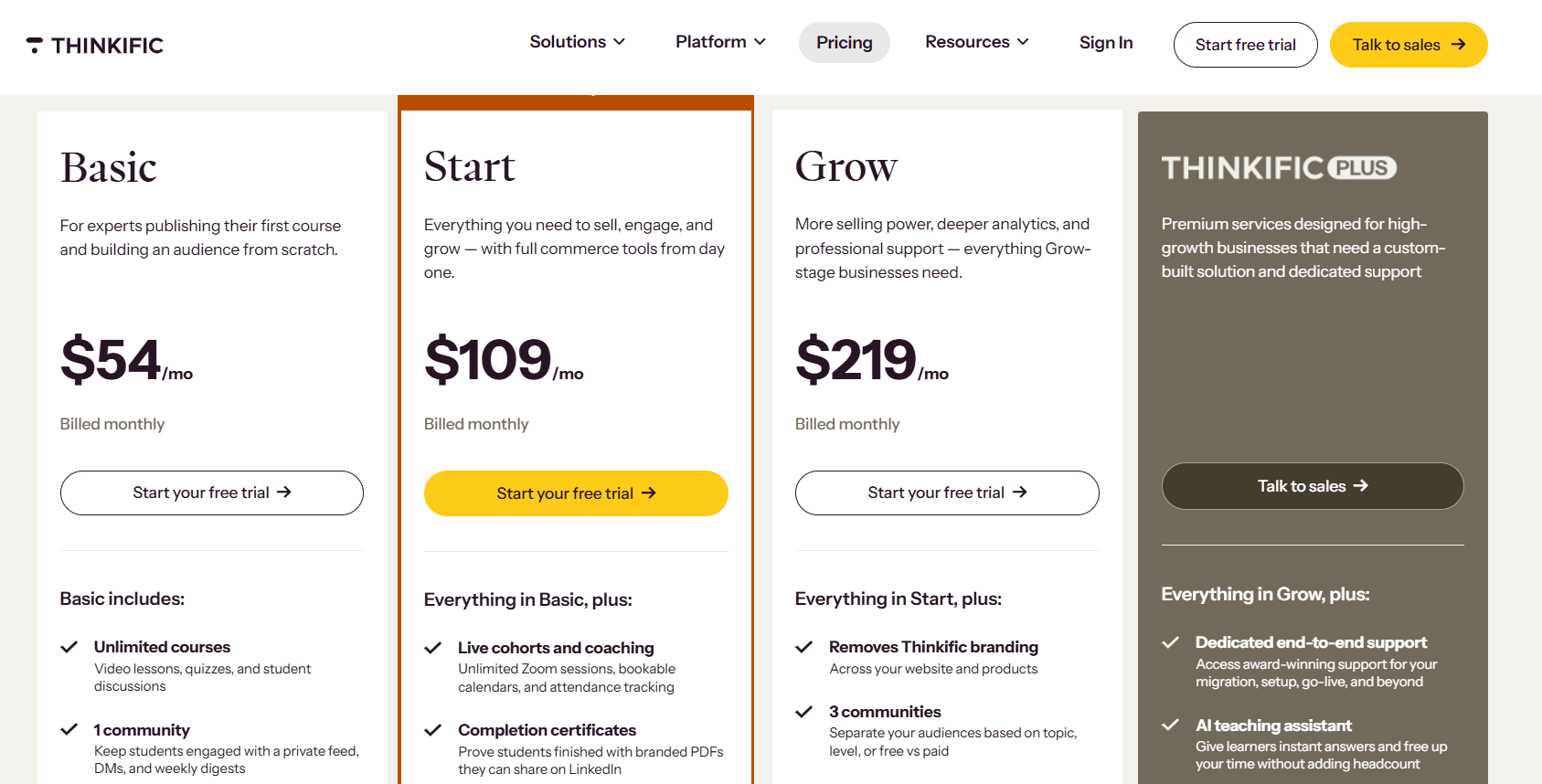
Thinkific's pricing plans carry no platform commission when you use Thinkific Payments, but several of its advanced features are only available on the Plus plan.
- Basic: $54/month
- Start: $109/month
- Grow: $219/month
- Thinkific Plus: Custom pricing (designed for large enterprises needing bespoke solutions.)
Note: With the annual plans, you instantly save around 25% over the monthly fees.
Heads up: These are Thinkific's post-increase rates. In 2026, Thinkific raised prices roughly 10% across Basic, Start, and Grow, and the new rates apply to all new customers at the time of this writing and to existing customers at their next billing cycle (renewal) after August 13, 2026.
A Brief Overview of Kajabi
Kajabi is an all-in-one “knowledge commerce” tool designed to let you create, market, and sell everything from online courses to digital products and memberships. It gives you the tools for building websites, creating content, managing marketing and sales, and handling payments, all within a single platform.
Pros
- Offers native email, funnels, and checkout sequences to shorten the jump from idea to revenue.
- A ton of customizable templates to keep branding consistent across course pages, sales pages, and newsletters.
- There’s an excellent website builder that also lets you host your website on a whim.
Cons
- You cannot remove the Kajabi branding unless you’re on a higher pricing tier.
- Changes are published straight to production; there’s no staging sandbox for experimental redesigns.
- The feature set can feel overwhelming on day one, and third‑party integrations are fewer than on open‑ecosystem rivals.
Pricing
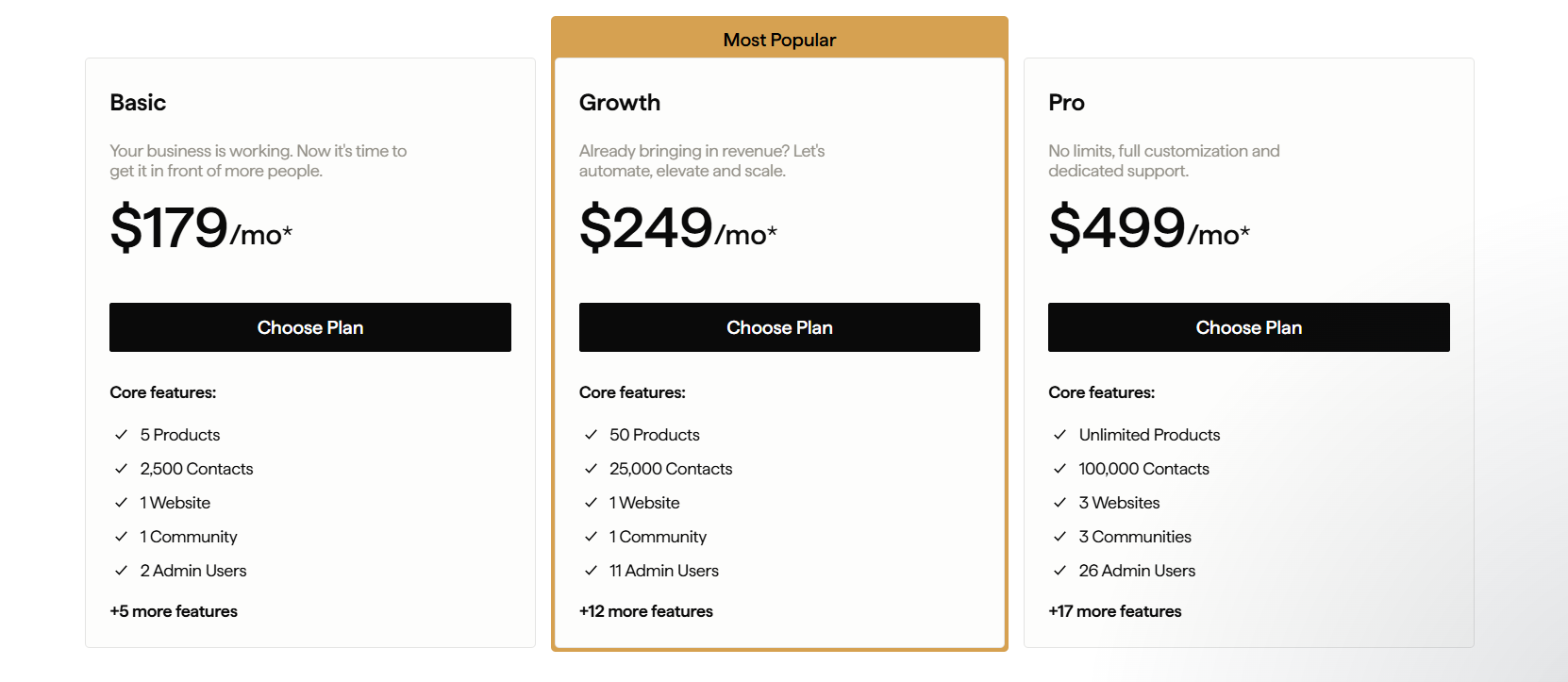
Kajabi pricing plans are based on usage limitations. This results in Kajabi's high prices compared to other online course creator platforms when the same features are provided.
The different pricing plans are:
- Basic: $179/month
- Growth: $249/month
- Pro: $499/month
Kajabi retired its entry-level Kickstarter plan, so Basic is now the cheapest way in; that single change moved Kajabi's floor from $89 to $179 a month.
Note: Like Thinkific, you get a 20% discount if you opt for the annual plans. If you’re making money with the platform, annual plans do make sense.
Thinkific vs Kajabi: Which Is The Better Course Creation Platform?
Now that we have a cursory understanding of what both Kajabi and Thinkific offer, let’s delve deeper and compare the platforms’ top features.
1. Customization and site design
Our first focus is also probably what you’ll use the first time you launch either platform: site design and customization.
Page Builder
On Thinkific’s Site Builder, you start with a clean outline, then drag in “Smart Sections” such as Curriculum, Video, Countdown Timer, or Lead Capture. All of it snaps to the typography and color rules of your chosen theme.
The library is broad enough for a polished marketing page yet small enough that you’re not paralyzed by choice as a beginner.
To us, it’s perfect for shipping a course quickly.

Kajabi’s new site builder, Encore, takes the opposite road: abundance. It replaces the legacy editor called Premier and brings more than twenty content blocks (hero, pricing, FAQs, podcast feed, Instagram grid, and so on) that can be stacked in any order, resized with the 12‑column grid, and saved as reusable “sections”.
All plans allow an unlimited number of landing pages; that means you can A/B test headlines today and come up with a fresh webinar registration page tomorrow without hitting a cap.

Course website themes
Thinkific ships three responsive themes, each with three or four styles for a total of 12 theme and style combinations that you can apply and customize to your Thinkific site.

That’s a dozen variants out of the box, and you can dip into the Liquid code editor if your brand guidelines demand pixel‑level tweaks.
Kajabi, on the other hand, comes with a growing template catalogue, which includes some great options like Streamlined Home, Kim, Rise, Serenity, Reach, and several others. Pick one, swap in brand fonts via the Style Guide, then override specific layouts in the code editor when you need something off‑menu.

Both platforms expose full theme code. It’s useful when you want, say, a parallax hero or a headless Stripe checkout, and both accept third‑party or self‑built themes.
Verdict
Go with Thinkific if:
- You value a simple, teach‑first approach,
- You want to stay on brand with minimal tinkering.
Choose Kajabi if:
- You’d rather have complete design flexibility,
- The freedom to publish as many landing pages as you need.
2. Course creation
Kajabi and Thinkific have only minute differences when it comes to course creation and delivery.
If you’re looking for comprehensive course creation tools, you will appreciate Thinkific's extensive library of course materials and flexible delivery choices.
On the other hand, if you want to promote your expertise without relying much on third-party tools, you will like Kajabi more.
Course builder
Both the platforms cover the fundamentals you need to get a course in front of learners: drag‑and‑drop lesson assembly, bulk uploads for video, audio, PDFs, gated or drip schedules, quizzes, and completion certificates.
In other words, the “first draft” of any curriculum can go live in an afternoon, without any extra plug‑ins.

Our two contenders share a handful of features for building courses:
- Drag‑and‑drop syllabus builder: Create modules, reorder lessons, and clone sections in seconds.
- Bulk media upload: Drop in large video libraries, slide decks, worksheets, or audio files.
- Progress controls: Lock lessons until prerequisites are met or release content on a drip timer.
- In‑lesson quizzes: Get multiple choice, multi‑select, basic feedback, and pass or fail gating.
- Auto‑issued certificates: Mark completion and add social‑share credibility
But that’s where the similarities stop.
Thinkific’s builder is designed for instructors who need a variety of lesson types or highly interactive activities.

A Presentation lesson lets you upload an existing PowerPoint or Keynote deck (as a PDF) and record slide‑by‑slide narration right inside the editor. That means you can turn a live workshop into self‑paced content without extra software.

Beyond the default lesson types, the Thinkific App Store lets you use tools like H5P interactive widgets or Adaptive SimpleSim’s exam simulators, so you can drop branching scenarios, games, or niche assessments into the curriculum with a few clicks.
Choose Thinkific if your teaching style relies on richer media, custom quiz engines, or simulations that go beyond standard video‑and‑quiz delivery.
Kajabi focuses on speed from “draft” to “on sale.” The same pane where you add videos, live sessions, downloads, quizzes, and certificates also plugs directly into Kajabi’s funnels, offers, and when-then automations.

That means you can set a launch discount, bundle the course with coaching, or trigger follow‑up emails without exporting data or switching tabs.
Because the interface is shared across courses, coaching programs, memberships, and communities, you learn one workflow and apply it to every digital product you sell.
Learning experience
A good course is nothing if it’s not delivered well.
Kajabi’s polished course player, consistent visual templates, and native ties to email automations help you maintain momentum. Students can transition from one lesson to the next with minimal friction, and triggered messages can nudge inactive learners back on track.

Thinkific approaches engagement from a pedagogical perspective. You get more lesson formats (presentations, surveys, discussions), structured grouping tools, and recommended live touchpoints (via Zoom) that support instructional design that adapts to the rigor of the content.

With Thinkific, you can also mix self-paced modules with scheduled sessions and a threaded community to achieve higher completion rates.
Quizzes, assessments, and certificates
Both platforms let you build in-lesson knowledge checks, including multiple choice, multi-select, short answer, and file uploads, and use the results to gate progress or trigger follow-ups.

In Kajabi, automations tied to quiz or assessment outcomes automatically deliver extra resources, tags, or reminder emails. This helps with tightening the learning-to-marketing loop.

Thinkific offers the everyday quiz tools plus scalable options for deeper evaluation. You can bulk-import large question banks and randomize draws, and for regulated or high-stakes testing, you can integrate Brillium to deliver timed, pro-level exams with rich analytics. It’s only available on upper-tier plans and requires a Brillium account.

Certificates are available on both. Kajabi issues auto-sent completion certificates with limited visual customization (primarily logo/text fields and basic styling).

Thinkific lets you choose from multiple templates, bundles deeper design edits including fonts, colors, and background image, and supports external credentialing providers like Accredible if you need branded or verifiable certificates.

Online coaching
Kajabi treats coaching as a core product. You schedule availability, connect Google Calendar or other scheduling tools, host live calls, share session notes, and bundle coaching with courses or memberships, all within the same subscription footprint. That close integration reduces back-and-forth when selling premium packages.

Thinkific also supports coaching but uses external schedulers. A typical workflow looks like this: you block time in Calendly (or similar), drop the booking link into a course or page, or install a scheduling app from the Thinkific App Store.
The live calls then run through the connected tool, like Zoom, rather than a native coaching workspace. Clearly, Kajabi has the edge here with better coaching features.
Communities
Having even the best learning tools is wasted if there’s no sense of community, or a place to ask questions and interact with fellow learners. Thankfully, both Kajabi and Thinkific recognize that and offer reliable community features.

Each lets you set up spaces where members can post, ask questions, and interact with instructors.
Kajabi’s re-architected Communities layer now includes configurable Challenges (one-time or recurring), gamification elements (badges, levels), live rooms with video and chat, segmented access groups, and engagement prompts. What a fun way to keep learners engaged and make them keep coming back to your course!

Thinkific’s community features enable threaded discussions around courses, but advanced engagement mechanics like live chat, gamified challenges, and native live rooms generally need integration with external tools or apps; Thinkific’s own resources often recommend add-on tools for richer real-time interaction.

Verdict
Go with Thinkific if:
- You are looking for a variety of lesson types and granular assessment control,
- Simple navigation and Zoom-based live lessons beat in-platform video rooms for your teaching style, and
- You run regulated exams or need branded certificates via Brillium or Accredible.
Go with Kajabi if:
- You want pre-built pipelines and deep funnel automation out of the box,
- Replacing MailChimp or ConvertKit with a full ESP is a priority, and
- Richer affiliate features like a public sign-up page and custom cookies are important to you.
3. Live sessions
If live touchpoints are central to your pedagogy, pay attention here.

Thinkific integrates directly with Zoom Meetings and Webinars. You can schedule a Live Lesson from the course builder, auto-notify enrolled students, and run the session without leaving the platform interface (though a Zoom license is still required). Additional scheduling layers, like Appointo, can simplify bookings but run via third-party apps.

Kajabi offers built-in live video streaming and recording across its products (courses, coaching, community live rooms). Recorded sessions can be dropped back into the course library, and email notifications tied to events make it easier to drive attendance without external webinar software.
Verdict
Kajabi is the clear winner here, as Thinkific has to rely on external platforms to schedule live sessions. But there’s a catch.
Kajabi's Live Video is only available with Course Products, a manually scheduled coaching program, and Coaching Products using Kajabi Scheduler. If you have connected Calendly or a custom link to help you schedule your program, you will not be able to Go Live with Kajabi.
4. Branded mobile app
Thinkific and Kajabi both now offer optional mobile apps (separate from their free, platform-branded learner apps).

These apps show your courses, community spaces, and offers under your name in the Apple App Store and Google Play. These apps come with push notifications and in-app purchase support.

Implementation is handled for you. You will provide the brand assets and approve the listings, and the vendor will publish and maintain the app.
Here’s how app offerings from both compare:
The economics here have diverged. Thinkific sells the branded app as a $199/month add-on on top of whatever plan you're on, so a Basic subscriber pays $54 + $199 = $253/month for it. Kajabi no longer sells it as an add-on at all: a branded app is bundled into the Pro plan, which means jumping to $499/month to get one.
Verdict
If your priority is content consumption on the go, Kajabi's app serves students better today, as long as your course does not rely on in-app discussions or quizzes for iPhone users.
On the contrary, if your course relies on community interaction and frequent push nudges more than offline media, Thinkific's free Student App remains fully interactive across both iOS and Android.
And if a branded app is non-negotiable, price it before you pick a platform: it is the single most expensive line item on either side.
5. Marketing and sales
You can't expect to grow your course's audience without adequate marketing. We consider it a super important feature too.
Kajabi, being more marketing-heavy, handles funnels, email, automations, payments, and affiliates.
Thinkific keeps those levers lighter and, for the most part, optional, which is not an issue if you already trust a ConvertKit, ActiveCampaign, or HubSpot stack and simply need a reliable checkout beside your lessons
Let’s break down the sales and marketing tools both platforms offer:
Marketing funnels

Kajabi’s Pipeline Builder opens with a menu of pre‑built campaign templates, including webinar, product launch, evergreen challenge, freebie lead magnet, and more. Pick one, and the platform arranges matching landing pages, opt-in forms, email sequences, and offer objects.
You edit the copy and media inline, press publish, and the entire sequence runs itself. Because Pipelines syncs with Zoom and Kajabi Live, the tool also automatically starts events and drops registrants into reminder emails and post-webinar replays without extra tags or zaps.

Thinkific, on the other hand, calls its native builder Funnels and currently ships three templates: Free Lesson, Free Download, and Sales Page.
Each template produces a single landing page tied to a modest email auto‑reply. The layout is serviceable but relies on one default design, with limited styling controls and no way to add or rearrange pages inside the flow.

Most creators, therefore, pair Thinkific with a dedicated funnel tool or run ads directly to checkout and let Stripe or PayPal handle the heavy lifting.
The bottom line is that if your growth plan revolves around multi‑step launches, Kajabi’s deep funnel automation will feel like the better choice.
Email marketing
Thinkific’s native email suite covers broadcast newsletters and single‑step confirmations. There’s no segmentation, no visual builder, and no analytics beyond open rates.

Serious email workflows need integrations with AWeber, ActiveCampaign, or another ESP. This, unfortunately, means two dashboards and two bills.
Kajabi beats Thinkific here by shipping with a robust email marketing stack.

You get a drag‑and‑drop editor, list and tag segmentation, automated sequences, deliverability analytics, and templated “visual automations” that let you branch by behaviour (like opened, clicked, bought, didn’t buy). For many creators, this replaces Mailchimp or ConvertKit outright.
Automation
Complementing its strong email marketing suite, Kajabi also bundles a when‑then‑if automation engine that can branch by link clicks, lesson progress, or purchase events.

A failed quiz can trigger a remedial PDF; sixty days of inactivity can pull a win‑back offer; a tag can unlock a down‑sell coupon, and much more.

Thinkific introduced Email Automations in 2026, which brought abandoned‑cart nudges and basic nurture flows to its earlier broadcast‑only system.
The update helps, but segmentation is still rudimentary, and advanced logic remains the domain of external ESPs, connections that Thinkific supplies through direct integrations or Zapier.
Affiliate programs
If you are new to course creation, you have to take into account the possibilities for additional revenue in your online course platform.
Both platforms let you create an internal referral program, set commission percentages, and review payouts.

Thinkific unlocks affiliates on the Basic tier. It offers lifetime recurring commissions and a 90‑day cookie, which is straightforward but bare‑bones.

Kajabi reserves the feature for Growth and Pro plans; in return, you get a public affiliate sign‑up page, custom cookie windows, link generators for off‑site URLs, and the ability to track lead‑magnet opt‑ins as well as direct sales.
That gating matters more than it used to. Affiliates start at $54/month on Thinkific and $249/month on Kajabi, because Kajabi's cheapest affiliate-capable plan is now Growth.
Verdict
Go with Thinkific if:
- You're trying to keep costs low. Plans start well below Kajabi's, and there's no platform commission as long as you process through Thinkific Payments
- You'd rather upgrade only when you can't do without extras like better communities and enterprise features
Go with Kajabi if:
- You’re ready to pay more because of its marketing powers
- You want its built-in automation suite to replace separate subscriptions
- You manage a large product catalog and have a relatively large audience
6. Pricing
First, let’s look at the direct platform costs:
Annual pre‑pay drops each price around 20 to 25%, but the relative gap stays within the same range.
The gap is no longer a rounding error. Kajabi's entry point tripled when Kickstarter was retired, and Thinkific's 10% increase did not come close to closing the distance.
But this is deceptive, because as you build your business, you’ll be adding other integrations and features that cost extra. Not sure what we mean? Let us explain
Kajabi offers a marketing stack in every plan, with broadcast email, visual automations, funnels, and an affiliate dashboard, so the platform fee is close to your all‑in monthly cost. Thinkific keeps core LMS features cheap but expects you to add on marketing and engagement tools. In practice, that means one or more of these:
- Email service provider: ConvertKit Creator plan is $29/month for up to 1,000 addresses. The Creator Pro plan steps up to $59 at roughly 5,000 contacts.
- Live teaching: Both vendors rely on your own Zoom licence. Zoom Workplace Pro is $16.99/month (or $13.33 billed annually) per host; webinars add another $79/month if you need registration pages and Q&A
- Affiliate tracking: Kajabi includes it; Thinkific users often plug in Rewardful, which starts at $49/month.
- White-label mobile app: No longer an apples-to-apples add-on. Thinkific charges $199/month on top of any plan; Kajabi bundles it into Pro at $499/month.
- Transaction fees: Kajabi charges 0% platform commission on every plan. Thinkific charges 0% only if you process through Thinkific Payments; use your own Stripe or PayPal, and you pay a penalty of 5% on Basic, 2% on Start, and 1% on Grow. Either way, standard card fees still apply.
Verdict
If you’re on a budget or you are a beginner who only needs course delivery and a simple checkout, you can launch for much less on Thinkific and layer in marketing later.
The bundling argument for Kajabi is weaker than it used to be, and it now only holds at the top of the range.
Run the numbers: Thinkific Basic at $54, plus ConvertKit at $29, lands around $83/month with a basic affiliate program included, against $179 for Kajabi Basic, which does not even include affiliates.
Kajabi only becomes competitive higher up, where Thinkific Grow at $219, plus ConvertKit Pro at $59, comes to $278 against Kajabi Growth at $249 with funnels, a full ESP, and advanced affiliates in the box.
So Kajabi is more expensive at checkout and, at the entry level, more expensive after you price the missing pieces too.
It wins on value only once you genuinely need the whole marketing stack; below that, Thinkific stays the lower-cost path if you're happy curating and paying for your own tools.
Thinkific vs Kajabi: Which One to Pick?
If the answer were so simple, you’d not be reading an article like this. However, we have hopefully made the difference clear: focus. Thinkific concentrates on the teaching part, and Kajabi on the revenue and growth part.
Start with the outcome you need most and work backwards from there.
Choose Thinkific when your top priority is the learning experience, or if
- You want granular lesson formats, slide-plus-audio presentations, interactive apps from the Thinkific Store, or exams through Brillium, and you're happy to bolt on marketing tools you already have.
- You value every dollar. Plans start at $54/month, with no platform commission when you use Thinkific Payments, and you can upgrade only when you need advanced communities or enterprise features.
- Your growth model leans on content quality, word-of-mouth, or an existing mailing list rather than elaborate funnels and flash sales.
Thinkific’s classroom‑first philosophy means fewer distractions for instructors who’d rather perfect curriculum flow before messing with marketing.
Choose Kajabi when you need an all‑in‑one revenue platform, or if
- You’d like one login for page‑building, email sequences, sales funnels, live webinars, coaching calendars, and affiliate payout reports.
- You want pre‑built Pipeline templates and a native ESP that lets you launch campaigns without Zapier and extra SaaS subscriptions.
- Your budget is less of a constraint than time: the $249/month Growth tier replaces several standalone services, and paying more to keep everything together is an acceptable trade-off.
Kajabi’s strength is momentum. Courses, memberships, coaching, and communities converge into the same automation engine, so scaling the business rarely involves new tools.
Is There a Third Option? What to Do if Neither Kajabi nor Thinkific is a Perfect Fit
Even after sizing up Thinkific’s teaching power and Kajabi’s sales power, you might feel neither platform lands exactly where you need it.
Maybe the price is too high, the feature list still leaves gaps in your workflow, or you’d rather keep full control by assembling a lighter, custom stack instead of locking into either ecosystem.
Well, FreshLearn might be just what you’re looking for.
It is a Thinkific alternative and Kajabi alternative that unifies course delivery, growth automation, and customer support in one dashboard, without charging a premium for the privilege. The platform already powers more than 15,000 creator schools and advertises unlimited courses and students on every tier, all at 0% transaction fees.
Here’s what Freshlearn does better:
Profit-friendly economics, right out of the gate
FreshLearn starts with a free plan (good for up to 25 sales) and then moves to paid tiers at $49, $79, and $149 per month.
Commit for a year, and those drop to $41, $59, and $119; commit for two years, and they drop even further to $35, $46, and $89. Even at the monthly rate, FreshLearn's entry tier costs less than a third of Kajabi's, and its top tier costs less than Kajabi's cheapest plan.
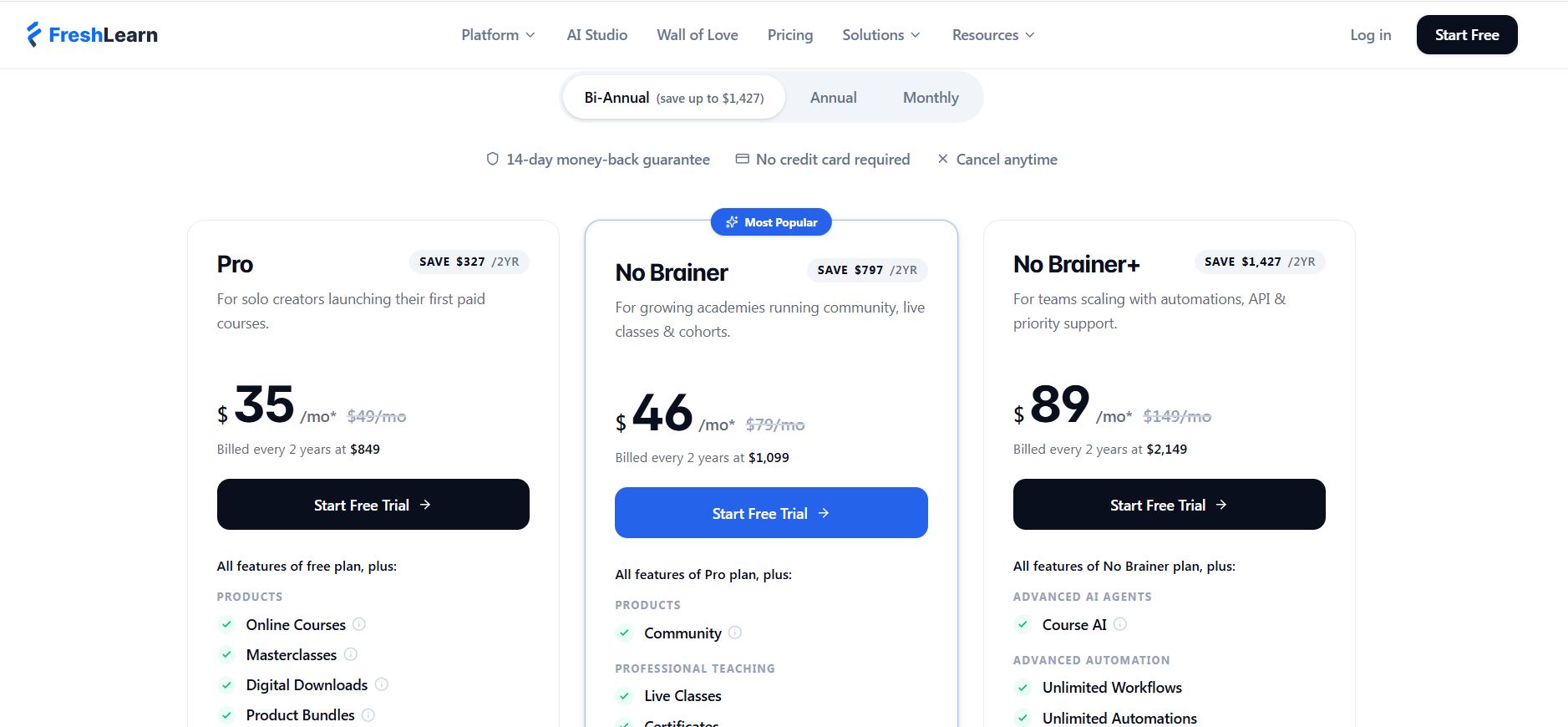
Every plan keeps unlimited enrolments, in-house checkout, and Stripe or PayPal payments at zero platform commission, so growth doesn't drag hidden costs behind it. There's no payment-gateway penalty either: you can run your own Stripe or PayPal without losing a percentage of every sale.
AI Studio: AI built into your academy, not bolted on
FreshLearn's AI Studio generates a complete course structure (modules, lessons, and learning objectives) from a single topic, then creates quizzes, captions, and lesson summaries automatically from content you've already uploaded.
Where it separates from both platforms here is on the learner side. Your students can chat with your course videos and get answers with the exact lesson timestamp, search your whole academy like ChatGPT, and rehearse real-world scenarios (sales calls, interviews, objection handling) with AI Coach.
Every answer is grounded in your lessons rather than the open internet, and you can see which topics learners ask about most and where they get stuck. Thinkific and Kajabi both ship AI course generators; neither gives your learners an AI that answers from your content.
A complete product and marketing system
One subscription covers on-demand courses, workshops, digital downloads, paid communities, and soon 1:1 coaching. Email campaigns, visual automations, referrals, coupons, and a blogging CMS sit beside a drag-and-drop website builder, so creators can attract, convert, and nurture students without stitching together half a dozen external apps.
Learner engagement built to scale
FreshLearn introduces gamification elements to improve the learning journey, like badges, question banks, certificates, and white-label mobile apps on top of its core platform.
The branded app is $199 per year, not per month; the same app costs $199 a month on Thinkific and requires Kajabi's $499/month Pro plan.
Real-time analytics pinpoint drop-off points, while 24x7 live-chat support keeps creators from stalling mid-launch. This is a level of support many users say was missing on other platforms.
Done-for-you migration that preserves every asset
Switching from Kajabi, Thinkific, or another LMS doesn’t cost extra engineering hours when you’re on any annual FreshLearn plan. The easy migration system moves up to 10 full courses on No Brainer and 15 on No Brainer Plus, with larger catalogues handled on a personalized quote.

All videos, student data, and SEO-friendly URLs come across intact, so you relaunch on FreshLearn without losing momentum.
Actionable analytics, unified in one dashboard
FreshLearn’s built-in reporting tools tell you of enrolments, watch-through percentages, quiz scores, revenue by product, and campaign attribution in a single live view.
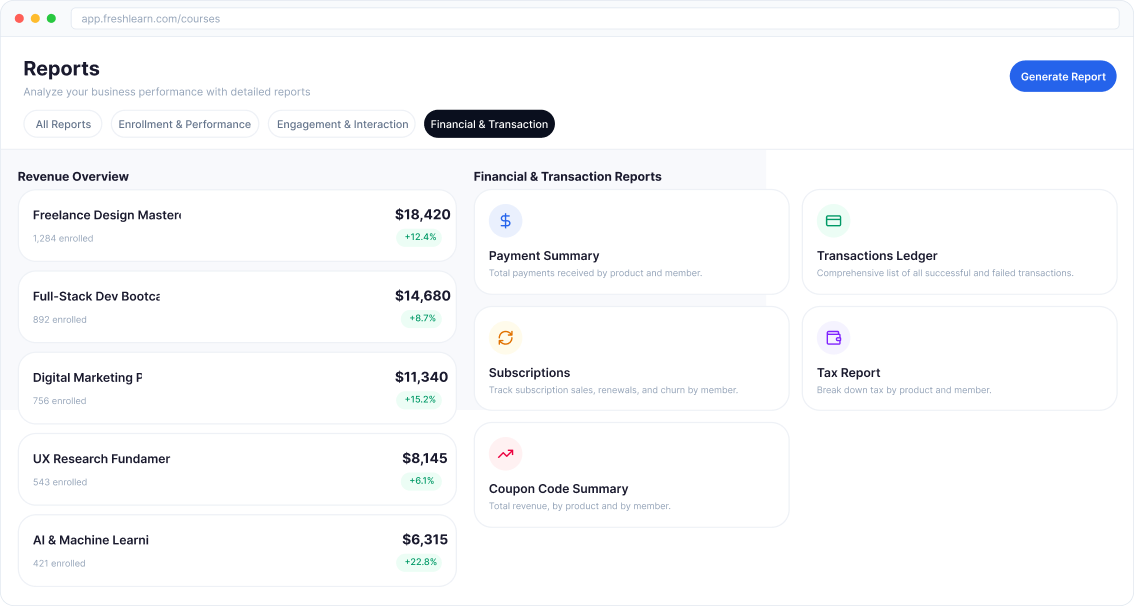
Filters highlight where learners face issues, while CSV exports and webhook streams feed finance sheets or BI tools. These are insights that might require separate apps (or Zapier chains) on competing platforms.
AI Course Idea Validator that clears your doubts before you film
Before you burn hours recording lessons, paste your topic into FreshLearn’s free AI course validator. The AI drafts a wait-list landing page, then tracks sign-ups so you can measure demand in days, not months.

When the numbers look right, the same workflow spins your validated outline directly into the course builder.
Monetization levers built to scale revenue, not fees
Beyond one-off course sales, FreshLearn supports subscription communities, tiered memberships, digital downloads, order-bump add-ons, instalment plans, and coupon-driven promos, all processed through Stripe, PayPal, Razorpay, or PayU at 0% platform commission. Creators keep full pricing control and can launch new revenue streams without changing providers or paying for extra plug-ins.
Thinkific Too Lean? Kajabi Too Costly? FreshLearn is Your Answer.
Choosing a course platform should feel like unlocking possibilities, not picking compromises. Thinkific gives you teaching depth, Kajabi supplies marketing muscle, and FreshLearn offers the perfect balance of the two.
FreshLearn pairs robust pedagogy with built‑in growth tools and fair, flat pricing. Pick the path that matches your priorities today, knowing you can always level up or switch as your business evolves.
To learn more about FreshLearn, schedule a demo today.
FAQs
1. Is Thinkific or Kajabi better?
Neither is better outright; they optimise for different jobs. Thinkific is the stronger teaching platform, with more lesson types, bulk quiz imports, slide-plus-narration presentations, and integrations for high-stakes exams and verifiable certificates. Kajabi is the stronger selling platform, with native funnels, a full email service provider, coaching as a built-in product type, and automations that connect course behaviour to marketing. Pick based on whether your bottleneck is delivering the learning or selling it.
2. Which is cheaper, Thinkific or Kajabi?
Thinkific, by a wide margin. Thinkific starts at $54/month against Kajabi's $179/month, and the gap holds at every tier: $109 versus $249 in the middle, and $219 versus $499 at the top. Kajabi bundles email, funnels, and affiliates into its price, so the all-in cost narrows once you add those tools to Thinkific, but only at the higher tiers does Kajabi come out even.
3. Is Kajabi worth the extra cost over Thinkific?
It depends on how much of its marketing stack you will actually use. Thinkific Basic at $54 plus an email tool at around $29 comes to roughly $83/month, against $179 for Kajabi Basic, which does not include an affiliate program. Higher up the range, the maths shifts: Thinkific Grow at $219 plus a larger email plan at $59 reaches $278, while Kajabi Growth at $249 includes funnels, email, and advanced affiliates. Kajabi earns its price only when you need the whole stack.
4. Do Thinkific and Kajabi charge transaction fees?
Kajabi charges no platform commission on any plan. Thinkific charges no commission when you process payments through Thinkific Payments, but if you use your own Stripe or PayPal account, it applies a penalty of 5% on Basic, 2% on Start, and 1% on Grow. Standard card processing fees apply on both platforms regardless.
5. Which is better for beginners, Thinkific or Kajabi?
Thinkific, on both simplicity and cost. Its site builder offers a smaller, more guided set of sections, the course builder is straightforward to learn, and the entry plan costs a fraction of Kajabi's. Kajabi's feature set is broad enough to feel overwhelming on day one, and paying $179/month while validating a first course idea is a heavy commitment.
6. Which platform handles live sessions and coaching better?
Kajabi. It offers native live video streaming and recording across courses, coaching, and community rooms, and it treats coaching as its own product type with scheduling, session notes, and bundling built in. Thinkific runs live lessons through a Zoom integration and relies on external schedulers such as Calendly for coaching. One caveat on Kajabi: its live video works with course products and coaching products using the Kajabi Scheduler, so connecting Calendly or a custom scheduling link disables the go-live option.
7. Do I need a separate email tool if I use Thinkific?
For anything beyond basic sends, yes. Thinkific covers broadcasts, confirmations, abandoned-cart nudges, and simple nurture flows, but segmentation stays rudimentary and conditional logic requires an external provider connected directly or through Zapier. Kajabi includes a full email suite with segmentation, visual automations, and deliverability analytics, which replaces a standalone provider for most creators.
8. Can I get a branded mobile app on Thinkific or Kajabi?
Both offer one, at very different prices. Thinkific sells a white-label app as a $199/month add-on on top of your existing plan. Kajabi no longer sells one separately; a branded app is bundled into its Pro plan at $499/month. Both also provide a free, platform-branded learner app, though community features are disabled inside Kajabi's iOS app.
9. Can I move my courses from Thinkific to Kajabi?
Yes, but the process is manual. To move from Thinkific to Kajabi, export your course videos and materials from Thinkific (via the Content Library download option), then rebuild your course curriculum inside Kajabi's product builder and re-upload media files. Student enrollment data can be exported as a CSV from Thinkific and re-imported into Kajabi, though students will need to be notified and may need to create new Kajabi accounts. Sales pages and landing pages need to be rebuilt in Kajabi's site builder from scratch. Neither platform provides a done-for-you migration service, so large catalogs typically require a paid specialist or significant time investment. If you are open to alternatives, FreshLearn includes free done-for-you migration on annual plans, covering courses, student data, and SEO URLs, at no extra cost.
10. Is there an alternative to Thinkific and Kajabi?
Yes. FreshLearn covers course delivery and marketing in one platform with unlimited courses and students on every tier, no platform commission, and no payment-gateway penalty, starting at $49/month. It also includes free done-for-you migration on annual plans, which neither Thinkific nor Kajabi offers.
11. Which platform is better for selling memberships and subscriptions, Thinkific or Kajabi?
Both platforms support memberships and subscription billing, but Kajabi integrates them more tightly with its marketing tools. On Kajabi, memberships connect directly to email automations, community access, and coaching products, so you can manage recurring revenue and engagement from one dashboard. On Thinkific, membership and subscription billing is available from the Start plan ($82/month annually), but community and marketing automation features are more limited and often require external tools. For creators whose primary revenue model is recurring memberships, Kajabi's integrated approach reduces the need for third-party tools, though at a significantly higher price.
12. Which is better for course creators just starting out, Thinkific or Kajabi?
Thinkific is generally the better starting point. Its course builder is straightforward, the entry plan costs $54/month (or $40/month annually), and you can launch without committing to Kajabi's full marketing suite before you know whether you need it. Kajabi's $179/month entry plan requires a larger financial commitment while you are still validating your first course idea, and its broader feature set can feel overwhelming early on. Both offer a free trial period. If budget is tight or you are still testing your first course, starting on Thinkific and switching once you outgrow it is a lower-risk path than committing to Kajabi from day one.
You might also like
Hosted by