
Top 10 LMS Platforms for Nonprofits to Make Training Easy [2026 Updated]

In the process of researching LMS platforms for multiple industries, I noticed something: The platforms rarely talk about non-profits.
This is because the focus is usually on course selling, product training, or enterprise learning, while organizations working for social impact struggle to find tools that fit their purpose and budgets.
So, I took a closer look.
From open-source platforms to affordable SaaS tools, I compared dozens of options to see which ones truly help nonprofits train, collaborate, and grow.
Here’s the result — a list of the 10 best LMS platforms for nonprofits in 2026, picked for their affordability and features that work well for impact-focused teams.
Why an LMS is a strategic asset for your nonprofit
As a nonprofit stakeholder, you face a constant balancing act: limited staff, volunteers with varying schedules, and big goals to achieve. In situations like these, a Learning Management System can quietly take a lot off your plate. Here are a few scenarios of LMS in action.
Scenario #1: Scaling volunteer onboarding and training
A non-profit animal rescue center just opened a second shelter across town. It’s an exciting step forward; more space means more animals saved. But the challenge is, with dozens of new volunteers each month, in-person training couldn’t keep up, and inconsistent instruction risked affecting animal care.
That’s when they turned to an LMS, uploading orientation modules on safety and adoption procedures into a single, easy-to-access platform.
Now, every volunteer receives the same high-quality training through self-paced learning and feels confident in their roles. It also frees staff from having to repeat sessions for each new group.
Scenario #2: Developing staff and reducing turnover
A nonprofit constructs homes for low-income families, and the team has doubled in size in just three years. While that growth is good, the organization quickly noticed a problem: employees felt stuck. There weren’t enough structured learning opportunities or career development programs.
To solve this, the non-profit rolled out an LMS that offered personalized learning tracks for staff, covering leadership skills, project management, and community relations.
Team members could take courses anytime, track their progress, and even receive internal certifications. It also helped retain skilled employees who felt invested in the organization’s scope.
Scenario #3: Delivering community education programs
A nonprofit organization hosts monthly nutrition workshops in local schools. They pulled in a good crowd, but only from one city. They wanted to make the program accessible to schools nationwide, but lacked the staff and travel budget to do it.
An LMS changed that. By converting their workshops into interactive, online courses, they could deliver the same course curriculum to hundreds of classrooms in multiple locations. Teachers could log in, download submissions, and track student progress through reporting and analytics, all from one dashboard.
Scenario #4: Enhancing donor engagement
The nonprofit foundation sought to strengthen its relationships with donors. Most donors received standard email updates, but the organization realized that showing their impact could go much further than just telling.
They built a short “Donor Education Module” using their LMS. In this space, contributors could explore videos, track project milestones, and even take quizzes to learn more about the organization. Through this, donors felt part of the cause, not just supporters from afar.
Scenario #5: Automating compliance and grant reporting
A nonprofit manages multiple health programs, and compliance training was a constant challenge. Each year, they had to prove to grant providers that every staff member completed required certifications, and the manual tracking took weeks.
Implementing an LMS turned that around. Every training completion, quiz score, and certificate was automatically recorded and stored. When it's time for reporting, all the data is just a click away. The result? Zero last-minute scrambles, faster audits, and more time spent where it really matters: serving their communities.
How to choose the right LMS: A 6-step framework
You’ve got limited time and a long to-do list; the right LMS should save you work, not create more. These six steps cut through the noise and point you to tools that actually help.
- Start with your “why”: Begin by asking yourself: What’s the main goal? Are you training 50 volunteers in one city or 5,000 members across the country? When you know your “why,” the rest of your decisions become a lot clearer.
- Identify your learners: Who will actually use the LMS? Tech-savvy staff? Non-technical volunteers? Or the general public? Choose a platform that feels intuitive for them.
- List your must-have features: Think of this as your non-negotiable checklist. Do you need self-paced courses, live sessions, downloadable resources, or certifications? Use that as a reference point to note what really matters for your nonprofit.
- Set a realistic budget: Research typical pricing plans, but don’t stop there; always ask if they offer a nonprofit discount. Many providers do, and those savings can go straight back into your mission.
- Create a shortlist and request demos: Narrow it down to three to five LMS platforms and book live demos. During the demo, notice how responsive the team is, including its customer support, which often makes or breaks your experience later.
- Check for key integrations: Finally, make sure the LMS can connect with the tools you already rely on, such as your CRM, donor database, or email platform. Easy integrations save hours of manual work and keep your data clean.
The most important LMS features for nonprofits
Now that we know the structural elements to look for in an LMS for nonprofits, let’s see the granular functionalities to consider in the LMS selection process.
The 10 best LMS platforms for nonprofits in 2026
We saw the factors to look for in an LMS for nonprofits. With that as a base, here are the 10 platforms that shine. Compare the prices and features and choose the one that better aligns with your nonprofit’s needs.
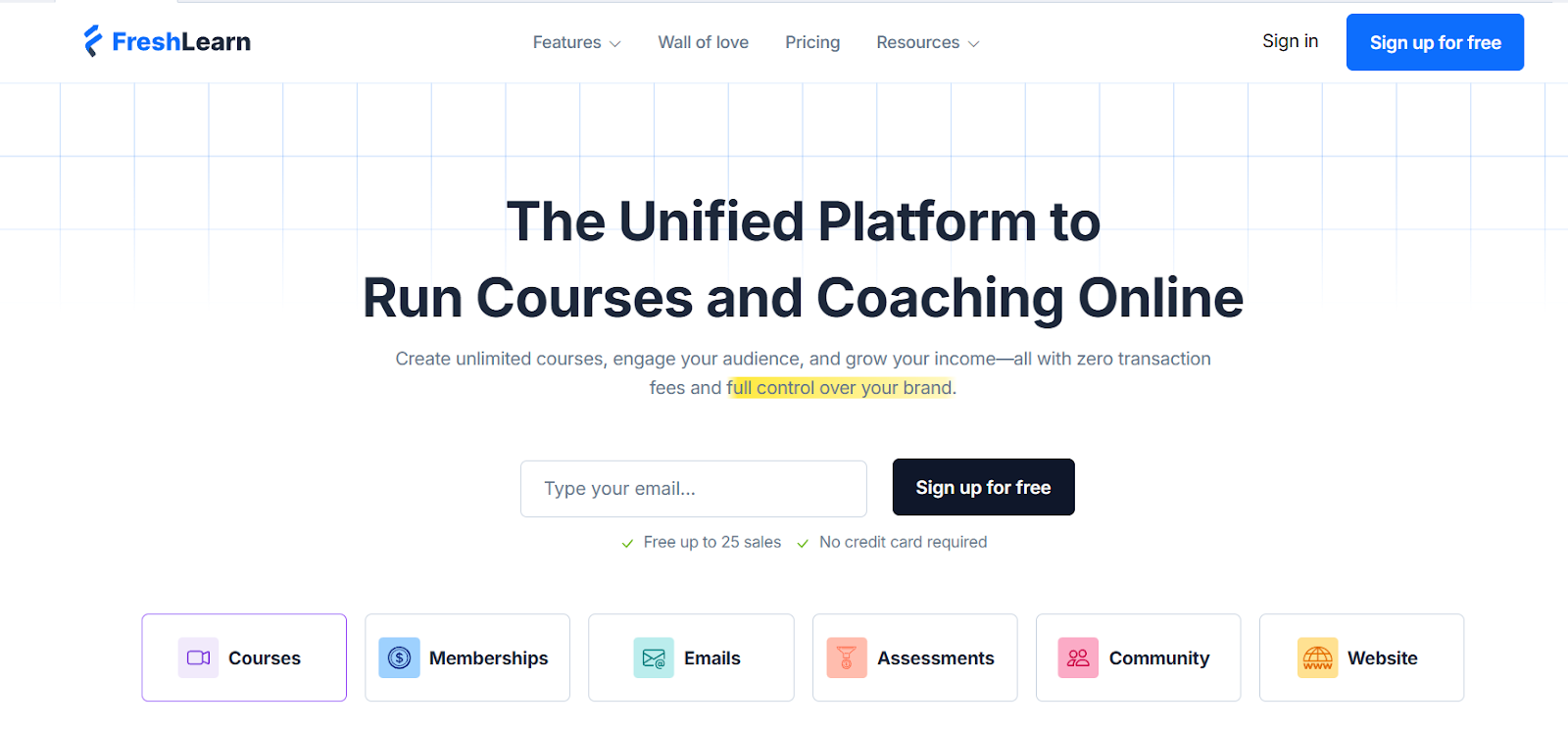
1. FreshLearn
Best for: Nonprofits looking for an intuitive, budget-friendly platform to deliver engaging, self-paced, and live training experiences for volunteers, staff, and supporters, without much technical overhead.
Key features for nonprofits
- SCORM support: Build interactive, multi-media courses easily with a drag-and-drop editor and one-click imports.
- Mobile-optimized learning: FreshLearn gives you a branded mobile app on both Android and iOS, helping your frontline volunteers and staff learn from anywhere.
- Live sessions: Run real-time sessions where learners can ask questions and interact with instructors and peers.
- Customizable certificates: Easily create certificates to recognize achievements and motivate your team.
- Gamification elements: FreshLearn offers features like leaderboards and quizzes to make learning more interactive and engaging.
- Automated reporting and analytics: It offers tools to help you track training completion rates and provide support to learners when needed.
- AI-supported functionalities: FreshLearn’s AI Agents act like your smart assistant for course creation. They help at every stage of your course delivery process, including quiz building, course outline creation, and course idea validation, which helps you test it out before making any investment.
- Multi-language support: FreshLearn lets you offer training in multiple languages, so everyone on your team across locations can learn comfortably.
- No transaction fees: FreshLearn does not incur transaction fees, allowing nonprofits to maximize their limited budgets and focus on their goals.
Pricing
Free plan: Ideal for small teams or pilot programs, offering core features with no cost.
For course creators:
- Pro plan: Pricing starts at $49/month ($37/month if billed annually). It's suitable for creators launching on-demand courses and workshops.
- No Brainer Plan: Pricing starts at $79/month ($59/month if billed annually). This plan includes additional features like live classes and certificates.
- No Brainer+ Plan: Pricing starts at $149/month ($119/month if billed annually). It offers unlimited workflows and automation tools.
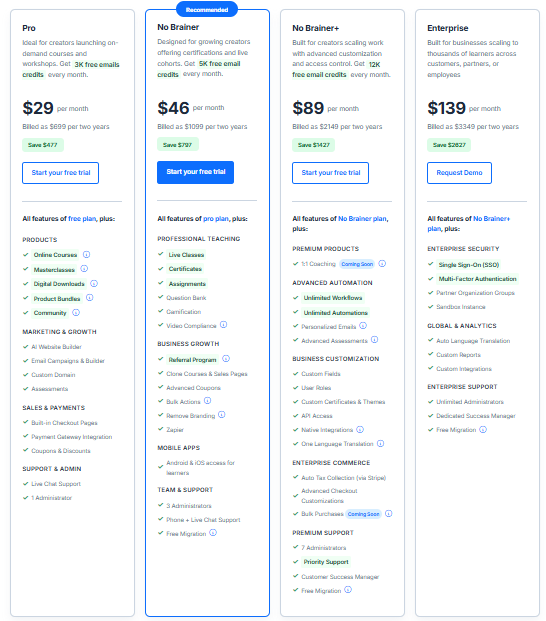
For businesses:
Enterprise: $249/month + 50¢ per registered learner.

The good news is that FreshLearn offers a 25% discount on yearly plans to nonprofit organizations.

Pros
- The SCORM support helps deliver globally compliant courses and issue certificates for mandatory certifications in accordance with international regulations.
- The AI Agents help quickly draft courses and quizzes, which could save you time and resources.
- The mix of self-paced and live cohort sessions makes it easy for volunteers and staff to learn on their own schedule while still feeling connected.
- FreshLearn gives you competitive pricing, offering good value for the money invested.
- The platform is clean and intuitive, so your team will require minimal onboarding to get started.
Cons
- You may feel limited by the third-party integrations compared to the more premium enterprise solutions.
- Advanced features, such as live sessions and certificates, are available only from the No Brainer plan.
- While FreshLearn handles course delivery and engagement well, its marketing funnels and automation tools are limited compared to platforms specifically designed for these purposes.
2. Teachfloor
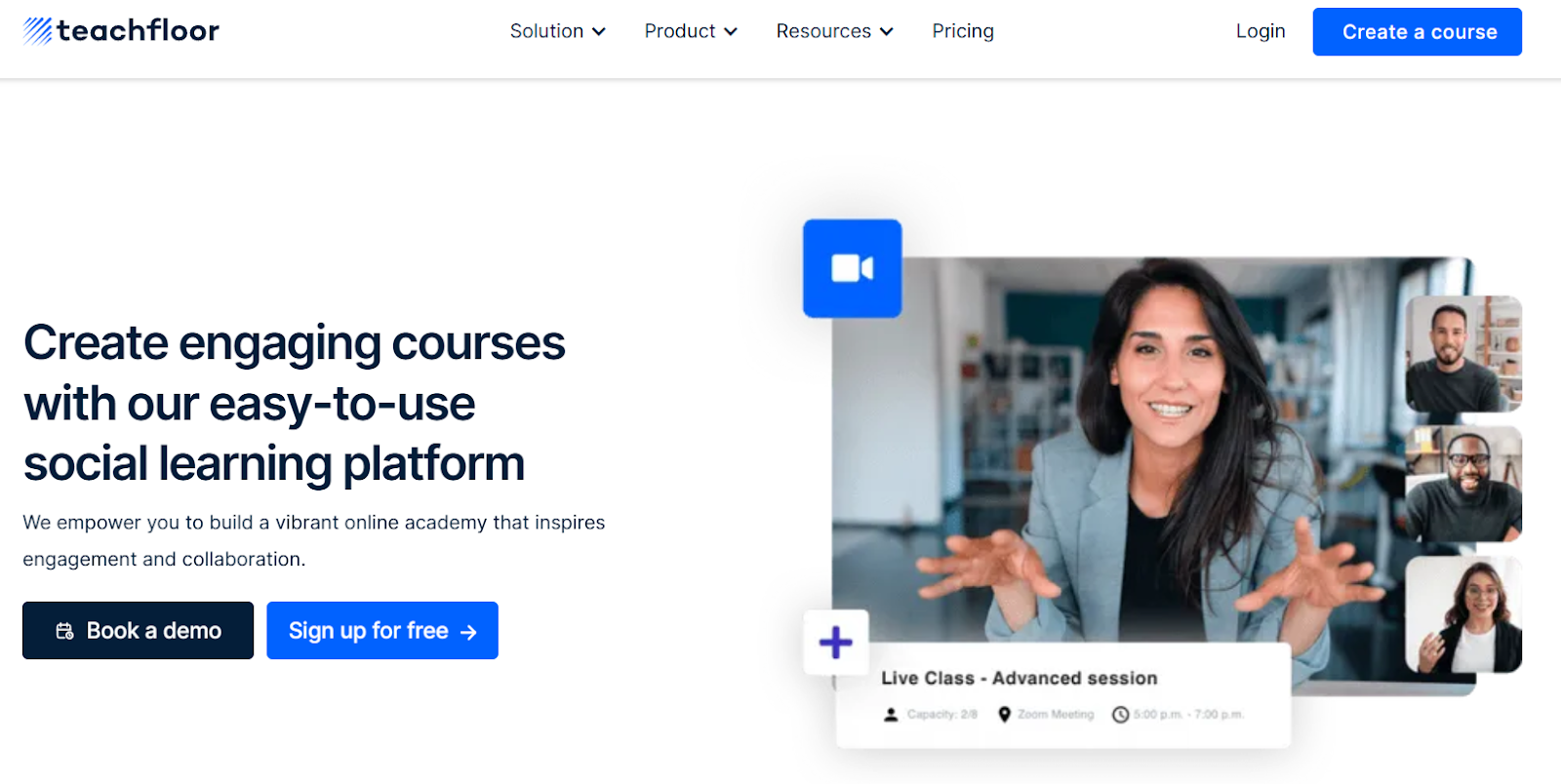
Best for: Nonprofits aiming to deliver interactive, cohort-based training with an emphasis on community engagement and peer learning.
Key features for nonprofits
- Group activity: Teachfloor enables you to run structured group sessions, allowing volunteers and staff to learn together and support one another.
- Zoom support: Live sessions can easily integrate with Zoom, allowing learners to join and interact in real-time.
- Discussion and collaboration spaces: Teachfloor lets you build a dedicated community where learners can ask questions, share ideas, and collaborate, helping teams stay connected while learning.
- In-app calendar: Manage all your live sessions in one place, making it easy for learners to see upcoming classes and join on time.
- Completion tracking: View which learners have completed their courses, allowing you to easily track progress and identify those who may require additional support.
Pricing
Teachfloor gives a 30-day free trial. Its pricing plan starts from $89/month, which may increase depending on your organization’s requirements.
Pros
- Peer reviews and discussion forums encourage collaboration and interaction among learners.
- Integrations with tools like Clickfunnels, ActiveCampaign, or Kit let you bring in content, automate basic tasks, and streamline course delivery.
- Teachfloor offers a gradebook, completion rate tracking, and progress analytics, providing a quick view of the offering’s performance.
- You can set start and end dates for courses or cohorts, helping learners stay on track and creating a sense of shared learning.
Cons
- The platform tracks learner progress well, but exporting detailed reports by group or location can be tricky without extra manual work.
- Some nonprofits may hit storage or user limits faster than expected, which can be restrictive as programs grow.
- Costs can feel high for smaller nonprofits, especially as you scale up your learners or content.
3. TalentLMS
Best for: Small nonprofits looking for an intuitive, scalable learning platform with a user-friendly interface.
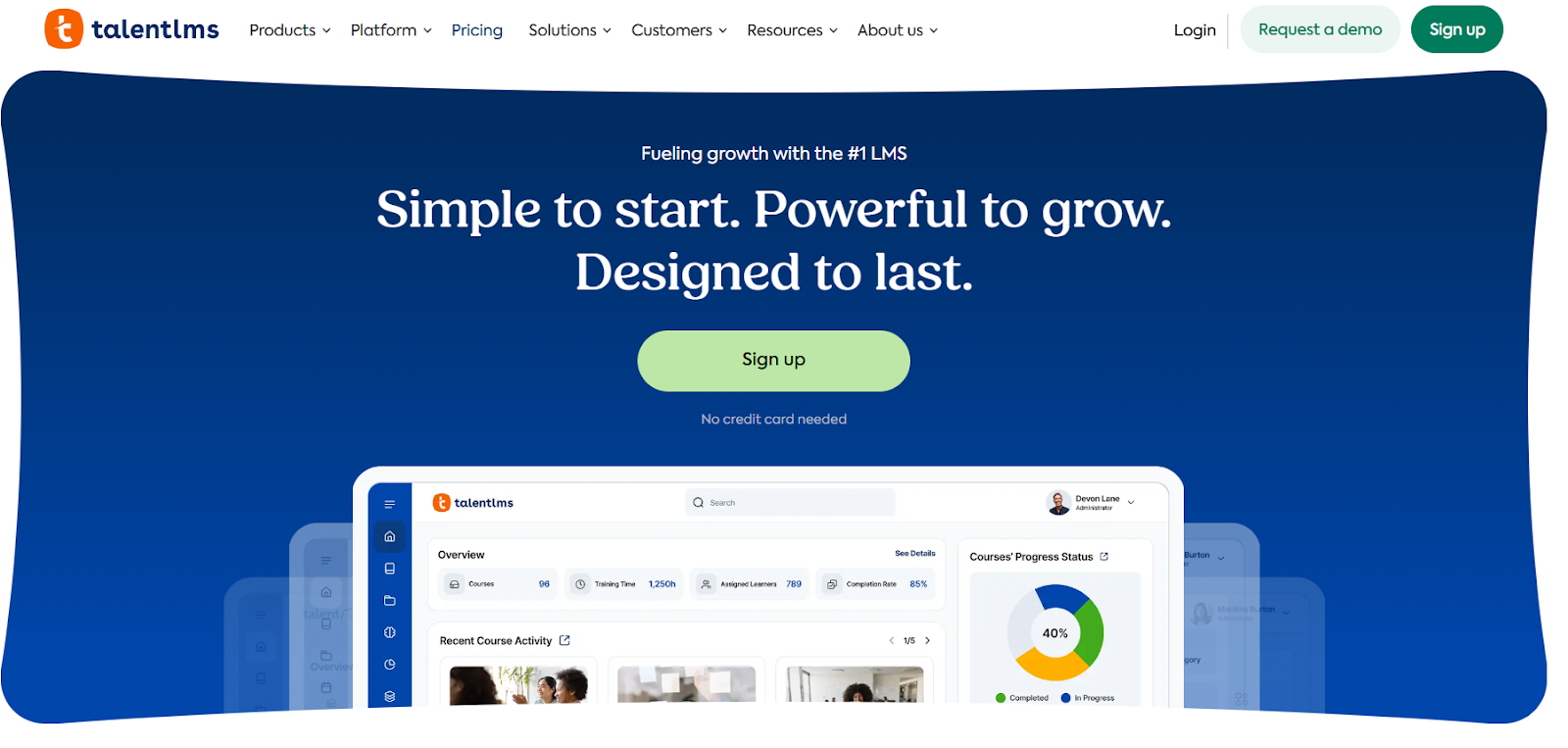
Key features for nonprofits
- Free plan for small teams: TalentLMS offers a free plan that supports up to 5 users and 10 courses, making it suitable for small teams.
- Blended learning support: Supports a mix of online and in-person training sessions, accommodating multiple learning preferences within nonprofit organizations.
- Gamification and certificates: TalentLMS lets you use quizzes, leaderboards, and certificates to make learning more interactive and motivated.
- Integration: Supports easy integration with various tools, including Zoom, Salesforce, and Slack, streamlining the learning experience.
- Mobile accessibility: Offers a mobile application, allowing learners to access training materials on the go, which is beneficial for field staff.
Pricing
In addition to the free plan, TalentLMS also offers 4 pricing tiers.
- Core: Costs $149/month or $119/month, if billed annually.
- Grow: Costs $299/month or $229/month, if billed annually.
- Pro: Costs $579/month or $449/month, if billed annually.
- Enterprise: Custom pricing.
This pricing tier depends on your user base. Choosing a flexible user limit and/or TalentLibrary will further increase the cost. TalentLMS also gives a 20% discount on its annual plan to nonprofit organizations.
Pros
- Many nonprofit teams lack a dedicated IT person, so TalentLMS’s clean, point-and-click interface helps anyone, including first-time administrators.
- TalentLMS can handle both small and large training groups, so you can start small and expand without switching platforms.
- Automated reminders and progress tracking free up time for program leads to focus on real impact instead of chasing people for training completion.
- Built-in reporting tools help nonprofits track course completions and generate reports needed for grants or regulatory requirements.
Cons
- The reporting tools feel basic. You can’t easily track results across multiple courses or build reports for a complete training program.
- TalentLMS doesn’t connect directly with Google Meet, which can be inconvenient for teams already using it for large meetings or training sessions.
- The course builder uses basic tools, so lessons can look plain and lack the dynamic experience some learners expect.
4. ProProfs Training Maker
Best for: Nonprofits that want a ready compliance training, built-in course creation templates, and AI support.
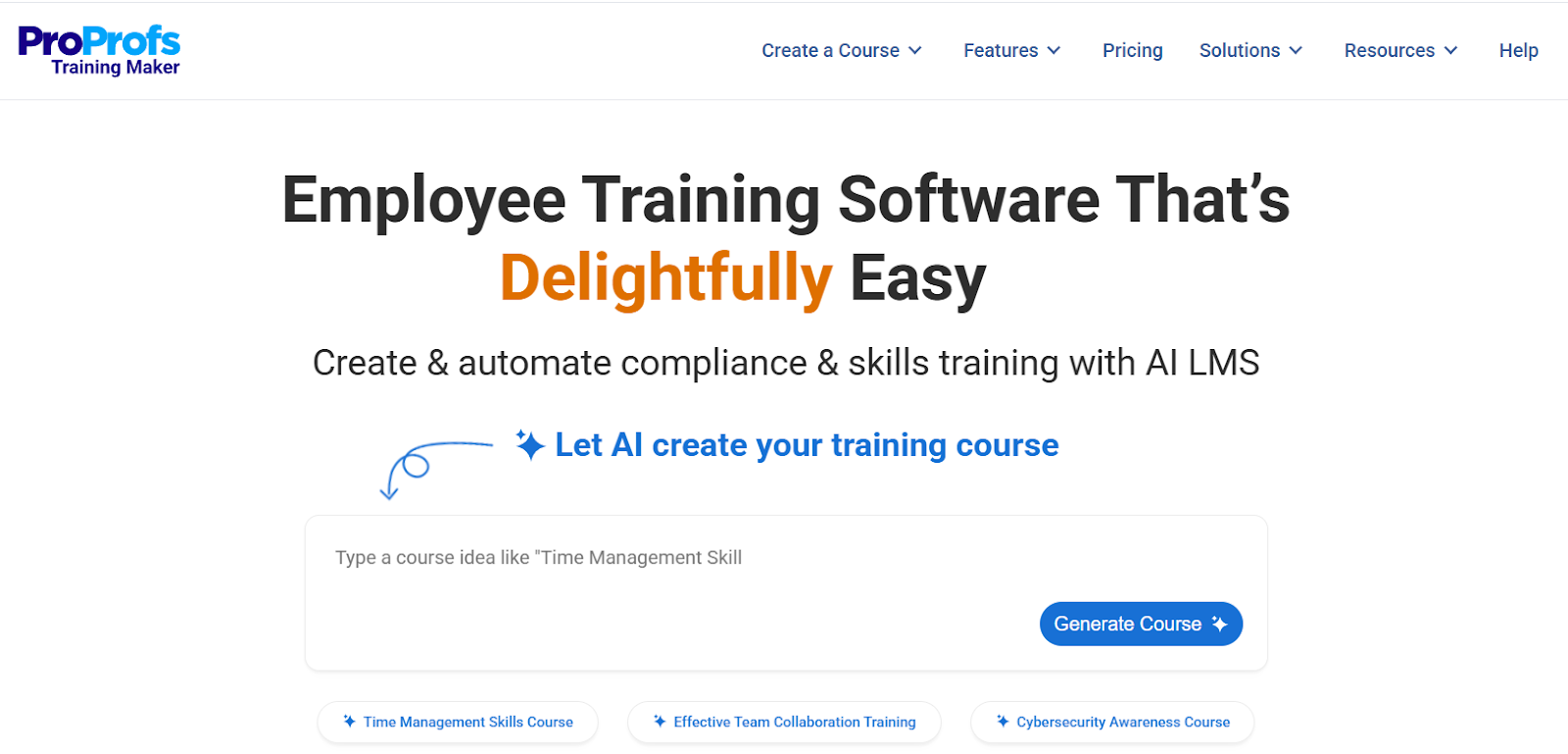
Key features for nonprofits
- AI course creator: ProProfs Training Maker uses AI tools to help build course content and quizzes faster, lowering the barrier for small teams.
- Pre-built compliance/policy courses: Provide a library of ready-made courses (safety, HR, OSHA) that nonprofits can adapt.
- Reporting and analytics: It lets you track learner progress, completion rates, and quiz scores, and you can also export reports for grants or oversight.
- Role-based access and groups: The platform helps you organize learners and assign permissions to administrators, instructors, and volunteers.
- Course authoring/upload options: You can upload existing materials (PDFs, PPTs, videos) or use their authoring tool to build courses.
Pricing
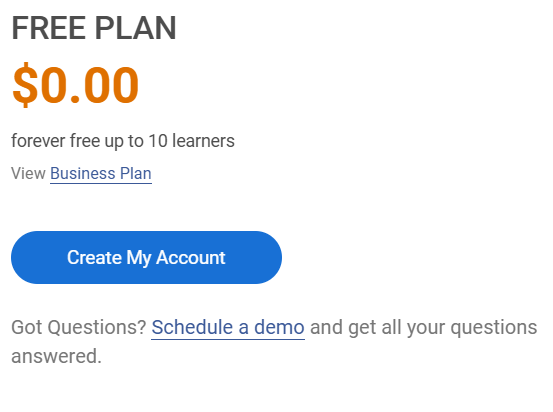
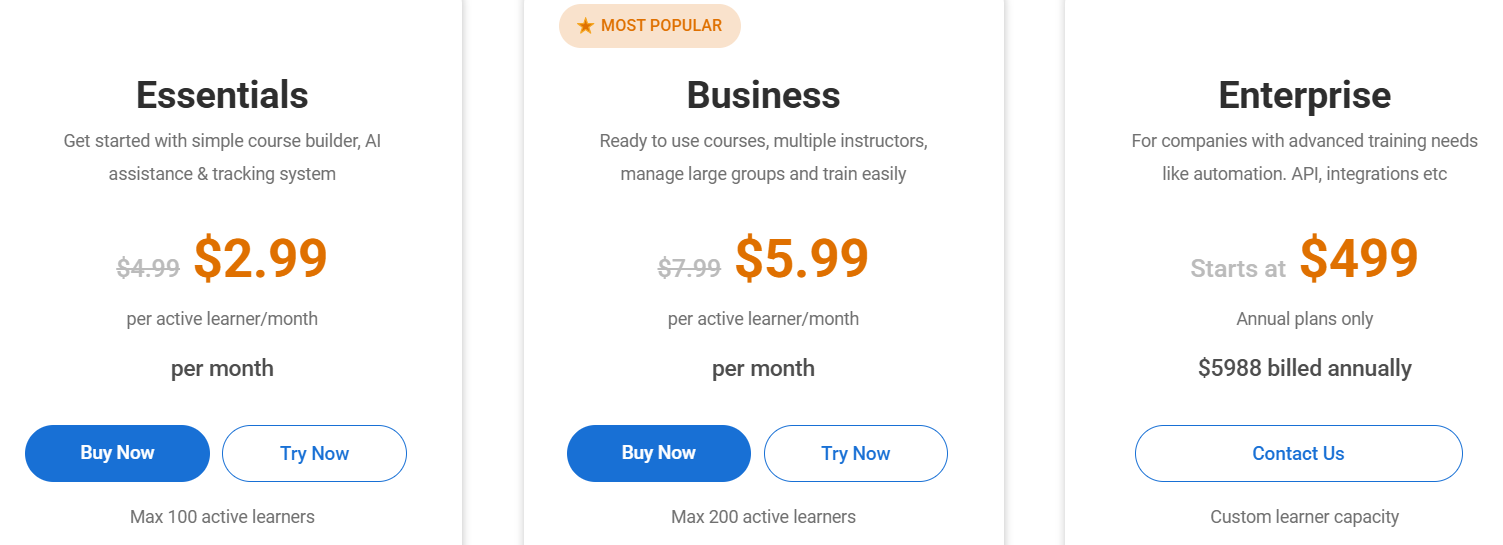
The platform is free to use for up to 10 learners. For more than 10 learners, ProProfs Training Maker has 3 pricing plans:
- Essential: $2.99/user/month or $1.99/user/month (if billed annually).
- Business: $5.99/user/month or $3.99/user/month (if billed annually).
- Enterprise: $499/month. This plan only offers an annual billing option at $5,988.
Pros
- Nonprofits with limited staff can use the AI tool and pre-built templates to quickly create training materials.
- It’s budget-friendly, fitting many small nonprofit organizations.
- Its reporting and analytics let you know who has completed training, who's lagging, and what areas need more attention.
- Multiple team members can work together to build or review courses, which is helpful for small nonprofit staff who are spreading responsibilities.
Cons
- If many nonprofits use the same templates, your training may feel less unique or personalized.
- Although the starting price is significantly lower, as you scale to more users, add more content, or incorporate features, subscription fees can increase.
- Some of the more advanced capabilities (e.g., grouping, branching, complex surveys) require time to master.
5. LearnDash
Best for: Nonprofits seeking a customizable, WordPress-based LMS with course creation and reporting tools.
Key features for nonprofits:
- AI course outline builder: LearnDash lets you quickly generate course outlines by inputting basic details, making your course creation process easier.
- Blended learning support: Combine virtual and in-person learning formats, ideal for community programs and workshops.
- Course drip content: The platform helps control the release of course materials over time using a drip schedule to maintain learner engagement and pacing.
- Customizable course completion pages: Encourage feedback and promote other programs or events upon course completion.
- Comprehensive reporting and analytics: It helps you track learner progress, completion rates, and quiz scores, with export options for reporting purposes.
Pricing
LearnDash does not offer a free plan or free trial. Its pricing plans are listed below; eligible nonprofits receive a 25% discount on its plugin and cloud versions, and 15% off bundles.
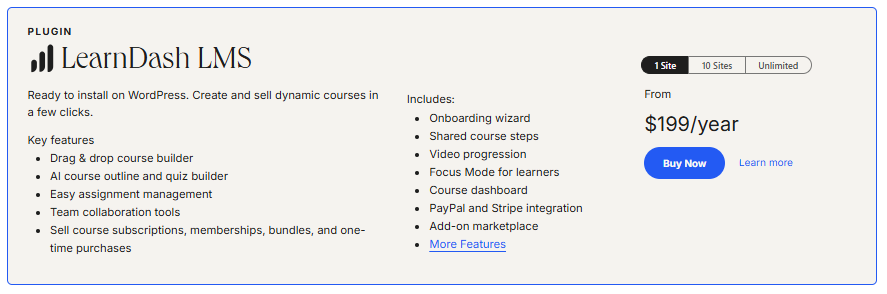
LearnDash LMS (plugin):
- $199/year for 1 site.
- $399/year for 10 sites.
- $799/year for unlimited sites.
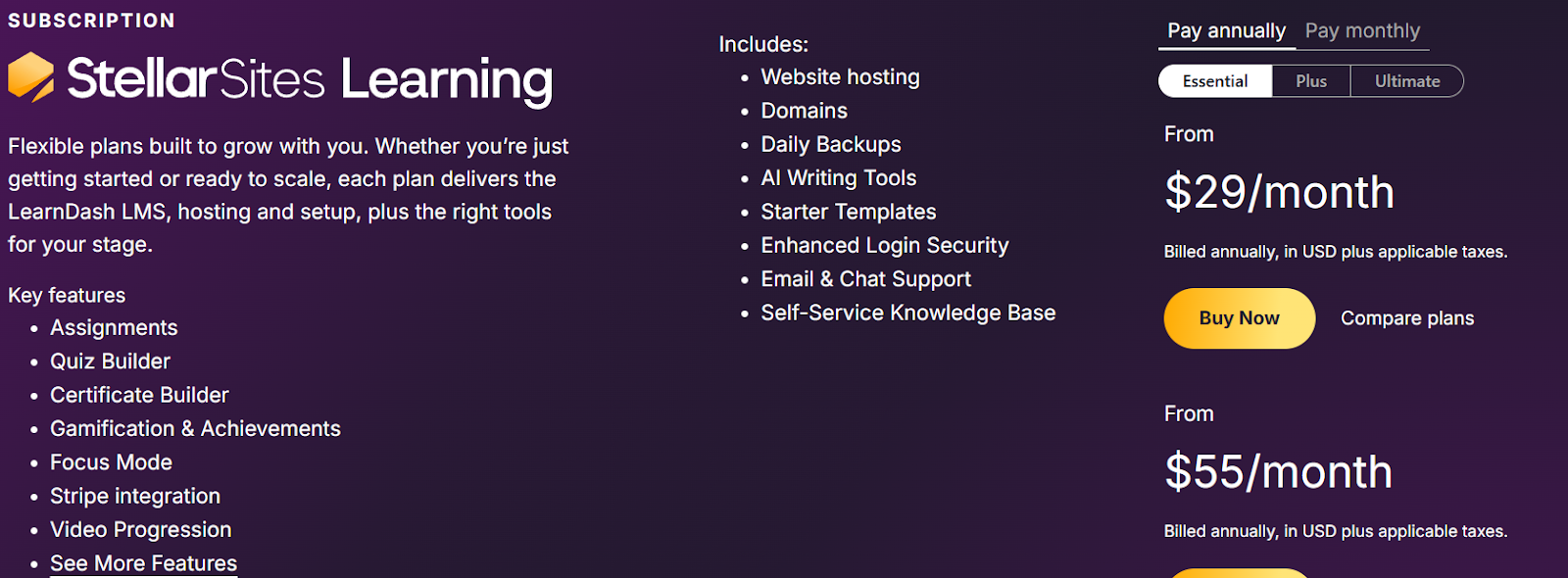
StellarSites Learning (Cloud version)
- Essential: $39/month or $29/month, if billed annually.
- Plus: $69/month or $55/month, if billed annually.
- Ultimate: $99/month or $79/month, if billed annually.
Users can also opt for a bundled solution that matches their requirements. The platform also offers add-ons, including Gradebook, notes, and Propanel 3.0, which come at an extra cost.
Want to have more insights about LearnDash’s pricing plans? Read our article on LearnDash Pricing and Comparison with Affordable Alternatives.
Pros
- Users can tailor courses to meet specific nonprofit training needs.
- Easily integrates with existing WordPress websites, leveraging familiar tools.
- Upload playlists from YouTube, Vimeo, or Wistia, and the platform automatically turns them into a course.
- Set start and end dates for courses to create shared learning and accountability for volunteers and staff.
Cons
- Nonprofits unfamiliar with WordPress may face a learning curve.
- You will incur additional costs for hosting, as the self-hosted solution (LearnDash LMS plugin) requires separate hosting arrangements.
- LearnDash includes a few essential features as add-ons, which can further increase your monthly subscription cost.
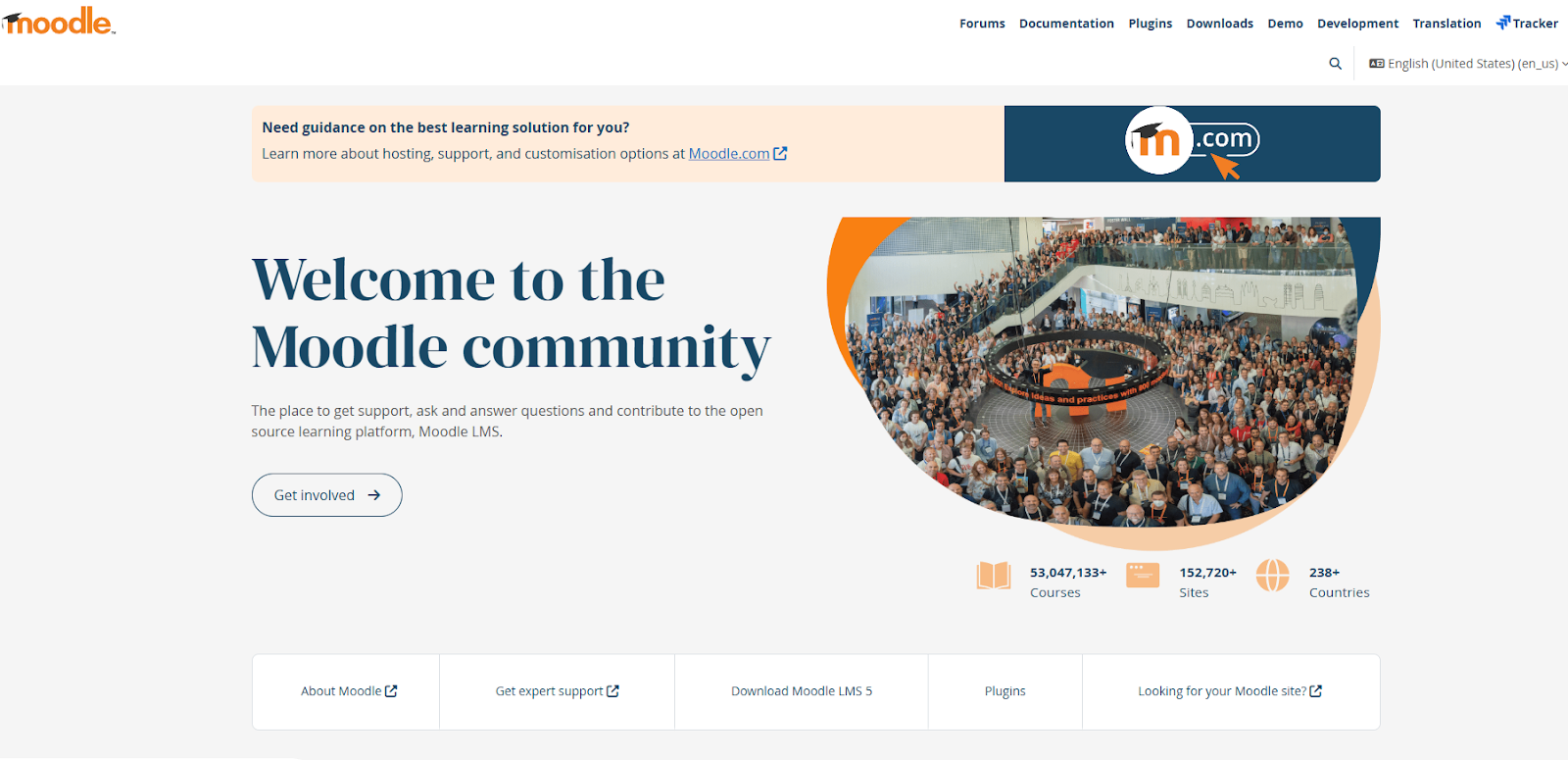
6. Moodle
Best for: Nonprofits that want total control and that prefer managing their own training system with open-source tools
Key features for nonprofits
- Open-source and cost-free core: Moodle lets you download and use the platform’s self-hosted software without paying any license fee.
- Plugin ecosystem and integrations: Hundreds of plugins let you add features (video tools, gamification, reports) to suit your nonprofit’s needs.
- Multilingual support: Moodle supports many languages, helping teams across regions learn in their own language.
- Detailed reporting and analytics: It offers logs, course-completion tracking, visual indicators, and exporting capabilities.
- Role-based permissions and grouping: The platform allows you to assign different access levels (admins, teachers, learners) and segregate groups.
- Blended and self-paced learning support: Through Moodle, combine online modules, live sessions, and in-person training approaches.
- Backup, versioning, and bulk actions: Moodle supports backups, bulk course edits, and system version control.
Check out our article on the ‘Top 7 Moodle Alternatives’ to know further about LMS choices that may fit your nonprofit.
Pricing
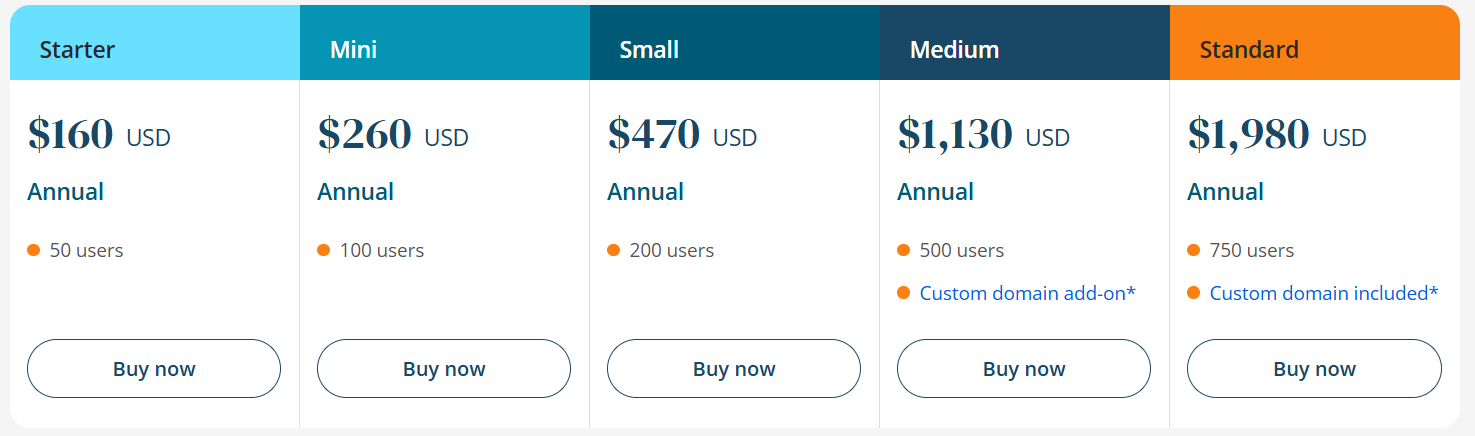
Core software is free (open source). MoodleCloud plans start at yearly fees of $160 (for the hosted service). The pricing increases depending on your user base and storage requirements.
Pros
- You don’t pay to acquire the core LMS; instead, your budget goes towards hosting or customization.
- Users can tailor Moodle to their needs using plugins or custom code.
- You benefit from thousands of existing plugins and community support.
- Moodle can grow as your number of learners or programs expands.
- Learners can use mobile apps (with offline access available for certain features) to browse their courses.
Cons
- Setting up, customizing, and managing Moodle takes time and technical know-how.
- You need to manage hosting, updates, backups, and security; this can be particularly challenging for small nonprofit teams.
- The interface can feel dated. Some users think that Moodle’s UI is less modern or sleek.
- Costs shift to infrastructure and support. While the software is free, you may spend heavily on servers, plugins, or developer support.
7. SC Training
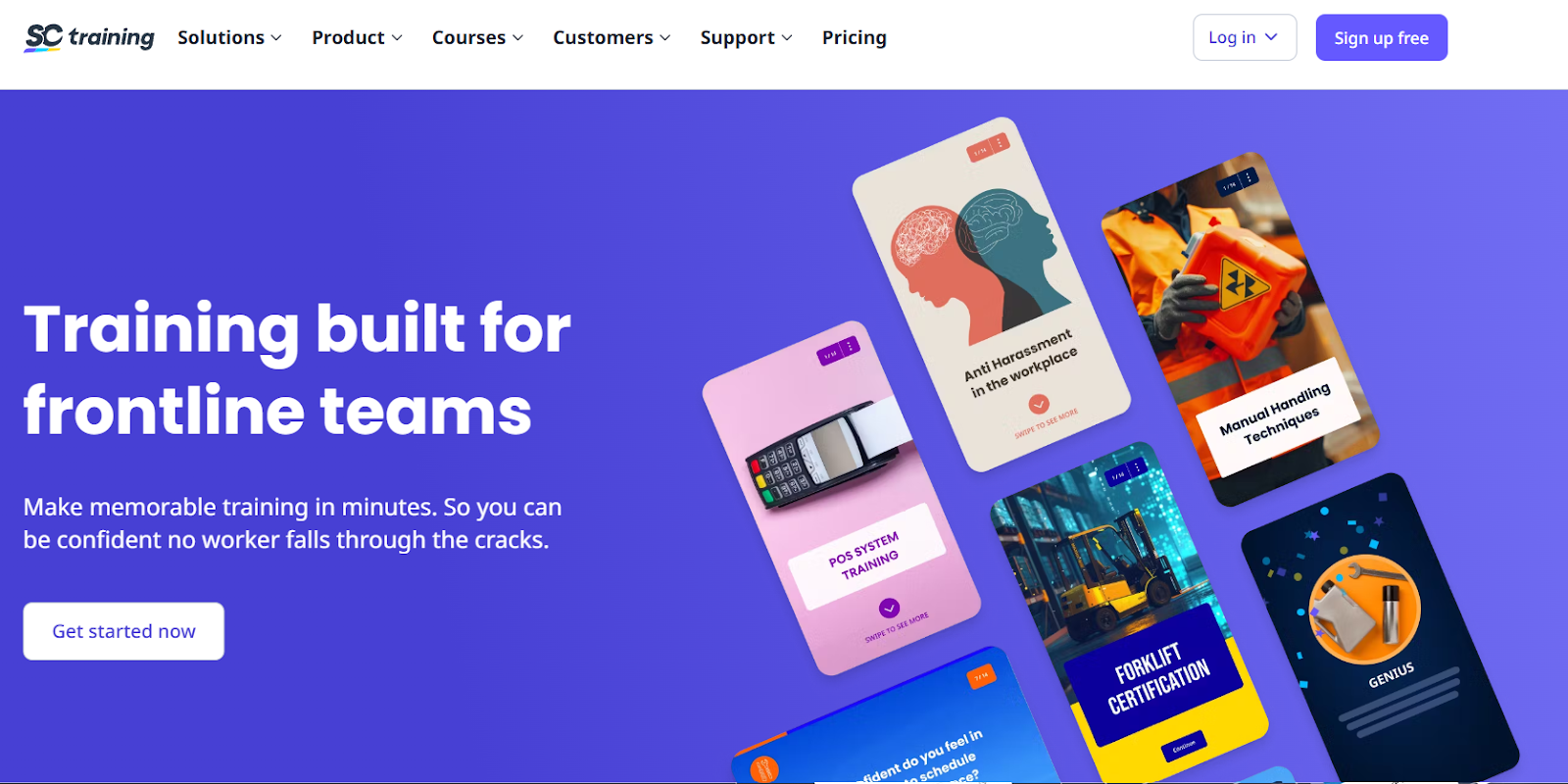
Best for: Nonprofits that want mobile-first, bite-sized learning with AI tools and a free plan for small teams.
Key features for nonprofits
- AI course builder: Quickly generate assignments, quizzes, and lessons using AI, saving time for lean teams.
- Editable course library: Access 1,000+ ready-made courses that you can adapt to your nonprofit’s needs.
- Mobile-first/microlearning design: Mini courses are available for mobile devices, making it easier for field staff or volunteers to learn in short bursts.
- Gamification and engagement tools: Features like leaderboards, spaced repetition, and peer learning help improve completion and interaction.
- Progress tracking and reporting: SC Training lets you see who has completed lessons, view quiz scores, and access analytics to guide training decisions.
- Multi-language and translation: Translate content into multiple languages using built-in AI translation, helpful for diverse teams.
Pricing
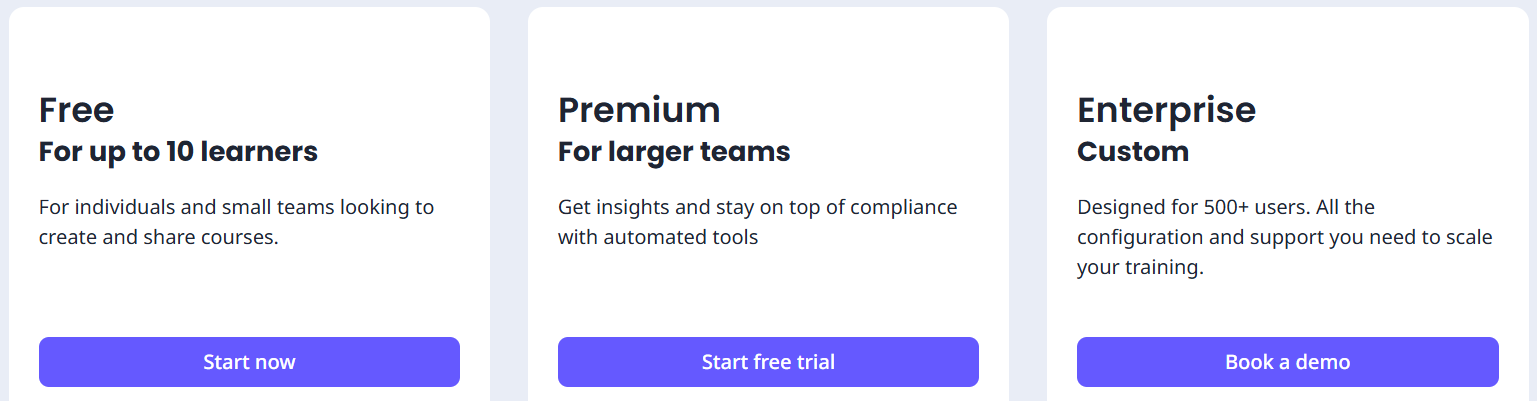
- The platform is free to use for up to 10 learners.
- Premium: For more than 10 learners, you will pay $5 per learner/month, billed annually. It also offers a 30-day free trial.
- Enterprise: SC Training offers custom pricing (for more than 500 users).
Pros
- Mobile-first design and gamification features help maintain learner interest and completion rates.
- The free option, up to 10 users, lets nonprofits pilot their training before paying.
- AI tools in the course creation speed up the process, and translation features make training accessible to multilingual teams.
- SC Training provides access to a vast library of over 1,000 pre-built courses covering compliance, safety, and leadership, which nonprofits can leverage.
Cons
- Some advanced capabilities (SSO, larger groups, deeper analytics) require upgrading to a higher plan.
- The platform charges $5 per learner for its premium plan, billed annually. If your nonprofit has many learners, costs can quickly scale up. For example, 200 learners × $5 = $1,000/month, which is $12,000/year. That might be too pricey for many nonprofits.
- Though the platform leverages AI for multiple capabilities, the AI-generated content may feel formulaic or not fully tailored, requiring edits and customization.
8. Google Workspace
Best for: Nonprofits looking for a free, straightforward platform for managing courses and assignments, especially in educational settings.
Key features for nonprofits
- Free access for eligible organizations: Nonprofits can use Google Classroom at no cost through Google Workspace for nonprofits, provided they meet eligibility criteria.
- Integration with Google Workspace: Users can easily integrate with tools like Gmail, Google Drive, Docs, and Meet, supporting collaboration and communication.
- Assignment management: Allows educators to create, distribute, and grade assignments efficiently, with options for attaching files, links, and videos.
- Customizable class organization: Users can organize classes by subject, grade, or any other criteria, tailoring the platform to their specific needs.
- Data security and privacy: The platform follows Google's strong security protocols, ensuring user data protection.
Pricing
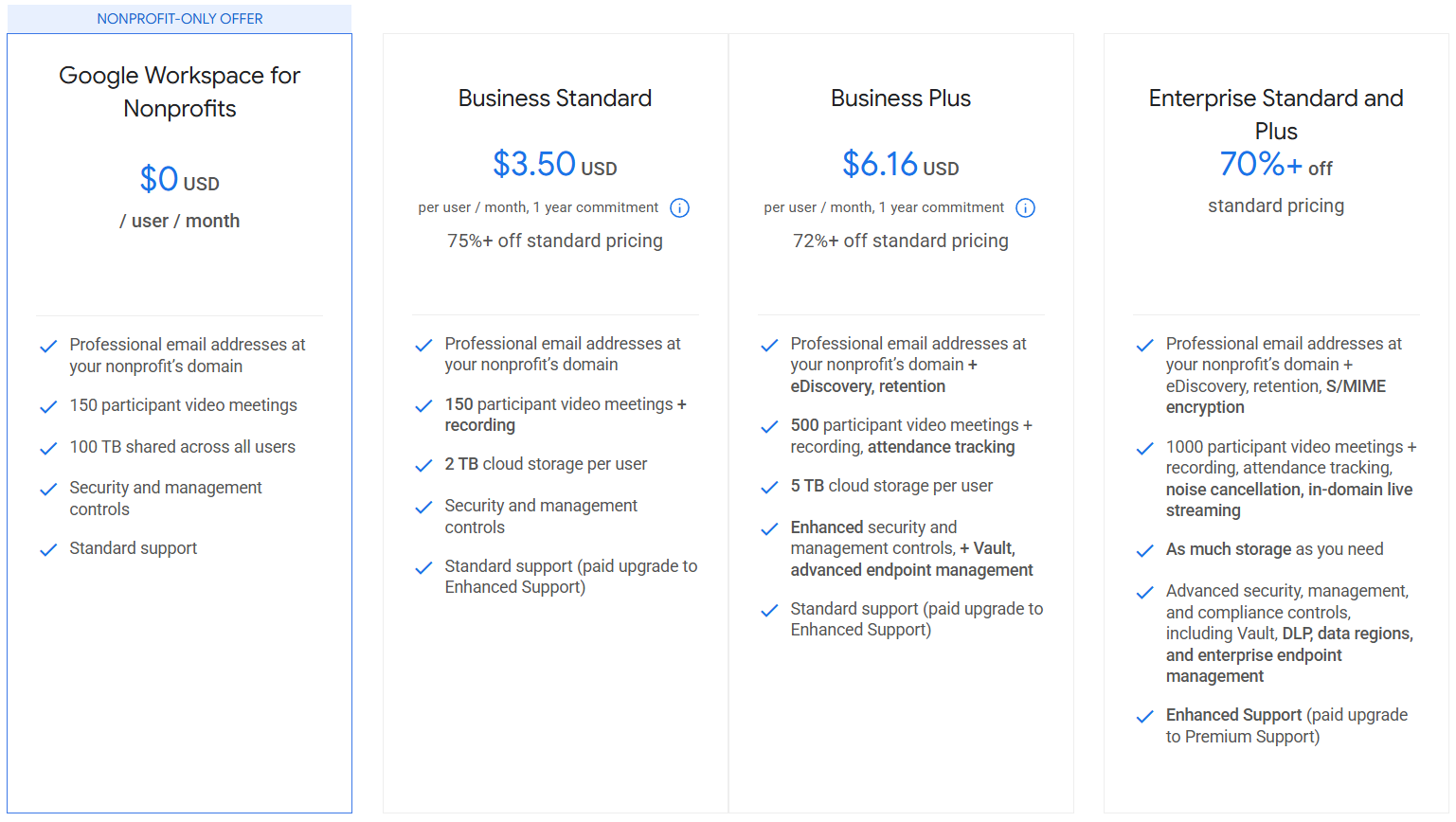
Google Workspace for nonprofits: Free for eligible organizations, providing access to Google Classroom and other productivity tools.
Google Workspace business plans: There are 3 pricing plans, and nonprofits can get discounted rates.
- Business Standard: $3.50 per user/month (1-year commitment).
- Business Plus: $6.16 per user/month (1-year commitment).
- Enterprise Standard and Plus: Custom pricing.
Pros
- The availability of mobile apps ensures that learning and teaching can continue outside the classroom.
- Suitable for both small teams and larger groups, adapting to the organization's needs.
- The easy connection with other Google services enhances productivity and collaboration.
Cons
- Some advanced functionalities, like automations, sales funnels, marketing tools, and workflows, may be lacking compared to specialized Learning Management Systems (LMS).
- While adaptable, Google Classroom is better suited to K-12 and higher education settings.
- The analytics and reporting features are relatively simple and may not meet the needs of all organizations.
9. OasisLMS
Best for: Nonprofits (especially associations and education providers) that run courses requiring certification, continuing education (CE), and revenue-generation alongside training.
Key features for nonprofits
- Flexible delivery modes: OasisLMS supports live, on-demand, or hybrid learning depending on your needs.
- Certification and CE compliance workflows: The platform helps automate issuing credentials, tracking continuing education credits, and managing accreditation.
- Quizzing and proctoring tools: OasisLMS offers secure, timed exams, auto-grading, AI proctoring, and review options.
- AI-generated quizzes: Users can automatically generate quiz questions from your course materials, such as PDFs or slides, helping you save time on assessments.
- Integrations (CRM/AMS, etc.): Connects with your existing systems to streamline workflows and data.
Pricing
OasisLMS does not provide a free trial or free plan. It has 3 pricing tiers:
- Standard: $1,000/month
- Professional: $2,000/month
- Enterprise: Custom pricing
The platform also offers a mobile app as an add-on, which costs $1,500/month for iOS and Android devices.

Pros
- OasisLMS automates workflows (enrollments, reminders) so staff spend less time on routine tasks.
- Organizations that require certification or CE credits find Oasis’s built-in compliance tools especially useful.
- The “wizard” import tool lets you upload video, PowerPoint, or other documents and get the content live quickly.
Cons
- The platform is expensive (Starting at $1,000/month), which can impact nonprofits on a limited budget.
- While basic use is intuitive, configuring advanced accreditation or multi-step learning paths can be complex.
- Its strength in CE and association markets means smaller NGOs without certification needs may find parts of its interface more than needed.
10. 360Learning
Best for: Nonprofits that want collaborative, social learning plus strong course authoring and analytics in one platform.
Key features for nonprofits
- Collaborative learning tools: Learners can comment, ask questions, and coach one another within courses.
- AI-powered authoring and improvement: 360Learning lets you use AI to help build courses, suggest improvements, and personalize content.
- Globalization and translation support: Translate courses, paths, widgets, and more for multilingual teams.
- Video and interactive question formats: The platform includes video pitches, screencast questions, and open-ended criteria within content.
- Multiple integrations: Works with tools like Zoom, Salesforce, and more to fit your existing stack.
Pricing
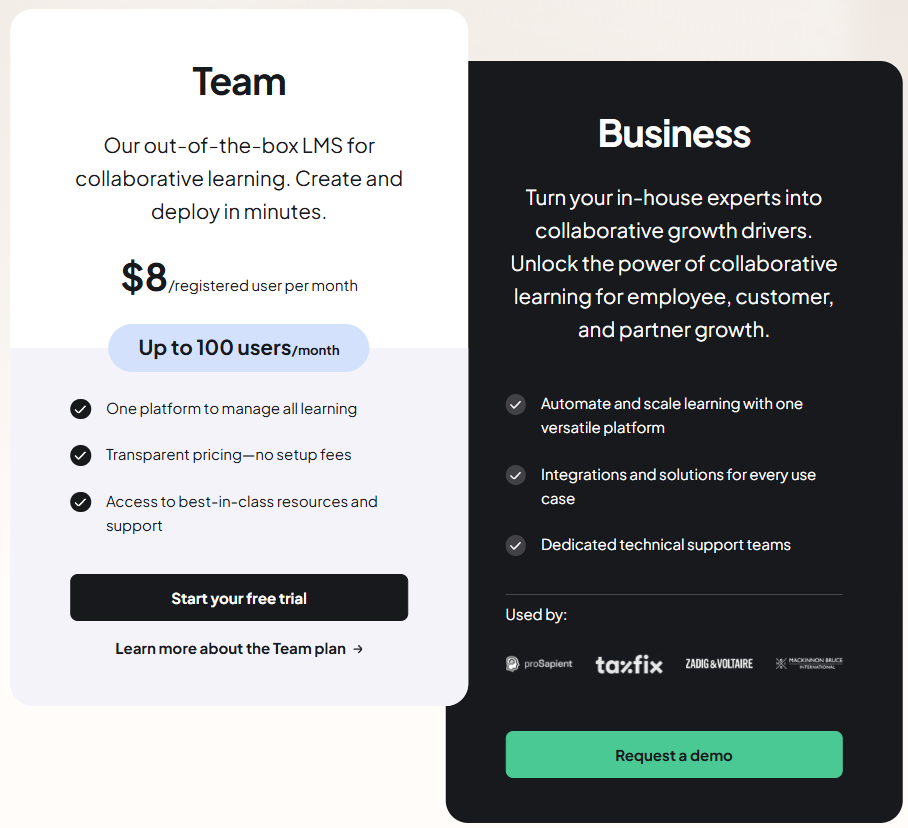
360Learning gives a 30-day free trial on its paid plans. Its pricing tiers are:
- Team: Costs $8 per registered user/month
- Business: Custom pricing.
Pros
- AI suggestions help refine content continuously without a heavy manual overhaul.
- The translation tools help nonprofit teams across regions use the same curriculum in their local languages.
- Tools like discussions, peer feedback, upvoting, and collaborative tasks help learners feel connected and encourage knowledge sharing.
Cons
- Paying per user can become expensive for large teams, especially without volume discounts.
- For nonprofits with modest training needs, the abundance of features might feel excessive and harder to manage.
- Users say there’s no shared library or central place to download all course materials; you often have to hunt through past lessons to find what you need.
Case Study: How nonprofits succeed with LMS
Let’s see how LMS platforms help nonprofits in the real world.
The organization:
Children's Home Society of Minnesota and Lutheran Social Service of Minnesota, collectively CHLSS, are nonprofit organizations dedicated to adoption services. For over a century, they have supported children and families by providing licensing, education, and preparation for foster care resource families, ensuring every child has a stable, loving home.
The challenge:
CHLSS needed a way to deliver pre-adoption training that was consistent, accessible, and flexible. Traditional in-person sessions were limited by geography and scheduling, making it difficult for prospective parents to attend. The organization sought a scalable solution that maintained high-quality education while reaching more families efficiently.
The solution:
CHLSS partnered with FreshLearn to move its pre-adoption education online. Using on-demand courses, live masterclasses, assignments, and interactive community features, families could learn at their own pace while engaging with peers and instructors. Certificates and structured programs ensured all educational requirements were met, creating a comprehensive learning experience.
The result:
FreshLearn supported CHLSS to expand its reach and improve engagement significantly:
- 60% more families served
- 75% fewer scheduling conflicts
- 90% course completion rate
- 85% higher participant satisfaction
Final Thoughts
Choosing the right LMS isn’t just about picking software; it’s about finding a platform that helps your organization save time, scale learning, and reach more people with your mission. The right LMS can turn training, volunteer onboarding, and community education into smoother, more consistent experiences for everyone involved.
Take the time to define your goals, understand your learners, and identify the features that truly matter for your nonprofit. Use the 6-step framework in this guide to evaluate platforms, identify those that meet your needs, and schedule demos to experience them firsthand.
FreshLearn makes course creation simple and effective, so mission-driven organizations can focus on delivering impact instead of managing software. Eventually, picking the right LMS lets your team, volunteers, and the communities you serve reach their full potential.
Want to know more about how FreshLearn can help? Sign up for free with us today.
FAQ
- What is the best free LMS platform?
Moodle is a widely used open-source LMS that offers extensive customization. However, it requires technical expertise for installation, hosting, and maintenance. For a more user-friendly alternative, FreshLearn offers a free plan that includes core features such as product creation, a blogging CMS, and email support, with no technical setup required.
2. What is the best software to use for a non-profit organization?
FreshLearn. Because it is easy to use and affordable, especially for non-profits. It offers a free plan and paid plans starting at $49 per month, making it accessible for organizations with limited budgets. The platform also supports course creation, live workshops, and digital downloads, all within a single platform.
3. What is the most affordable LMS?
FreshLearn offers a free plan with no monthly cost, allowing organizations to create and sell online courses, cohorts, live workshops, and even digital downloads. Paid plans start at $49 per month and include additional features such as advanced customization and access control. It also offers a 2-year commitment pricing plan, which further helps you save.
4. Is Google free for non-profits?
Yes, Google Workspace for Nonprofits is available at no charge to eligible organizations. It includes professional email addresses, video meetings, cloud storage, and collaboration tools. Additional features are available at discounted rates for nonprofits.
5. Can Microsoft Teams be used as an LMS?
While Microsoft Teams is primarily a collaboration tool, it can be integrated with LMS platforms like LMS365 to create a learning environment. Teams also supports features like Classwork and Class Teams, which can facilitate learning activities.
You might also like
- The Future of Learning Management Systems for SMBs
- 7 Top LMS Platforms For Church & Religious Organizations
- Why nonprofits should invest in LMS
- Why Universities Should Invest in LMS
- Why sales training should be online
- Mandatory training for every organization
- Why online training is good for employees
- Why Fintech companies should digitize training
- Why Employee Training Must Happen Online?!
Hosted by
