Top 10 Community Platforms For Creators In 2026

Last updated: September 30, 2026
Quick Answer
The right community platform depends on whether community is your product or an extension of something you already sell. Circle (from $89/month, billed annually) and Mighty Networks (from $79/month, billed annually) are the leading dedicated community platforms, and both charge a transaction fee on top of the subscription. BuddyBoss (from $299/year) suits WordPress owners who want to own their stack outright, while Bettermode (from $149/month billed yearly) targets businesses rather than individual creators. Free platforms like Facebook Groups, Discord, Reddit, and Slack cost nothing but give you no access to member email addresses, no white-labelling, and no native way to charge. FreshLearn bundles community with courses, checkout, and email from $41/month billed annually with 0% transaction fees, which fits creators whose community supports something they sell rather than standing alone.
Key Takeaways
- Circle's Professional plan costs $89/month billed annually and charges a 2% transaction fee; Business is $199/month at 1%, and Circle Plus is custom-priced at 0.5%.
- Mighty Networks' Launch plan costs $95/month, or $79/month billed annually, plus a 2% transaction fee; Scale is $215/month ($179 annually) at 1%, and Mighty Pro is custom-priced at 0.5%.
- Podia's Mover plan costs $42/month billed annually but charges a 5% transaction fee, the steepest percentage fee among the paid platforms here; Shaker ($84/month) and Earthquaker ($150/month) charge 0%.
- BuddyBoss's core Platform plugin is free; the Pro bundle with the theme costs $299/year, and the newer Plus bundle costs $349 for the first year, then $599 annually.
- FreshLearn charges 0% transaction fees on every plan, and its community features are included from the No Brainer plan ($79/month, or $59 billed annually) rather than the entry Pro tier.
- Bettermode's Starter plan costs $149/month billed yearly, and its Growth plan costs $1,500/month, a tenfold jump with nothing in between; it has no free plan and no native payments.
- Facebook Groups, Discord, Reddit and Slack do not give community owners access to member email addresses, which means you cannot contact your own members off-platform if the platform changes its rules.
- Neither Slack nor Reddit offers white-labelling. Slack lets you set a workspace name and icon, but the interface and domain stay Slack's; subreddits live on reddit.com under Reddit's branding and moderation rules.
Hey there, fellow creator.
Are you ready to build a community around your work and grow your online presence? We've got your back.
In this post, we've picked the ten best community platforms for creators, with pricing verified against each platform's own pricing page in September 2026. Where a platform's price or fee structure changed during the year, we've said so.
The platforms below are judged mainly on how well they serve creators who want to monetize their knowledge, using four parameters:
- Monetization. Can you charge subscription fees, tips, or one-time payments directly, and what does the platform take?
- Automation. Can you automatically enrol or remove members based on payments, course enrolments, or tags?
- White label. Can the community run on your domain with your logo and colours, or does it stay branded as the platform?
- Privacy and data ownership. Is the community visible to outsiders, and crucially, do you get your members' names and email addresses?
That last one separates the free platforms from the paid ones more than any feature list does.
Why Online Communities Matter for Creators
A community does three things for a creator business that content alone cannot.
It shortens the distance between you and the people who pay you. Members ask questions, show their work, and tell you what they're stuck on. That feedback is the cheapest product research you will ever get.
It improves retention. People stay subscribed to a place where they know other people. A course finishes; a community does not.
It makes members into advocates. Peer answers reduce your support load, and members who feel known refer others without being asked.
The caveat worth stating up front: a community is a commitment, not an asset you launch and leave. An empty forum is worse than no forum, because it signals abandonment. Before choosing a platform, be honest about whether you can show up in it several times a week.
Comparison Table: Community Platforms at a Glance
Top 10 Online Community Platforms of 2026
1. FreshLearn
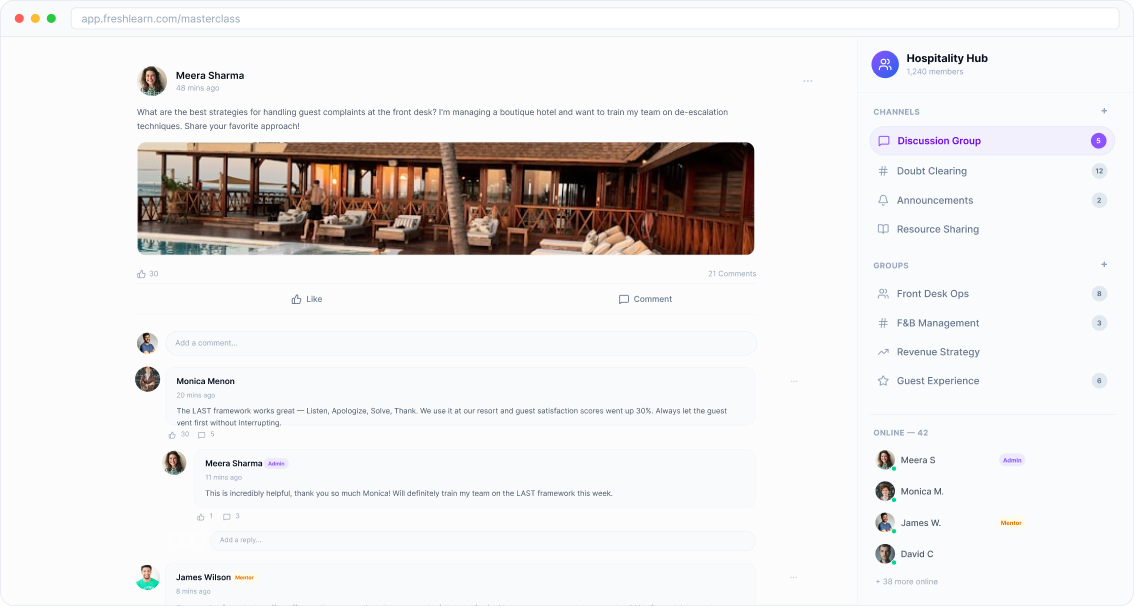
FreshLearn is a platform for creators to build and monetize online courses, and its community features sit alongside those courses rather than standing on their own.
That framing matters when you're choosing. If your community exists to support a course, a cohort, or a paid membership you already sell, having it in the same place as your checkout, your email, and your content removes an entire tool from your stack. If community is your product, a dedicated platform will go deeper.
Key features
- Monetization of community. Accept payments from members through Stripe, PayPal, or Razorpay, with 0% platform transaction fees on every FreshLearn plan, including the free one. You keep everything except standard payment processing.
- Automation. Members enrolled in a course can be granted access to specific groups automatically, based on rules you set, so you're not moving people between lists by hand.
- Privacy and data ownership. You get your members' names and email addresses, and you can moderate and control the space directly.
- Ease of platform. Create both free and paid communities, and let members enrol and participate.
- White-label the community. Connect your own domain and apply your brand's colours and logo, so the community reads as yours rather than as a platform you rent.
- Mobile-friendly. The community works on smartphones and tablets, with branded mobile apps available on higher tiers.
Pros
- One place for community, courses, checkout, and email, which removes the need to pay for and connect a separate community tool
- 0% transaction fees, unlike every other paid platform in this comparison except BuddyBoss
- Members can share documents, tools, and templates, and find each other through profiles
Cons
- FreshLearn's community is a feature of a course platform, not a standalone community product. If you want member directories, native live streaming, or the depth of moderation and discovery tooling that Circle and Mighty Networks are built around, those platforms go further.
- Community features require the No Brainer plan rather than the entry-level Pro plan, so budget accordingly if community is the reason you're signing up.
Pricing
FreshLearn offers a free plan, and paid plans priced at $49/month for Pro ($41 billed annually, $35 billed every two years), $79/month for No Brainer ($59 annually, $49 biennially), and $149/month for No Brainer+ ($119 annually, $99 biennially). Community features are included from the No Brainer plan onward. All plans carry 0% transaction fees.
2. Facebook groups

Talking about online communities and leaving out Facebook Groups would not be fair. Groups are genuinely good at bringing people together around shared interests, and the barrier to starting one is close to zero.
Key features
- Monetization of community. Facebook does not charge members to join a group, and there is no native subscription billing for creators to rely on. Any paid access has to be handled outside Facebook and enforced manually.
- Automation. Enrolment can be partly automated using third-party tools that integrate with Groups, or Messenger bots for onboarding messages.
- Privacy and data ownership. This is the critical limitation: as a group owner, you do not get members' email addresses or contact details. Facebook keeps that data. If your group is removed or Facebook changes its rules, you have no way to reach the audience you built.
- Ease of platform. Free, familiar, and quick to set up.
- Mobile-friendly. Native iOS and Android apps.
Pros
- Almost everyone already has an account, so joining takes a couple of clicks
- Free to create and run, with no platform costs
- Simple built-in tools for posts, scheduling and events
Cons
- Requires constant monitoring of membership requests, posts and comments
- Managing membership at scale is laborious
- Discussion quality is hard to control in large groups
- You never own the member relationship, which makes it a risky place to build a business
Pricing
Free.
3. Bettermode
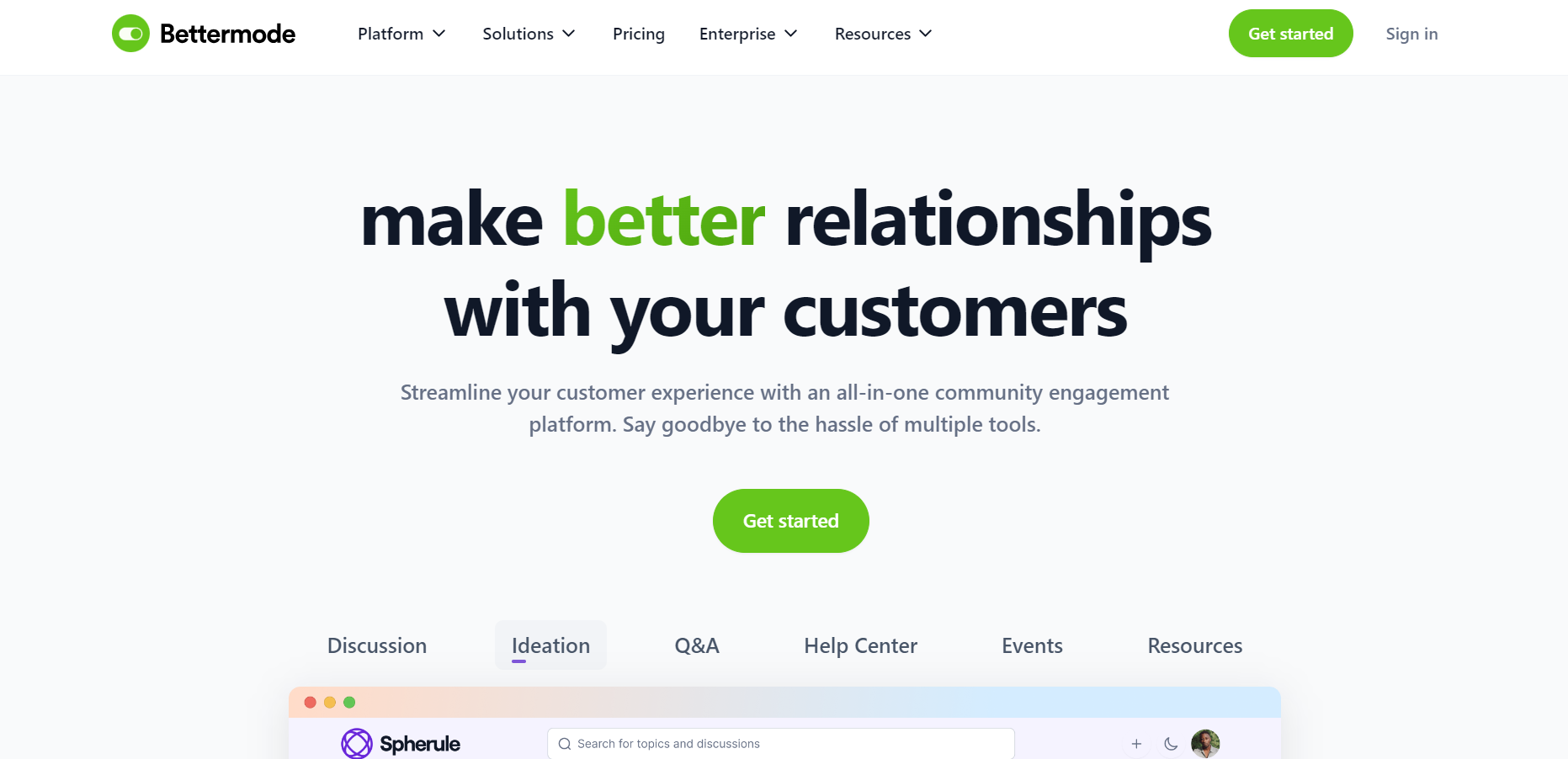
Bettermode is a highly customizable community platform aimed at companies and creators launching branded communities. Communities can be public or private, and can run standalone or embedded inside a product or website.
In practice, it is positioned at businesses, particularly SaaS companies building customer communities, rather than at individual creators.
Key Features
- Monetization of community. Bettermode has no native payments, checkout, or subscription billing; none appear anywhere in its plan comparison. It is built as a branded community layer rather than a creator storefront, so charging for access means running billing through a separate system.
- Automation. You can automate enrolment and member management based on actions such as payments and course enrolments, including automatically adding members upon payment and generating reports on member progress.
- Privacy. A built-in filter automatically flags posts containing offensive language, which helps with moderation at scale.
- Ease of platform. An all-in-one platform intended to reduce the number of separate tools a support or community team needs.
- White-label the community. You can remove Bettermode branding entirely and use your own domain, logo, and email address.
- Mobile-friendly. The platform is mobile-responsive.
Pros
- Deep customization, which is its main draw over simpler platforms
- Suits businesses and organizations building customer or user communities
- Clean interface that is straightforward to navigate
Cons
- Expensive relative to creator-focused platforms: its entry tier costs more than any other paid platform here, and the next tier up is ten times that
- Analytics are frequently described as the weakest part of the product
- Reviewers consistently note the lack of a native mobile app
Pricing
Bettermode has three tiers, confirmed against its own pricing page. Starter costs 149/month billed yearly ($1,788/year) or $199/month billed monthly, and covers up to 10,000 members and 5 collaborators. Growth costs 1,500/month billed yearly ($18,000/year) or $1,750/month billed monthly, and covers up to 25,000 members and 10 collaborators. Premium is custom-priced for 100,000+ members. There is a 14-day trial with no credit card required, and no free plan.
Worth planning around: the jump from Starter to Growth is tenfold, from $149 to $1,500 a month. There is nothing in between, so the features gated to Growth (AI search, full API and webhooks, sender email customization) effectively cost $16,000 a year more.
4. Circle
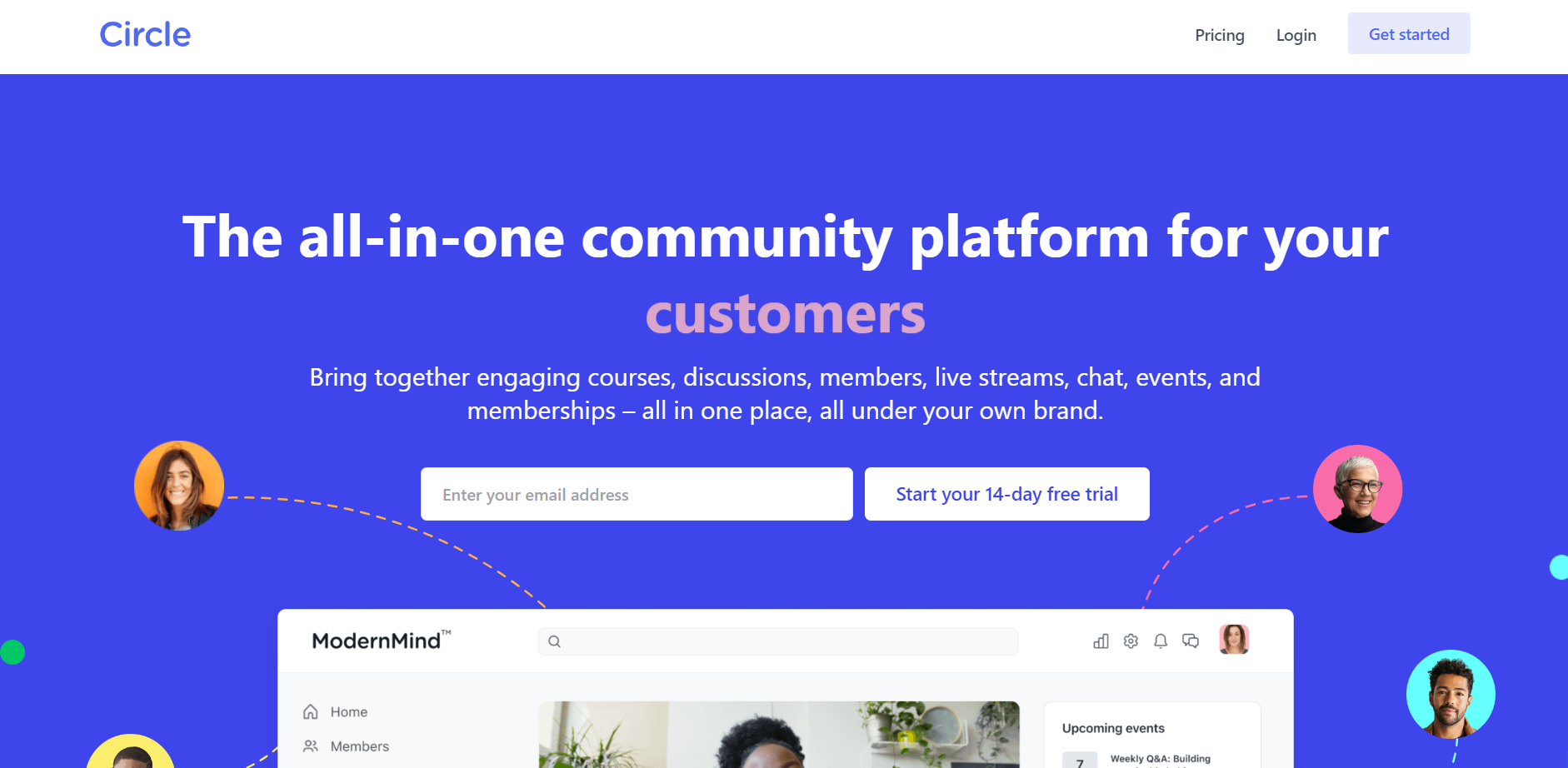
Circle is a dedicated community platform built for creators who want to gather members around their content, run discussions, and build a paying subscriber base. Alongside discussions, members can message each other directly.
If community is the product rather than a companion to one, Circle is the most established option in this list.
Key features
- Monetization of community. Creators can charge a membership fee, with payments handled in-platform. Circle charges a transaction fee on top of the subscription: 2% on Professional, 1% on Business, and 0.5% on Circle Plus, on top of standard payment processing.
- Automation. You can trigger automations when a tag is added to a member, and welcome new members automatically on signup.
- Privacy. Private spaces are restricted to invited members; non-members can only view or comment after joining.
- Ease of platform. You own your member relationships, including their contact details, which is the main structural advantage over Facebook or Discord.
- White-label the community. Circle supports white-labelled email notifications by configuring DNS records on your domain, alongside custom branding.
- Integrations. Connects to thousands of applications through Zapier, with analytics for tracking growth and engagement.
Pros
- Polished, approachable interface that members pick up quickly
- Broad integration support through Zapier
- Detailed analytics on community growth and activity
Cons
- Expensive relative to alternatives, and useful capabilities are often add-ons that accumulate
- Transaction fees apply on every plan, which is easy to miss because they are not shown on the pricing page
- Weaker fit if you are primarily a course creator, since course functionality is thinner than on dedicated course platforms
Pricing
Circle's Professional plan starts at $89/month billed annually, Business at $199/month, and Circle Plus is custom-priced (typically starting around $360/month). Its Email Hub add-on is free under 100 contacts and starts at $19/month beyond that.
5. BuddyBoss
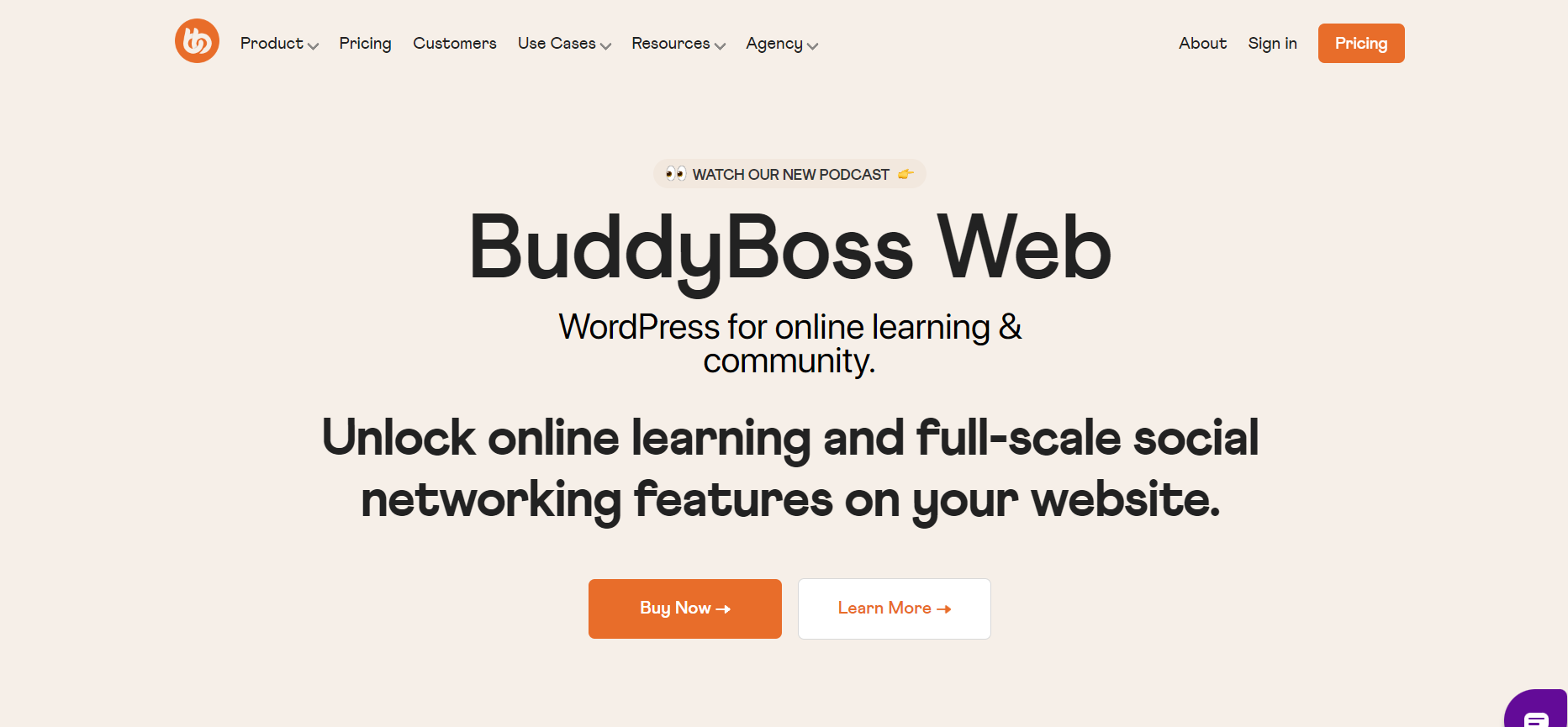
BuddyBoss is a WordPress-based platform for building online communities. It lets you sell memberships and courses, run internal training, launch a branded mobile app, and keep everything on infrastructure you control.
Key features
- Monetization of community. Integrates with WooCommerce and similar tools to charge a one-time joining fee or recurring subscription, and to gate member-only content. Because payments run through your own gateway, BuddyBoss itself takes no cut of your revenue.
- Automation. Integrates with major automation plugins, letting actions in your community trigger workflows across 100+ tools.
- Privacy. Built-in GDPR setup and cookie consent give members control over how their data is collected and used.
- Ease of platform. Fully customizable to your brand, with direct messaging, unlimited groups and events.
- White-label the community. As a self-hosted, open-source-based solution, it can be tailored completely to your project.
- Mobile-friendly. Web and mobile synchronize in real time, with a separately priced branded app product.
Pros
- Live notifications keep members up to date on activity
- Groups, events and gamification tools out of the box
- Extensive design control over the look and feel of your community
- You own your data, your hosting and your member relationships outright
Cons
- Steep learning curve for beginners, and you are responsible for hosting, updates, and security
- Renewal pricing is significantly higher than the first-year price on the Plus bundle, which is easy to miss at purchase
Pricing
The core BuddyBoss Platform plugin is free. The Pro bundle, which adds Platform Pro and the BuddyBoss Theme, costs $299/year. The newer Plus bundle costs $349 for the first year and then $599 annually, and adds gamification and media offloading. The branded mobile app is a separate product at additional cost. BuddyBoss offers a 14-day money-back guarantee.
6. Mighty Networks
Mighty Networks brings community, courses, content, and commerce together. Its Spaces blend live streaming, events, courses, forums, messaging, and written and video content.
Key features
- Monetization of community. You can run your network free or charge a monthly or annual subscription. Mighty Networks takes a transaction fee on paid plans: 2% on Launch, 1% on Scale, and 0.5% on Mighty Pro.
- Automation. Works standalone or inside your stack, with Zapier connectors for onboarding sequences, CRM syncing, and sales funnels.
- Privacy. Private networks are discoverable but require an invitation or approved request. Secret networks are invitation-only and stay hidden entirely.
- Ease of platform. Straightforward to start, with little learning curve for end users.
- White-label the community. Full white-labelling, including your own iOS and Android app, comes with Mighty Pro.
- Mobile-friendly. iOS and Android apps, with a custom-branded app available on Mighty Pro.
Pros
- Member profiles with interests and preferences
- Group direct messaging alongside individual messaging
- Event management for both virtual and in-person events
- Supports mastermind and small-group formats within the wider community
Cons
- Charges a transaction fee on all paid plans
- No live chat support, so troubleshooting runs through email
- White-labelling requires Mighty Pro, which is custom-priced and a significant step up from the self-serve tiers
Pricing
Mighty Networks restructured to three tiers. Launch costs $95/month, or $79/month billed annually, with a 2% transaction fee. Scale costs $215/month, or $179/month billed annually, with a 1% fee. Mighty Pro is custom-priced with a 0.5% fee and adds branded apps.
7. Podia
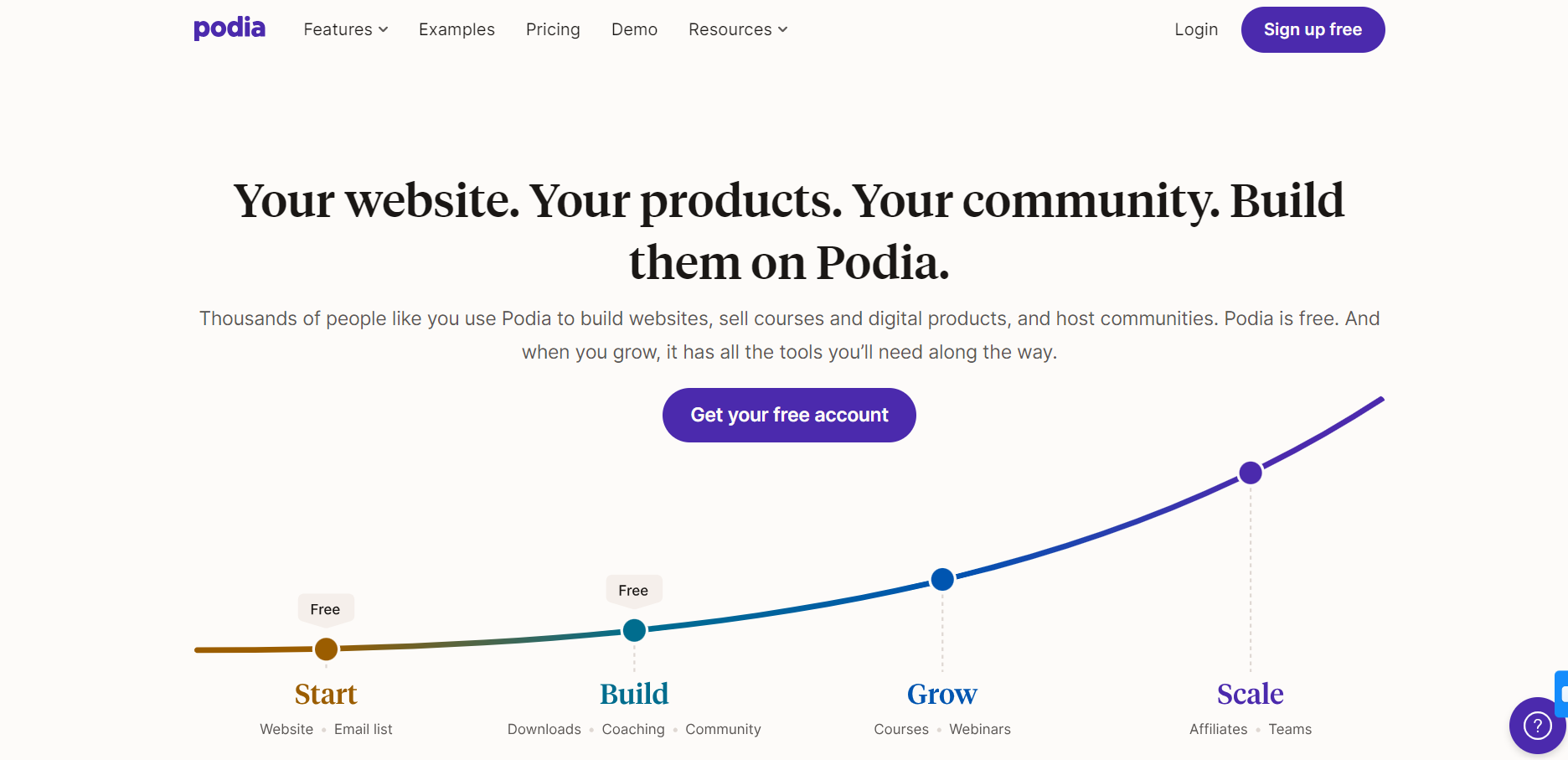
Podia lets creators build and sell online courses, memberships, and digital downloads, with community features alongside them. Members can join discussions tied to the products they've bought.
Key features
- Monetization of community. Take payments directly from supporters, with a dedicated space for updates and rewards. Podia's Mover plan charges a 5% transaction fee; Shaker and Earthquaker charge 0%.
- Automation. Automatic enrolment onboards members into your products without manual steps.
- Privacy. Public topics are visible to all members, private topics only to invited members, and closed topics only to members on a particular plan.
- Ease of platform. Supports both free and paid communities, with customer support tools built in.
- White-label the community. Available on higher plans, letting you rebrand the community to match your own site.
- Mobile-friendly. Works well across devices, though there is no dedicated mobile app.
Pros
- Flexible monetization alongside content and engagement
- Private topics work well for cohorts and mastermind groups
- Digital products integrate directly, so community members get resources in the same place they learn
Cons
- Not the right fit if you want to build custom tools around your business
- The Mover plan's 5% transaction fee is the steepest percentage fee among the paid platforms here, and Podia introduced product and video caps in its June 2026 relaunch
Pricing
Podia rebuilt its platform and repriced in June 2026. Mover costs 42/month billed annually ($49 monthly) with a 5% transaction fee and caps of 50 products and 500 videos. Shaker costs 84/month billed annually ($99 monthly) with 0% fees and higher caps. Earthquaker, a new top tier, costs 150/month billed annually ($179 monthly) with unlimited products and videos.
8. Slack
Slack is a business messaging app designed to facilitate seamless communication and connect individuals with the information they require.
By fostering collaboration and enabling unified teamwork, Slack revolutionizes organizational communication and enhances productivity within companies.
Key features
- Monetization of community. Slack has no native payment or subscription functionality. Charging for access means handling billing elsewhere and managing invitations manually.
- Automation. Automates routine workflows, with a large library of integrations.
- Privacy. Strong security controls including single sign-on, domain claiming and enterprise mobility management support.
- Ease of platform. Excellent real-time communication with a familiar interface.
- White-label the community. Slack does not offer white-labelling. You can set a workspace name and icon, but the interface, apps, and domain remain Slack-branded.
- Mobile-friendly. Full-featured mobile apps for iOS and Android.
Pros
- Many professional audiences already use it daily, lowering the barrier to participation
- Free tier makes it easy to start
- Large ecosystem of integrations
Cons
- Limited native moderation tooling for community managers
- No native monetization
- Paid plans are priced per user per month, not as a flat community fee, so costs scale directly with membership. This is the single biggest reason Slack suits small professional networks rather than large creator communities.
- The free plan limits message history, which means older discussions become inaccessible
Pricing
Free plan available. Paid plans are priced per user per month, which makes Slack's economics fundamentally different from every other platform in this list; check Slack's current pricing page for the exact per-seat rate in your region.
9. Discord
Discord, a widely adopted platform, has gained immense popularity among gamers as a dedicated space for online connection and engagement.
Additionally, Discord offers the ability to join larger servers, facilitating networking opportunities and enabling communities to thrive in a shared environment.
Key features
- Monetization of community. Server Subscriptions let you charge members a monthly fee for access to perks and exclusive channels. Discord takes a platform fee on these subscriptions, so check the current rate before building a paid server around it.
- Automation. Bots handle moderation, role management, and interactive features.
- Privacy. Secure, though misconfigured permissions are a common risk. Setting permissions by category rather than per channel reduces mistakes.
- Ease of platform. Community discovery through tags, categories and search helps people find servers relevant to their interests.
- White-label the community. Discord does not offer white-labelling. You can create customized welcome screens with your own messaging and guidelines, but the platform remains Discord-branded.
- Mobile-friendly. Full mobile apps for iOS and Android with text, voice, screen sharing, and file sharing.
Pros
- Integrates with tools like Patreon, Twitch, YouTube, and Zendesk
- Free to create and run a server
- Strong real-time community management features
Cons
- Member anonymity can complicate moderation
- A 2,000-character message limit constrains longer-form discussion
- The informal interface is a poor fit for most B2B audiences
- You do not get member email addresses, so the audience is not portable
Pricing
Free to create and run a server. Optional paid features exist for members, and Server Subscriptions carry a platform fee for creators.
10. Reddit
Reddit is a social networking site that enables anyone to start and run their own community, or "sub-reddit," as Reddit refers to it.
It serves as a social aggregation site where users can curate content they discover online or create themselves, fostering a community-driven experience of sharing and organizing materials.
Key features
- Monetization of community. Reddit offers no native way for a subreddit moderator to charge for access. Some subreddits gate content informally, but there is no built-in subscription billing for community owners.
- Automation. Bots handle welcome messages, polls, and scheduled posts, alongside Reddit's own moderation standards.
- Privacy. You can control whether posts are public or restricted to community members.
- Ease of platform. Reddit's strength is genuinely active niche communities and the discovery that comes with them.
- White-label the community. Reddit does not offer white-labelling. Subreddits live on reddit.com, under Reddit's branding, design and moderation rules, and cannot be moved to your own domain.
- Mobile friendly. Mobile apps for iOS and Android, plus a mobile-optimized site.
Pros
- Reddit offers a simple and intuitive user interface, making it particularly accessible for beginners
- By adhering to proper etiquette and actively engaging in relevant communities, businesses can leverage Reddit as a platform to build brand awareness and establish meaningful connections.
- Posting compelling and relevant content on Reddit has the potential to rapidly increase traffic to external websites or resources
- People from diverse backgrounds and professions can participate in open discussions, contributing their perspectives and engaging in thoughtful debates.
Cons
- It can be a time sink, meaning it can be highly addictive and consume a significant amount of time.
- It has a non-regulatory environment. While the platform has moderation standards and guidelines, the enforcement can vary across different subreddits.
- No member data, no white-labelling and no native monetization, which makes it a marketing channel rather than a community you own
Pricing
Free.
Final Verdict
There is no single best community platform, only the right fit for what you're building.
If community is your product, Circle and Mighty Networks are the strongest dedicated options, and you should factor their transaction fees into your pricing rather than looking only at the monthly cost.
If you own a WordPress site and want full control, BuddyBoss gives you ownership of your data and infrastructure for a predictable annual fee, provided you're comfortable maintaining it.
If you want reach rather than ownership, Facebook Groups, Discord and Reddit cost nothing and put you where people already are. Just go in knowing you cannot take those members with you.
If your community supports courses or products you already sell, FreshLearn puts community, courses, checkout, and email in one place with 0% transaction fees, which removes a tool from your stack and a fee from every sale. It is not the deepest standalone community product here, and if community alone is the business, the dedicated platforms above will serve you better.
FAQs
1. Which community platform is cheapest for creators?
Facebook Groups, Discord, and Reddit are free, but none of them give you member email addresses or let you charge natively. Among paid platforms, Podia's Mover plan is the lowest monthly cost at $42 billed annually, though its 5% transaction fee makes it more expensive than it looks once you're selling. BuddyBoss is cheapest over a year at $299 if you already run WordPress and can maintain it yourself.
2. Which platforms charge transaction fees on top of the subscription?
Circle (2% on Professional, 1% on Business, 0.5% on Circle Plus), Mighty Networks (2% on Launch, 1% on Scale, 0.5% on Mighty Pro), and Podia (5% on Mover, 0% above it) all charge a percentage of your revenue on top of the monthly fee. Discord charges a platform fee on Server Subscriptions. FreshLearn charges 0% on every plan, and BuddyBoss takes nothing because payments run through your own gateway. On $3,000 a month in member revenue, a 2% fee costs $720 a year.
3. Can I take my members with me if I switch platforms?
Only from the paid platforms. Circle, Mighty Networks, Podia, BuddyBoss and FreshLearn all give you your members' names and email addresses, so you can export and migrate them. Facebook Groups, Discord, Reddit and Slack do not, which means the audience you build there stays there. This is the single most important difference between the free and paid options, and it is worth more than most feature comparisons.
4. What does white-labelling actually get me?
A white-labelled community runs on your domain with your logo and colours, so members experience it as your product rather than as a third-party tool. FreshLearn, Circle, BuddyBoss and Bettermode all support it. Mighty Networks reserves full white-labelling, including branded mobile apps, for its custom-priced Mighty Pro tier. Slack, Discord, Reddit and Facebook Groups do not offer it at all.
5. Should I use a dedicated community platform or one bundled with courses?
If your revenue comes from community membership itself, use a dedicated platform: Circle and Mighty Networks are built around discovery, member profiles, events and moderation in ways bundled tools are not. If your community exists to support courses, cohorts or digital products you already sell, a bundled platform like FreshLearn or Podia removes a subscription and keeps members, content and payments in one system. The question is not which is better, but which is the product.
6. How much time does running a community actually take?
More than most creators expect, especially at the start. An empty or quiet community actively damages your brand, so plan to seed discussions, respond daily in the early weeks, and set a posting rhythm before you launch. Automation helps with enrolment and onboarding, but not with the part that makes a community work, which is you showing up.
You might also like
Hosted by