
Moodle Pricing: What It Actually Costs (Self-Hosted, MoodleCloud & Workplace)

Last updated: August 14, 2026
Quick Answer
Moodle's software is free and open-source (no license fee), but running it is not free. There are three paths, each with very different costs: self-hosted Moodle (free software, but you pay for hosting, maintenance, and staff time, often $1,000 to $6,000 per year for small deployments and far more with dedicated staff); MoodleCloud (Moodle's managed hosting, with paid plans from $170 to $2,120 per year for 50 to 750 users, and no permanent free plan anymore); and Moodle Workplace (enterprise, custom-quoted through partners, typically tens of thousands to $150,000+ per year). What you'll actually pay depends far more on hosting, support, and setup than on the software itself.
Key takeaways
- The Moodle software license is free under the GNU GPL. Your real spend is hosting, support, plugins, and labor.
- MoodleCloud removed its permanent free plan; it now offers a free trial, with paid tiers starting at $170 per year for up to 50 users (Starter).
- MoodleCloud caps at 750 users and allows no custom plugin installation on any tier, which is its biggest limitation. Selling courses via its built-in Stripe integration is only available from the Small tier ($500/year) upward; Starter and Mini cannot sell courses at all.
- Self-hosted Moodle is "free" only in license; realistic total cost runs from about $1,000 per year for a small stack to $19,000 to $76,000+ per year once you count dedicated admin time.
- Moodle Workplace (multi-tenancy, advanced reporting, SLAs) is custom-priced, typically $50,000 to $150,000+ per year for enterprise deployments.
- For an individual creator who wants to sell courses rather than run institutional training, Moodle's hidden costs, and its selling restrictions even on MoodleCloud, often make a hosted creator platform cheaper once your own time is counted.
How we approached this
This guide breaks down what Moodle costs across all three deployment paths and quantifies the hidden costs that most pricing pages skip. Figures are verified against Moodle's own pricing and recent public sources, and noted as August 2026 snapshots because Moodle bills in local currency and adjusts prices over time. Where a number is a real-world estimate (like staff time), we say so and cite the basis.
Why Moodle Pricing Is Confusing
Moodle is open-source, so the software itself is free to download under the GNU General Public License. That headline ("Moodle is free") is true but misleading, because the software is only one line in the budget. As one widely cited principle in Moodle costing puts it: the software is free; your spend is hosting, support, and one-time setup work.
There are three distinct ways to run Moodle, and they cost wildly different amounts:
- Self-hosted Moodle (you host and manage it)
- MoodleCloud (Moodle hosts and manages it for you)
- Moodle Workplace (the enterprise edition, via certified partners)
Here's what each actually costs.
1. Self-Hosted Moodle: Free Software, Real Costs
Self-hosted Moodle is the "free" version. You download the software at no cost and run it on your own infrastructure. The license genuinely costs nothing. Everything around it does.
- Hosting and infrastructure. You need a server, storage, and bandwidth. A small deployment on a mid-tier cloud instance plus storage and data transfer realistically runs $40 to $200+ per month depending on size and traffic, with costs spiking during peak usage (exam periods, course launches). Small self-hosted stacks commonly land in the $1,000 to $6,000 per year range for infrastructure alone.
- Staff and technical labor (the big one). This is the cost most "Moodle is free" claims ignore. Someone has to install, configure, secure, update, back up, and troubleshoot the platform. Independent total-cost analyses estimate self-hosted Moodle requires roughly 0.25 to 1.0 full-time staff equivalent, which translates to somewhere between about $19,000 and $76,000 per year in labor depending on deployment size. If you outsource to a developer or certified partner instead, you pay their rates.
- Plugins and customization. Moodle's core covers the basics, but many real-world needs require plugins. Many are free; premium or custom plugins typically run $500 to $5,000+, and custom themes commonly cost $500 to $3,000. Specific examples of paid plugins that fill common gaps include premium form builders, advanced media/assessment tools, and verified credentialing tools, each adding annual cost.
- Maintenance and security. Updates, security patches, and plugin-compatibility testing are ongoing. Skipping them is a security risk; doing them properly is recurring time or money.
Best for: organizations that need full control and customization and have genuine technical resources (or budget for a partner). It rewards scale and in-house expertise; it punishes solo operators and small teams without IT support.
2. MoodleCloud: Managed Hosting With Tiered Pricing
MoodleCloud is Moodle's own managed hosting. Moodle runs the infrastructure, handles updates and security, and you pay an annual subscription. It removes the hosting and maintenance burden in exchange for less control.
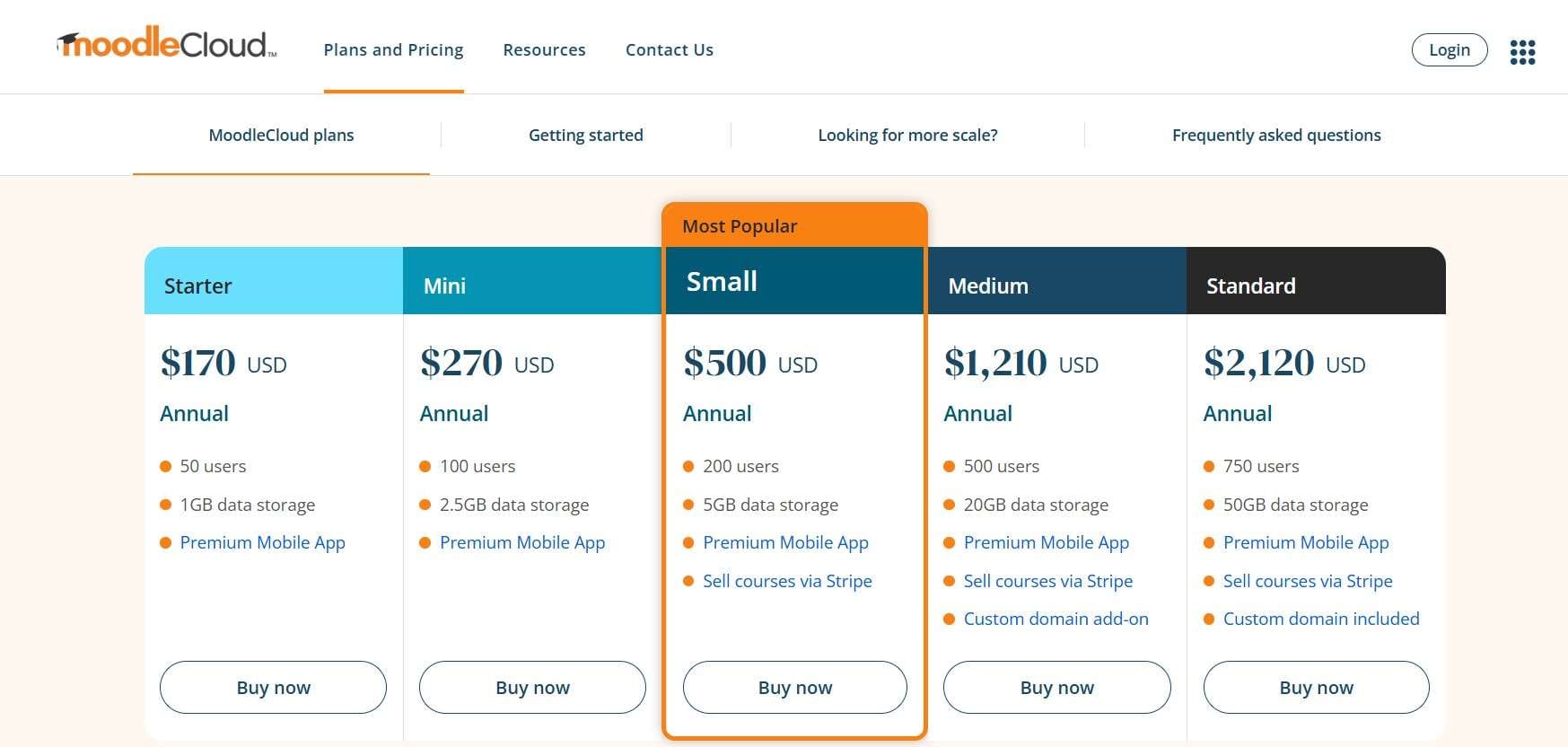
Pricing: MoodleCloud offers five tiers that share the same core features but differ by user count, storage, and whether course selling is enabled:
- Starter: $170/year, 50 users, 1 GB storage. No course selling.
- Mini: $270/year, 100 users, 2.5 GB storage. No course selling.
- Small: $500/year, 200 users, 5 GB storage. Adds the ability to sell courses via a built-in Stripe integration, the first tier where this is available.
- Medium: $1,210/year, 500 users, 20 GB storage. Sell courses via Stripe; custom domain available as a paid add-on. Widely considered the value sweet spot for mid-size organizations without IT infrastructure.
- Standard: $2,120/year, 750 users, 50 GB storage. Sell courses via Stripe; custom domain included at no extra cost.
Prices are billed annually and in local currency (originally set in AUD), so the exact figure you see varies by region and exchange rate; confirm current pricing on Moodle's site. (Prices are as last shown in August 2026 on Moodle's website)
An important change: MoodleCloud no longer offers a permanent free plan. It now provides a free trial only, after which a paid plan is required. Older guides that mention a free MoodleCloud tier are out of date.
The three big limitations:
- No custom plugins on any tier. This is MoodleCloud's defining constraint. If you need specialized functionality (custom grading, proprietary integrations, advanced reporting), you cannot install it on MoodleCloud. You would need to move to self-hosted Moodle or Moodle Workplace.
- A hard cap of 750 users. Once you approach that ceiling, MoodleCloud stops being an option, and you face a migration decision.
- No course selling on the two cheapest tiers. Starter and Mini have no built-in way to charge for a course; that capability only turns on at Small and above.
Best for: small to mid-size organizations (roughly 100 to 500 users) that prioritize fast setup over deep customization and don't need custom plugins.
3. Moodle Workplace: Enterprise, Custom-Quoted
Moodle Workplace is the enterprise edition, built for corporate training with features standard Moodle and MoodleCloud lack: multi-tenancy, automated reporting, custom certifications, dynamic rules, and dedicated support.
Pricing: custom-negotiated through Moodle Certified Partners. There's no public price list. Independent analyses put enterprise Workplace deployments in the range of tens of thousands to $150,000+ per year, depending on user count, support SLAs, and hosting. For large organizations needing 24x7 support and hosting, all-in figures commonly land in the $4,500 to $6,000 per month range.
Best for: large enterprises and institutions with complex training needs, compliance requirements, and the budget to match.
Moodle's Mobile App Costs
Moodle's branded mobile app is a separate cost worth knowing about. The standard Moodle app has a free tier, with paid tiers (Pro and Premium) that unlock more push-notification capacity, offline features, and customization, plus a fully branded app at custom pricing. Institutions hosting with MoodleCloud or a certified partner typically receive the premium app tier at no additional cost, which means, in practice, it's mainly self-hosted operators who pay separately for advanced app features. Confirm current app tier pricing on Moodle's site, as these figures change.
Moodle Total Cost of Ownership: The Honest Summary
The pattern is consistent: Moodle's cost lives in hosting, labor, and customization, not the license. It rewards scale and technical capacity. The more of those you lack, the more "free" Moodle actually costs you.
What Real Users Say About Moodle's Cost
Moodle holds a 4.1/5 rating on G2 and is reviewed extensively on Capterra, where reviewers consistently describe it as cost-effective and genuinely open-source, while noting that setup, hosting, maintenance, and training require real technical expertise. That sentiment matches the cost structure above: the people who get the most value from Moodle are those equipped to handle its technical demands; the people who struggle are those who expected "free" to mean "free."
When Moodle Is Worth It (and When It Isn't)
Moodle is a strong choice when:
- You're an institution or enterprise with IT resources (or budget for a certified partner).
- You need deep customization and full control over your data and platform.
- Your usage swings seasonally, where owning infrastructure can beat per-user SaaS pricing.
- You have hundreds or thousands of learners, and the scale justifies the setup.
Moodle is usually the wrong choice when:
- You're a solo creator, coach, or small team without technical support.
- You want to sell courses, since Moodle has no native checkout, sales pages, or marketing.
- You want predictable, all-in pricing without managing hosting and plugins.
- You value speed to launch over configurability.
If Your Goal Is to Sell Courses, Not Run Institutional Training
A lot of people researching Moodle pricing are individual educators and creators trying to work out whether Moodle is a sensible home for courses they intend to sell. For that specific goal, the honest answer is usually no, and the reason is cost in disguise.
Moodle has no built-in way to sell: no checkout, sales pages, coupons, email marketing, or affiliate tools. MoodleCloud is a partial exception: its Small tier and above include a native Stripe integration for selling courses, but Starter and Mini, the two cheapest tiers, have no selling capability at all.
To run a course business on Moodle, you bolt those on through plugins and external services, then maintain them. Once you count your own time plus the add-ons, "free" Moodle frequently costs more than a hosted creator platform that includes selling and marketing in one predictable monthly price.
For that use case, creator-focused platforms are worth comparing on total cost:
FreshLearn bundles course hosting, checkout, sales pages, email campaigns, community, and certificates with 0% platform transaction fees. Pricing (annual billing): Free plan ($0, 1 product, 25 enrollments); Pro from $41/month ($499/year); No Brainer from $59/month ($699/year, adds community, live classes, certificates, gamification, mobile app, and free migration).
It holds 4.5/5 on G2. Its honest limitation: it's built for creators and SMBs, not for institutional governance or enterprise compliance, so it's not a like-for-like Moodle replacement for a university.
Other creator platforms worth comparing include Teachable and Thinkific (focused course platforms), or for institutional and corporate training that genuinely needs an LMS, TalentLMS (SMB-friendly, forever-free tier for small teams) and Docebo (enterprise). For a fuller comparison, see our guide on Moodle alternatives for course creators.
The point isn't that Moodle is bad. It's that Moodle is priced and built for institutions, and matching the tool to your actual goal is what keeps your real costs honest.
FAQs
1. Is Moodle free or paid?
Both, depending on how you run it. The Moodle software is free and open-source under the GNU GPL. But self-hosting it costs money for hosting, maintenance, and staff time, and Moodle's managed version (MoodleCloud) is a paid subscription. So the software is free; running it is not.
2. How much does MoodleCloud cost in 2026?
MoodleCloud's paid plans run from $170/year for up to 50 users (Starter) to $2,120/year for up to 750 users (Standard), billed annually in local currency. MoodleCloud no longer offers a permanent free plan, only a free trial. No MoodleCloud tier allows custom plugins; all cap at 750 users, and course selling via Stripe is only available from the Small tier ($500/year) upward.
3. How much does self-hosted Moodle really cost?
The software is free, but the realistic total cost runs from about $1,000 to $6,000 per year for a small deployment's infrastructure, rising to roughly $19,000 to $76,000+ per year once you account for the 0.25 to 1.0 full-time staff equivalent needed to run it properly. Plugins ($500 to $5,000+) and custom themes ($500 to $3,000) add more.
4. How much does Moodle Workplace cost?
Moodle Workplace is custom-quoted through certified partners with no public price list. Independent estimates put enterprise deployments in the range of tens of thousands to $150,000+ per year, depending on users, support level, and hosting.
5. Is Moodle free for commercial use?
Yes. Moodle is open-source under the GNU General Public License, so you can use, modify, and customize it for commercial or non-commercial projects without any licensing fee. You still pay for hosting, support, and any customization.
6. Is Moodle a good choice for selling courses?
Generally no. Self-hosted Moodle and Moodle Workplace have no native checkout, sales pages, or marketing tools, and MoodleCloud only enables course selling on its Small tier and above, not on the cheapest Starter or Mini plans. So a course business on Moodle either requires a higher MoodleCloud tier than the entry price suggests, or bolting on and maintaining external tools. For selling courses, a hosted creator platform with built-in commerce is usually cheaper once your own time is counted.
You might also like:
Hosted by
