Is Udemy Good for Instructors? What They Actually Earn (2026)

Last updated: August 21, 2026
Quick Answer
Udemy can work for instructors, but the economics depend heavily on how a sale happens: instructors keep 37% of an organic marketplace sale, 97% of a sale through their own coupon or referral link, and just 15% of Udemy Business subscription revenue (down from 25% in 2023, cut in three stages through January 2026). An independent analysis of hundreds of thousands of Udemy courses found the average instructor earns $3,306 per year, with 75% earning under $1,000 annually and only about 1% earning a full-time income. As of May 2026, Udemy is no longer a standalone company: it completed an all-stock merger with Coursera, and existing instructor agreements and payouts remained unchanged at close, though industry analysts expect continued downward pressure on payouts. For instructors who want to own their pricing, audience, and revenue, a self-hosted platform like FreshLearn is a genuinely different model worth comparing.
Key Takeaways
- Udemy completed an all-stock merger with Coursera on May 11, 2026, forming a combined company with over 290 million learners and 315,000+ courses. Existing instructor contracts, pricing, and course economics remained unchanged at the time of closing.
- Organic marketplace sales pay instructors 37% of the sale price (Udemy keeps 63%); this rate hasn't changed since May 2021.
- Sales made through an instructor's own coupon or referral link pay 97% to the instructor (Udemy keeps 3%), regardless of how the merger unfolds.
- Udemy Business subscription revenue share for instructors has been cut three times since 2023: from 25% down to 20% (January 2024), 17.5% (January 2025), and 15% (January 2026), a change Udemy disclosed via an SEC filing in November 2023.
- An independent study analyzing hundreds of thousands of Udemy courses found the average instructor earns $3,306/year, with 75% of instructors earning under $1,000/year and roughly 1% earning a full-time income above $50,000/year.
- FreshLearn charges 0% platform fees on every plan, a structurally different model from Udemy's revenue-share approach, and starts at $41/month billed annually.
Udemy is one of the best-known names in online learning, and it's often the first platform that comes up if you search "best online course platforms." For learners, it's an enormous, affordable catalog. For instructors, the picture is more complicated: how much you actually keep from a sale depends heavily on where that sale came from and which pricing model the student is on.
This guide breaks down Udemy's real commission structure, what instructors actually earn on average, the recent Coursera merger, and when Udemy makes sense for a creator versus when a different model is a better fit.
What Is Udemy? A Quick Refresher
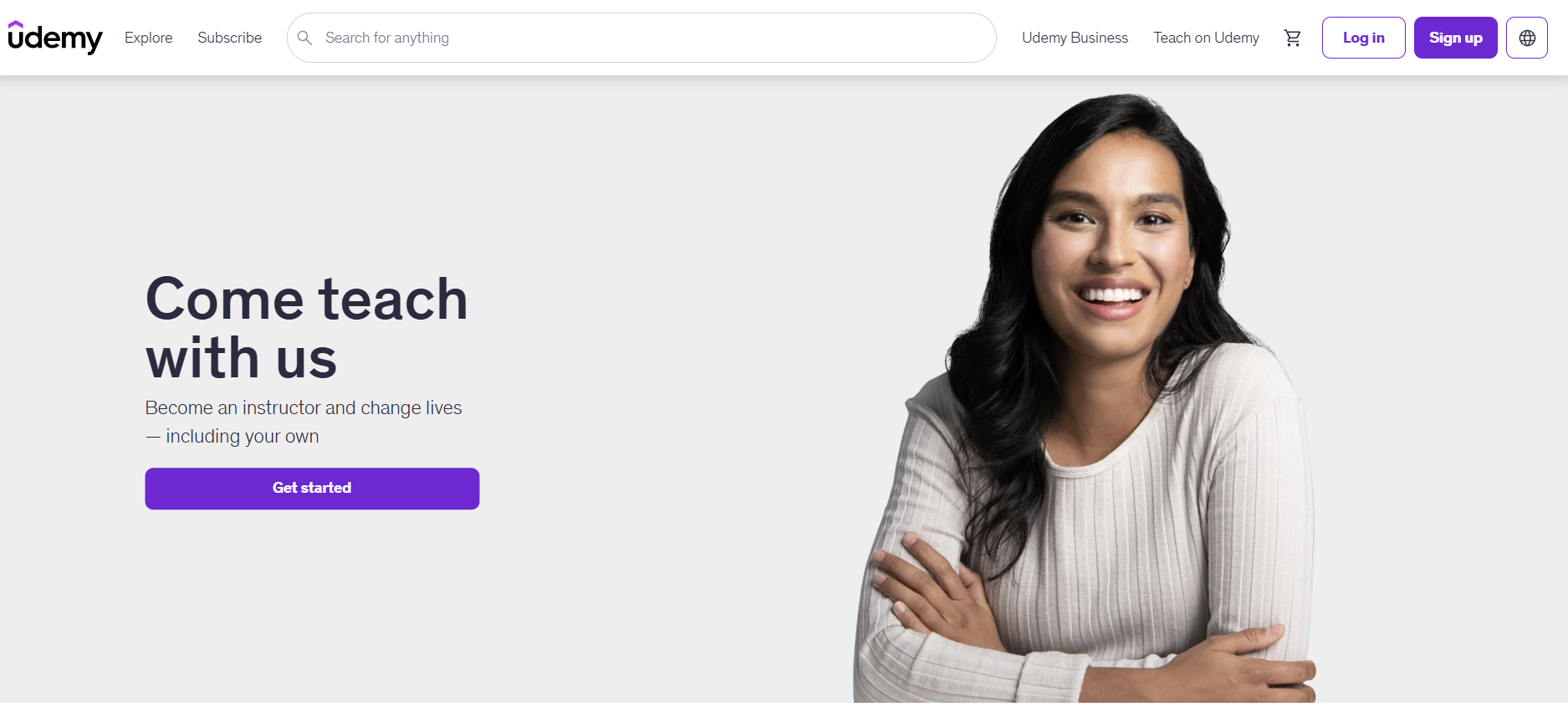
Udemy is a course marketplace where anyone can publish a course, and anyone can browse and buy one. It has grown into one of the largest course catalogs in the world, spanning technology, business, arts, and more, available in dozens of languages across many countries.
For creators, Udemy offers something genuinely valuable that's easy to underrate: distribution. You don't need to build an audience from zero to get your first students; Udemy's own search and browse traffic can bring buyers to a new course. That's a real advantage over launching on a platform with no built-in audience at all.
The tradeoff is that Udemy, not the instructor, controls pricing, discounting, and the student relationship. Understanding exactly how that tradeoff plays out financially is the point of this guide.
Udemy's Instructor Commission Structure, Explained
Udemy pays instructors differently depending on how a sale happens. There are three distinct rates:
1. Organic marketplace sales: instructors keep 37%
When a student finds your course through Udemy's own search, browse, or recommendation system (not through a link you shared), Udemy keeps 63% of the sale, and you keep 37%. This rate has been stable since May 2021. On a course discounted to $9.99 during one of Udemy's frequent sitewide promotions, that works out to roughly $3.70 per sale.
2. Instructor-referred sales: instructors keep 97%
If a student buys through a coupon link or referral link you created and shared yourself, you keep 97% of the sale, and Udemy keeps 3%. This is the best per-sale economics Udemy offers, and it rewards instructors who actively market their own courses (through email, social media, or a personal website) rather than relying purely on Udemy's own traffic.
3. Udemy Business subscription revenue: instructors now keep 15%
Udemy Business sells subscription access to a curated course library to companies. When a subscriber watches your course as part of that subscription, you're paid from a shared monthly instructor pool based on your share of total minutes watched that month, not a fixed price per view.
This is the rate that's changed the most, and the change matters. In a November 2023 announcement (also filed with the US Securities and Exchange Commission as Exhibit 99.1), Udemy disclosed a scheduled three-step reduction to the instructor subscription share:
- 25% through the end of 2023
- 20% starting January 2024
- 17.5% starting January 2025
- 15% starting January 2026, where it stands now
That's a 40% reduction in the subscription payout rate over three years, disclosed in advance but not something instructors could opt out of. Udemy has said the change was calibrated so total instructor payouts would hold steady even as the rate dropped, on the logic that subscription volume would grow to offset the lower per-unit share; independent analysis of Udemy's own financial disclosures has questioned whether that's held up in practice.

A note on Udemy for Business as an "invitation-only" program
Separately from the standard subscription revenue share above, Udemy has occasionally run an invitation-only enterprise instructor program with its own terms. Access to any special program terms is decided by Udemy, not something an instructor can opt into on demand, so it isn't a reliable planning assumption for most creators.
The May 2026 Coursera Merger, and What It Means for Instructors
As of May 11, 2026, Udemy is no longer an independent, publicly traded company. Coursera and Udemy completed an all-stock merger, with former Coursera shareholders holding roughly 59% of the combined company and former Udemy shareholders holding about 41%.
The combined business now reports more than 290 million learners, over 18,000 enterprise customers, and roughly 95,000 content creators and instructors across both platforms' catalogs, which together span more than 315,000 courses.
At the time the merger closed, Coursera and Udemy stated that existing instructor and content-partner agreements, pricing, subscriptions, and course access would remain unchanged, and that the two platforms would not be technically merged on day one.
Worth being direct about the longer-term picture, since it's the honest read of the available evidence rather than either extreme: the two companies paid an estimated combined total of roughly $440 million to instructors and content partners in 2025. Independent industry analysis published shortly after the deal closed projected that combined payouts could decline in 2026, pointing to the completed 15% Udemy subscription rate cut and a new platform fee Coursera introduced on its own content-partner revenue in 2026.
This is an analyst projection, not a confirmed company statement, and actual outcomes may differ; it's presented here as informed context, not certainty.
How Much Do Udemy Instructors Actually Earn?
Individual results vary enormously, from instructors who earn nothing to a small number who've earned well into six or seven figures over their time on the platform. Headline numbers from top earners aren't representative of a typical outcome, so it's worth looking at the distribution rather than the ceiling.
The most detailed independent research available comes from an analysis of hundreds of thousands of Udemy courses and their enrollment data, which found:
- The average instructor earns $3,306 per year on Udemy.
- 75% of instructors earn less than $1,000 per year.
- Only about 1% of instructors earn a full-time income (above $50,000/year), and roughly 4% cross the US poverty line threshold from Udemy income alone.
- The top 1% of instructors account for more than half of all instructor earnings on the platform; the bottom half of instructors collectively earn less than 1% of the total.
- Instructors who joined before 2020 earn more on average (around 5,400/year) than those who joined after (2,100/year), reflecting the value of an established course with years of accumulated reviews and search ranking.
What drives the difference between a course earning a few dollars a year and one earning a meaningful income comes down to a few consistent factors: demand for the specific topic (technical, high-demand niches like programming or data tools tend to outperform lower-demand categories), how much marketing the instructor does themselves (since instructor-referred sales pay nearly triple the rate of organic ones), and the quality and completeness of the course itself.
Can Instructors Control Their Earnings on Udemy?
To some degree, yes, though within real constraints:
- Pricing: Instructors can set and adjust course prices, but Udemy caps list prices and regularly runs sitewide discounts (commonly down to $9.99–$14.99) that instructors can't opt out of course-by-course. A $199 course can be sold to a student for $9.99 during a promotion, and the organic-sale commission rate applies to whatever price the student actually paid.
- Referral links: Since instructor-referred sales pay 97% versus 37% for organic sales, the single biggest lever an instructor has is bringing their own traffic through a personal coupon link rather than depending on Udemy's own marketplace traffic.
- Marketplace Insights: Udemy provides a tool that shows demand and competition data for a given course topic, which can help with positioning a new course before investing the time to build it.
When Udemy Makes Sense, and When It Doesn't
To be fair to Udemy: it isn't a bad option for every instructor, and treating it as one wouldn't be an honest read of the numbers above.
Udemy can be a reasonable fit if:
- You're testing a course topic and want built-in discovery traffic rather than starting from zero audience.
- You actively drive your own traffic through referral links, where the 97% rate applies, effectively making Udemy closer to a low-cost checkout and hosting tool for your own marketing efforts.
- You're using Udemy as one channel among several (a "top of funnel" for visibility) rather than your only source of income.
- Your topic is in a high-demand technical category where organic marketplace traffic is genuinely strong.
Udemy is usually a weaker fit if:
- You want to build a direct relationship with your students (email list, community, repeat customers), since Udemy doesn't give instructors direct access to student contact information.
- You want control over your own pricing and discounting.
- Udemy Business subscription traffic makes up a meaningful share of your views, since that's the revenue stream where the instructor share has fallen the most.
- You're building a course business as a primary income source rather than a side project or lead-generation channel.
An Alternative Model: Owning Your Own Platform
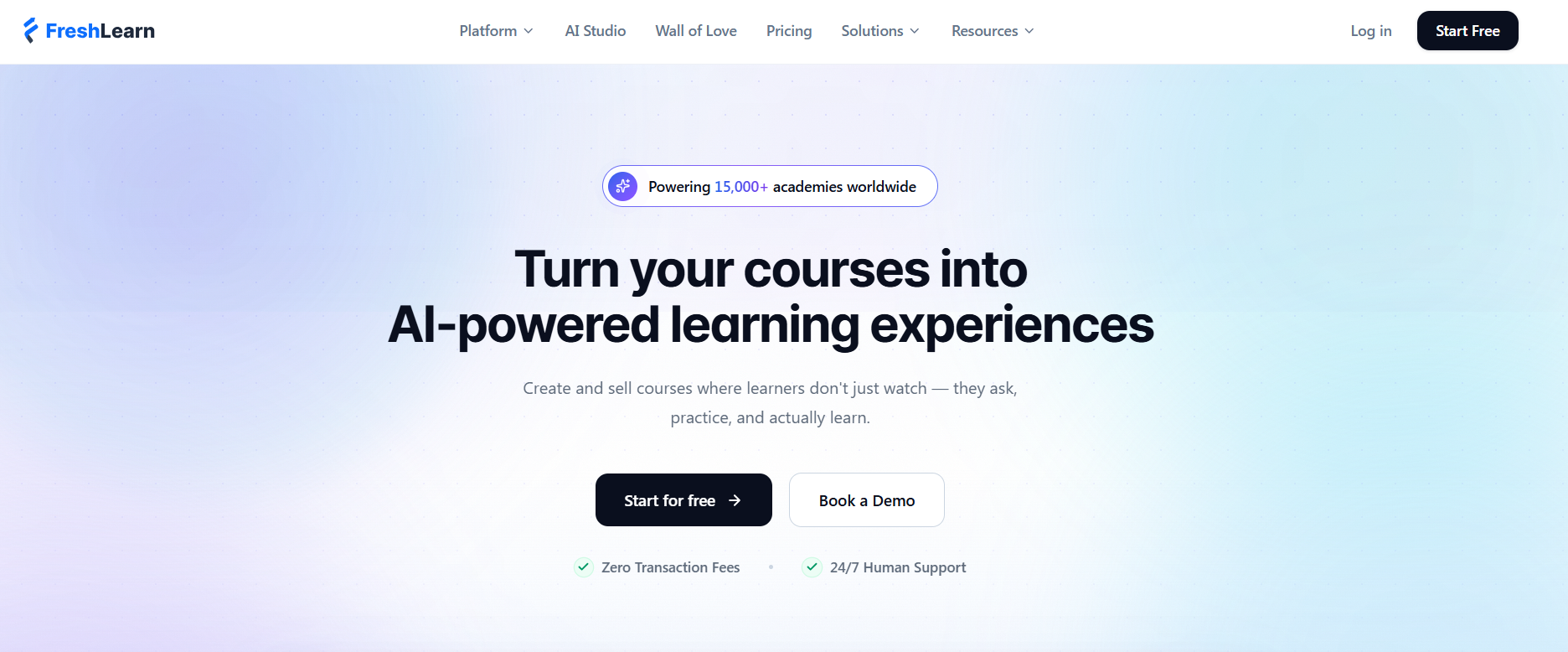
The core structural difference between Udemy and a platform like FreshLearn isn't features; it's who owns the pricing, the audience, and the revenue split.
On Udemy, you're a merchant inside someone else's marketplace: Udemy sets discount policy, owns the student relationship, and takes a percentage that can change (as it has three times since 2023) without requiring your approval.
On a platform you host yourself, you set your own price, keep your own student list, and (on a platform like FreshLearn) pay 0% transaction fees on every plan, including the free plan, rather than a revenue share that scales with your sales.
FreshLearn has enabled more than 15,000 creators and academies to earn over $240 million, with tools including a no-code course builder, drip content, quizzes, memberships, and a modern checkout with coupons and referrals built in.
The honest tradeoff: FreshLearn (and platforms like it) don't come with Udemy's built-in browsing traffic. You're responsible for bringing your own audience, the same audience-building work that also happens to be what earns the 97% referral rate on Udemy. For many creators, the two aren't mutually exclusive: some use Udemy as a discovery channel alongside a self-hosted platform where they build their real, owned business.
Start your free trial with FreshLearn today
FAQs
1. What percentage does Udemy take from instructor course sales?
It depends on how the sale happened. Udemy keeps 63% of an organic marketplace sale (instructor keeps 37%) and 3% of a sale made through the instructor's own coupon or referral link (instructor keeps 97%). For Udemy Business subscription views, instructors are paid from a shared pool and currently receive 15% of that pool's revenue, down from 25% in 2023.
2. How much does the average Udemy instructor make per year?
Based on an independent analysis of hundreds of thousands of Udemy courses, the average instructor earns about $3,306 per year. That average is pulled up significantly by a small number of top earners; 75% of instructors earn less than $1,000 per year, and only about 1% earn a full-time income above $50,000/year.
3. Is Udemy still a standalone company?
No. Udemy completed an all-stock merger with Coursera on May 11, 2026. At closing, existing instructor agreements, course pricing, and payout structures remained unchanged, and the two platforms were not technically merged on day one. Longer-term changes to instructor economics haven't been officially confirmed as of this writing, though industry analysts have projected continued downward pressure on payouts given other cost pressures across the combined company.
4. Why did Udemy cut its subscription revenue share?
Udemy disclosed the cuts (from 25% to 20% to 17.5% to 15%, phased in between January 2024 and January 2026) in a November 2023 announcement, framing it as necessary to fund platform, marketing, and sales investment. The company said it expected total instructor payouts to hold steady as subscription volume grew, though independent analysis of Udemy's own financial filings has raised questions about whether that offset has materialized as promised.
5. Can I set my own course price on Udemy?
Yes, within limits. Instructors can set and adjust list prices, but Udemy runs frequent sitewide discounts (often to 9.99-14.99) that instructors don't control on a course-by-course basis, and the organic-sale commission applies to whatever discounted price the student actually paid, not the list price.
6. Is it better to sell courses through Udemy's marketplace or through my own referral links?
Financially, referral links are far better: 97% of the sale versus 37% for a purely organic Udemy-driven sale. The tradeoff is that referral sales require you to already have an audience to send the link to (email list, social following, or your own website), whereas organic marketplace sales come from Udemy's own traffic with no marketing effort required on your part.
7. What's the alternative to Udemy if I want to keep more of my revenue?
Self-hosted or subscription-priced platforms like FreshLearn, Teachable, and Thinkific charge a flat monthly or annual fee (or, in FreshLearn's case, 0% transaction fees on every plan) instead of taking a percentage of each sale. The tradeoff is that these platforms don't come with Udemy's built-in browsing traffic, so instructors are responsible for bringing their own audience, the same work that also unlocks the best rate on Udemy itself.
You might also like
Hosted by