Video Monetization for Course Creators: How to Earn Directly From Your Content

Most conversations about video monetization start with YouTube ad revenue. For course creators and educators, that's the wrong starting point.
Ad revenue is unpredictable, controlled entirely by a platform, and pays poorly unless you're generating millions of views. A creator with 50,000 highly engaged subscribers who want to learn from them has something far more valuable than a faceless channel with 5 million passive viewers — but YouTube's monetization model treats both the same.
The more important question for educators isn't "how do I get YouTube to pay me?" It's "how do I earn directly from people who want to learn what I teach?" Those are different problems with very different solutions.
This guide covers the video monetization models that work for course creators and educators, the platforms built for direct video monetization, and how to build a video business that doesn't depend on an algorithm.
The Two Types of Video Monetization
Before comparing platforms and strategies, it's worth being clear about the fundamental difference between the two approaches to video monetization — because they lead to completely different business models.
Platform-dependent monetization means earning from an audience on someone else's platform: YouTube ad revenue, Twitch subscriptions, TikTok Creator Fund payouts, Instagram Reels bonuses. Your income depends on the platform's algorithm, its monetization policies, and its willingness to keep paying creators. All of these have changed materially — and not in creators' favor — over the past two years.
Direct monetization means selling your video content directly to your audience: paid courses, video memberships, live workshops, gated video libraries. Your income depends on your relationship with your audience and the value of what you teach. The platform you use is infrastructure, not your employer.
For course creators and educators, direct monetization is the right model. Platform-dependent monetization has its place — primarily as a top-of-funnel discovery channel — but it should never be the primary revenue source for someone with real expertise to sell.
Video Monetization Models That Work for Educators
1. Paid Online Courses
The highest-value video monetization model for most educators. A structured video course — typically 4–10 modules, each 15–30 minutes — priced at $197–$2,997 depending on depth and outcome.
What makes a paid course work as a monetization model:
- You set the price. No revenue share, no algorithm. A 100-student cohort at $497 is $49,700 — the same math regardless of how many views your YouTube channel gets.
- Students pay for the transformation, not the entertainment. People pay more for content that helps them achieve a specific, measurable outcome than for content they passively consume.
- It scales without additional effort. Once built, a self-paced course sells and delivers automatically. Your income isn't capped by how many hours you can teach.
The most successful course creators pick a specific, outcome-driven topic rather than a broad subject. "Video production for online courses" outperforms "video production" every time — the audience is more defined, the outcome is more specific, and the competition is more winnable.
2. Video Membership Sites
A recurring revenue model where subscribers pay monthly or annually for access to an ongoing library of video content, live sessions, and community.
The economics of memberships are compelling: 200 subscribers at $29/month is $5,800/month in predictable recurring revenue — independent of whether you launch anything new. The social dynamic of a membership (belonging to a community, consistent access to a trusted expert) also drives higher retention than one-time purchases.
For educators, the most sustainable memberships are built around a continuing need rather than a one-time skill acquisition. "Monthly training for fitness coaches" retains subscribers longer than "learn to code in 30 days" because the need is ongoing.
The critical factor: a membership requires consistent delivery. Subscribers who don't hear from you for six weeks cancel. Build the content calendar before the launch, not after.
3. Cohort-Based Courses and Live Workshops
The premium tier of video monetization for educators. The same content that sells for $297 as a self-paced course can sell for $997–$5,000 as a live cohort — because students pay for accountability, community, and direct access to you, not just the content.
Live workshops (single sessions, typically $47–$297) are the fastest product to build and sell. They require no pre-recorded content, no course platform setup — just a landing page, a Zoom link, and an audience willing to show up. Many educators use live workshops to validate a topic before investing in a full course.
Cohort-based courses (4–8 weeks, $497–$5,000) are the most intensive but highest-margin product. A cohort of 20 students at $1,997 is $39,940 for six weeks of work — a meaningful revenue event without a large audience.
4. Gated Video Libraries and VOD Memberships
A lighter version of a full membership: a library of pre-recorded video content gated behind a one-time purchase or monthly subscription. Rather than a structured course with a defined curriculum, this is more like a Netflix-style archive — browse and watch what's relevant to you.
This model works well for educators whose content is evergreen and topic-adjacent rather than sequentially structured. A yoga instructor with 200 class recordings, a chef with 150 recipe videos, or a language tutor with 300 lesson clips all have content libraries that suit this model better than a traditional course structure.
Platforms like Uscreen are specifically built for this model — offering branded OTT apps, TV streaming, and subscription management for video library businesses.
5. Pay-Per-View and Video Rentals
A transactional model: viewers pay a one-time fee to access a specific video or event. Works well for:
- Live event recordings (conference sessions, performances, one-off masterclasses) sold after the fact
- Premium single-topic deep dives priced at $9–$47
- "Rent" access to a video for 48 hours rather than permanent ownership
This model suits creators who produce one-off content rather than ongoing series, and works well as a complement to a subscription model — subscribers get included access; non-subscribers pay per view.
6. Sponsorships and Brand Partnerships
Worth including because it's relevant for educators with an audience, but with an honest caveat: sponsorships work best as a supplement to direct monetization, not the core of it.
If you're sending a weekly newsletter to 5,000 course creators, a relevant tool in your niche might pay $500–$2,000 per sponsored mention. If you're producing video content that 20,000 educators watch monthly, tool sponsorships are a real revenue stream.
The limitation: sponsorship income is inconsistent and depends on you having an audience large enough to attract sponsors. It also requires ongoing content production to maintain. Direct monetization (courses, memberships) generates revenue from your existing audience at any size.
Platforms for Direct Video Monetization
FreshLearn
Best for: Course creators who want to sell video courses, memberships, and digital downloads — with email marketing, community, and analytics — without managing multiple platforms.
FreshLearn is the most complete platform for educators monetizing video content directly. Rather than hosting your videos on a platform that pays you ad revenue, FreshLearn lets you sell access to your video content at your own price, keeping 100% of revenue minus standard payment processing.
What's directly relevant for video monetization:
Video course hosting — upload video lessons, organize into modules, set drip schedules, add quizzes and assignments, and require mandatory watch time for compliance-sensitive content. All video is hosted and streamed through FreshLearn — no external hosting required.
Live masterclasses and webinars — run live video sessions natively, sell tickets, and deliver recordings to attendees automatically after the session ends.
Cohort-based courses — run time-limited live cohorts with drip content delivery, community access, and automated reminders.
Digital downloads — sell supplementary video content (individual lesson recordings, bonus sessions) as standalone digital products alongside your courses.
Email campaigns — nurture leads, onboard new students, and re-engage past buyers with drip sequences and behavioral triggers, all from the same platform.
Analytics — video engagement data (watch time, drop-off points, completion rates) alongside revenue attribution, so you know which content is driving sales and which is losing students.
0% transaction fees on all plans. You pay only standard payment processing — FreshLearn takes no cut of your video revenue.
FreshLearn pricing (annual billing):
- Free: $0 — 1 product, 25 enrollments, 3 sales pages
- Pro: $41/month — video courses, live sessions, digital downloads, email (3K/month), custom domain
- No Brainer: $59/month — adds community, cohorts, certificates, gamification, referral program, mobile app
- No Brainer+: $119/month — advanced automation, API access, 12K emails/month
Uscreen
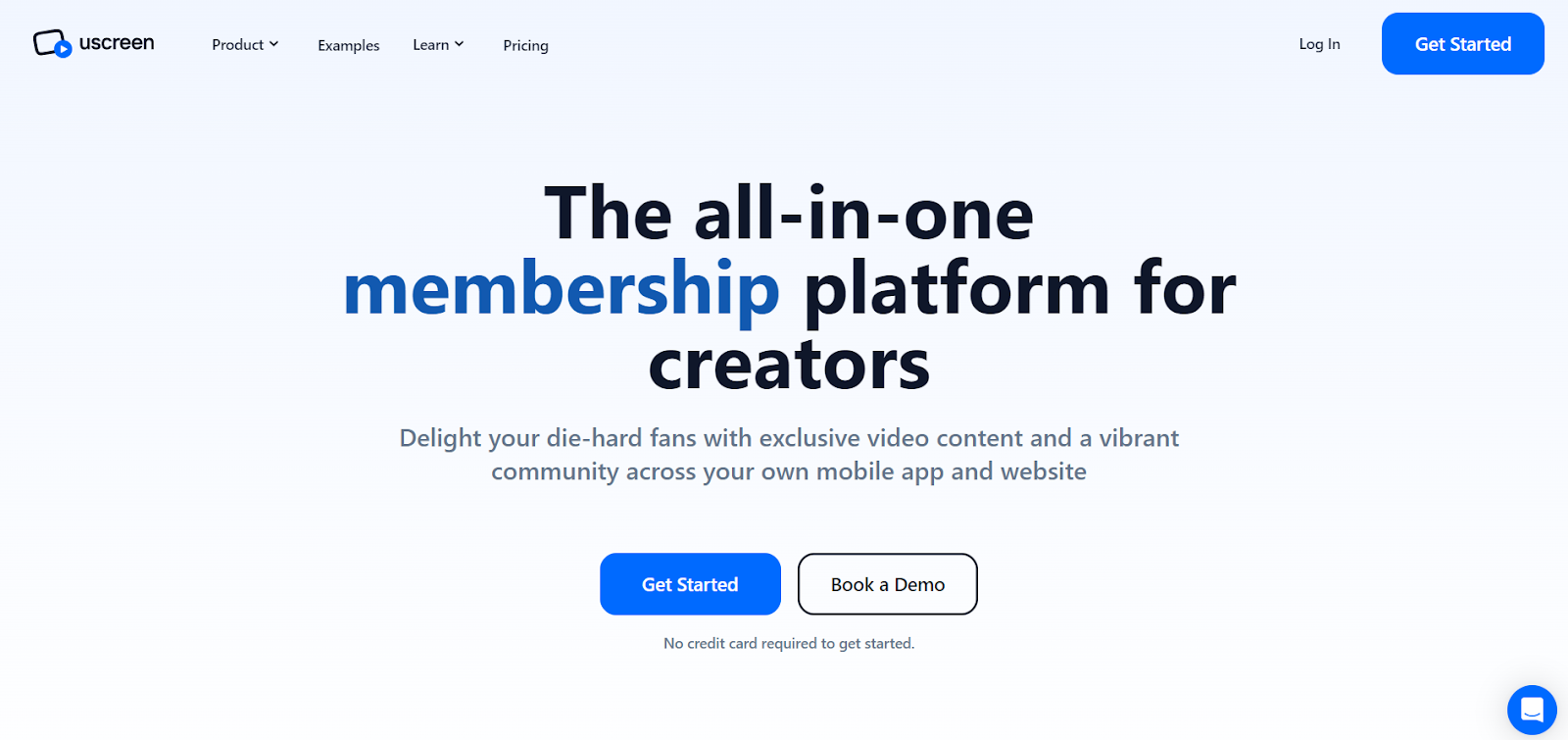
Best for: Video-first creators building Netflix-style subscription libraries — fitness instructors, yoga teachers, coaches with large back-catalogues of video content.
Uscreen is the platform of choice for creators whose primary product is a browsable video library rather than a structured course. Its standout feature is branded OTT app publishing — you can launch your own app on Apple TV, Roku, Fire TV, iOS, and Android under your own brand. For fitness, wellness, and entertainment-adjacent educators, this gives subscribers a TV-native viewing experience that no course platform matches.
Uscreen handles subscriptions, pay-per-view, live streaming, community, and detailed analytics natively. Creators like Yoga with Adrienne and Art for Kids Hub use it to run large video membership businesses.
The honest limitation: Uscreen is expensive at scale. Its per-subscriber fee ($0.50–$1.99/subscriber/month depending on plan) compounds as your membership grows — meaning your platform cost rises proportionally with revenue. It also lacks the structured course tools (quizzes, drip schedules, assignments, completion certificates) that educators typically need. If your video content is more course-shaped than library-shaped, FreshLearn is a better fit.
Uscreen pricing (2026):
- Starter: $49/month — up to 100 subscribers, basic features
- Growth: $149/month — unlimited subscribers + $0.50/subscriber/month, live streaming (1 hour included), 100GB storage
- Pro: $499/month — $1.99/subscriber/month, branded OTT apps, 500GB storage
- Enterprise: Custom
YouTube (As a Discovery Channel, Not a Revenue Source)
Best for: Top-of-funnel audience building and organic discovery — not as a primary monetization platform.
YouTube is worth addressing directly because it's where most conversations about video monetization start — and it's important to be clear about what it can and can't do for educators.
YouTube's monetization requirements (1,000 subscribers and 4,000 watch hours in the past 12 months to join the Partner Program) mean most educators won't earn meaningful ad revenue from YouTube for a long time. When they do qualify, RPM (revenue per thousand views) for educational content typically ranges from $2–$8 — meaning 100,000 views earns $200–$800. Compare that to a single $497 course sale.
The right use of YouTube for course creators is as a discovery and trust-building channel. Free valuable content on YouTube attracts your ideal audience. You then direct that audience to your email list, your lead magnet, or your course sales page — where the real monetization happens. YouTube builds the relationship; your own platform closes the sale.
YouTube's channel membership feature and Super Thanks are real monetization options for creators with large, engaged audiences. But for most educators, the ROI on optimizing for these features is far lower than optimizing a course sales page or email sequence.
Teachable and Thinkific
Best for: Educators who want a dedicated course platform and are comfortable handling email marketing and community separately.
Both Teachable and Thinkific are established course platforms that handle video hosting, course delivery, and student management well. They're worth mentioning as direct video monetization platforms, with the key tradeoff being that neither includes email marketing, community, or digital download delivery natively — you'll need additional tools to build a complete funnel.
For a full comparison of course platform options, see our guide on where to sell digital products.
How AI Has Changed Video Monetization for Educators
The workflow for producing monetizable video content has changed significantly since 2024. Three developments are worth understanding:
AI-assisted course creation. Most major course platforms now include AI tools that can generate course outlines, lesson summaries, quiz questions, and module structures from your raw content or a topic description. FreshLearn's AI Studio generates course content grounded in your own material — reducing the time from idea to publishable course from weeks to days.
AI video tools. Tools like Descript, Opus Clip, and CapCut's AI features let educators edit video, remove filler words, generate captions, repurpose long-form content into short clips, and produce polished output without video editing expertise. The production quality ceiling for solo creators has dropped significantly.
AI-generated sales copy. Landing pages, email sequences, and course descriptions can now be drafted quickly with AI assistance and refined in your own voice. For educators who struggle with the marketing side of video monetization, this removes the primary bottleneck between having great content and selling it effectively.
The honest note: AI accelerates the creation and marketing workflow. It doesn't replace the expertise, the point of view, or the trust relationship that makes a video course worth buying. Buyers pay for your knowledge and perspective — AI helps you package and sell it more efficiently.
Building a Direct Video Monetization Business: The Basic Framework
For educators starting out, this sequence consistently works better than any other approach:
Step 1: Start with a free YouTube or social media presence. Post valuable short-form or long-form video content consistently. The goal is not to earn from this content — it's to build an audience of people who trust you and want to learn more from you. Direct viewers to your email list at every opportunity.
Step 2: Build your email list with a lead magnet. Offer a free video lesson, mini-course, or downloadable resource in exchange for an email address. This converts passive viewers into warm prospects who have explicitly opted in to hear from you.
Step 3: Validate your first paid product. Before building a full course, validate demand. Pre-sell a live workshop on a specific topic. If people pay to attend a live session, they'll pay for a recorded course on the same topic. Validation before creation saves months of wasted effort.
Step 4: Build and sell your course on your own platform. Once demand is validated, build the full course and publish it on a platform where you own the customer relationship and keep 100% of revenue. Set up your sales page, email sequence, and checkout — then launch to your email list first.
Step 5: Systematize and scale. Once your first course is selling, add a second product (a membership, a higher-ticket cohort, a lower-ticket template pack). Build your affiliate program so satisfied students refer new buyers. Optimize your funnel based on analytics — which emails convert, where people drop off on your sales page, which course content gets the highest completion rates.
The educators who reach $5,000–$10,000/month from video content consistently followed this sequence. The ones who try to skip to step 5 without completing steps 1–4 consistently struggle.
FAQ
1. What's the best way to monetize videos as an educator?
Direct monetization — selling access to your video content through paid courses, memberships, or live sessions — consistently outperforms ad-based monetization for educators. A single $497 course sale generates more revenue than 100,000 YouTube views. Build an email list, validate demand, and sell directly to your audience through a platform you control.
2. Do I need a large audience to monetize video content? No. An email list of 500 engaged subscribers who trust you will outperform 50,000 passive social media followers who don't. Many educators make their first course sales from a handful of existing students or a small email list. Audience size matters less than audience trust and relevance.
3. What platform is best for selling video courses? FreshLearn is the most integrated option for educators who want video courses, live sessions, email marketing, and community on one platform with 0% transaction fees. Uscreen is better suited for video library memberships (fitness, wellness, entertainment). Teachable and Thinkific are solid for course-only use cases if you're handling marketing separately.
4. Should I use YouTube for video monetization? Yes, but not as a primary revenue source. Use YouTube as a discovery and trust-building channel to attract your ideal audience, then direct that audience to your email list and course sales page where the real monetization happens. YouTube ad revenue should be a bonus, not the business model.
5. How long does it take to make money from video content? Most educators who follow a structured approach — build a small audience, grow an email list, validate and launch a first product — make their first course sales within 3–6 months. The timeline depends almost entirely on how quickly you build trust with a relevant audience and whether you validate demand before building. Educators who build a course without validating demand first often wait much longer.
6. What is the 1,000 subscriber rule on YouTube? YouTube requires at least 1,000 subscribers and 4,000 public watch hours in the past 12 months (or 10 million Shorts views in 90 days) to join the YouTube Partner Program and earn ad revenue. For educators, this threshold is worth reaching eventually — but it shouldn't be the focus of your monetization strategy. Building your email list and selling courses directly is a faster path to meaningful revenue at any subscriber count.
You might also like:
Hosted by