How to Create a Certification Program

Quick Answer
A certification program isn't just a course with a certificate added at the end. There's a standard behind it. Someone has to meet that standard. And, ideally, another person should be able to check the credential later and see that it was actually earned. So the work starts before you build the course itself. You need to decide what you're certifying, build the curriculum around the outcome you're trying to prove, and put real requirements in place before someone gets certified. The certificates should have unique serial numbers and public verification links. If you're offering CE credit, you'll need proper seat-time tracking as well. FreshLearn handles much of the infrastructure that sits underneath this. You get zero transaction fees, branded iOS and Android apps, and certificates with serial numbers and verification pages built in.
Key Takeaways
- A certification program means a learner has met a defined standard and earned a credential that can be checked later. A regular course usually doesn't need either.
- Decide what you're actually certifying before you build the program. It could be a skill, a knowledge standard, or a compliance requirement such as CE credit hours.
- Build the curriculum backward from the outcome. Start with what the learner needs to be able to do or prove, then decide what they need to learn along the way.
- A credible certification should use at least two forms of assessment or verification: a scored exam, verified attendance or seat-time, or a practical assessment.
- At minimum, certificates need a unique serial number and a public verification page. CE programs also need seat-time tracking and exportable records that are ready for an audit.
- FreshLearn automatically creates serial numbers and verification links for certificates. CE providers can also make issuance dependent on completion, exam scores, and evaluation rules.
- Certification programs can usually charge more than courses covering the same subject because the credential itself has value.
- When comparing platforms, look beyond the course builder. Certificate infrastructure, compliance gating, branded apps, and transaction fees can make a big difference.
What actually makes something a certification
Here's a simple test.
Imagine someone comes to you six months after completing the program and asks, "How do I know this person is actually competent?"
Could you prove it?
I'm not talking about showing them a completion percentage or a list of videos the learner watched. I'm talking about showing that the learner met a specific standard and giving the person asking a way to verify it.
That's the difference.
Most courses aren't designed to do this. And, honestly, plenty of programs that call themselves certifications aren't either.
A course teaches something. A certification makes a claim about what someone can now do, what they know, or what requirement they've met. There's a credential attached to that claim, and that credential needs to mean something when it leaves your website.
Think about who might check it. A hiring manager could Google the credential. A licensing board might audit it. A prospective client might want to verify it before paying for someone's services.
For that to work, you need three things.
You need a defined standard. You need a genuine requirement that the learner has to pass before getting the credential. And you need a record that still exists after the learner clicks "complete."
Take any one of those away, and you're getting pretty close to a normal course with a certificate at the end.
The record-keeping part is particularly easy to overlook. It's also the part that tends to become very important when somebody actually asks questions about a credential.
If you're running licensed continuing education specifically, FreshLearn's CE provider tools are built around this exact scrutiny; there's more on that in Step 4.
Step 1: Decide what you're actually certifying
This sounds obvious, but it's worth slowing down here.
If you don't know what the certification proves, building the rest of the program becomes guesswork.
Most certifications fall into one of three broad categories. They overlap sometimes, but starting with the right category will make the rest of the decisions much easier.
Skill-based. The learner can now do something they couldn't do before. Maybe that's running a coaching modality, carrying out a technical process, or applying a framework in a live situation. The important word here is do. You're testing whether they can perform the skill, which usually calls for some kind of practical assessment rather than a multiple-choice quiz.
Knowledge-standard. The learner has demonstrated a certain level of understanding. This could be a professional framework, methodology, or body of knowledge that an industry recognizes. An exam makes more sense in this situation because you're checking whether the learner actually understands and has retained the material.
Compliance. This is a little different. The learner has completed a defined curriculum or a required number of hours set by a board, employer, regulator, or another organization. Continuing education credit for licensed therapists and counselors falls into this category.
Mental health CE providers generally sit in that third bucket, although some programs combine compliance requirements with a knowledge standard.
Once you've figured out which one you're dealing with, other questions start answering themselves. You'll have a better idea of what attendance needs to be tracked, what belongs on the certificate, and how long your records need to be kept.
Before you build a single module, write one sentence explaining exactly what the certification proves.
If that sentence is fuzzy, the program probably isn't ready to be built yet.
Step 2: Structure the curriculum around outcomes
Now work backward.
Don't start by opening a blank curriculum and listing every topic you could possibly teach. Start with the finished learner.
What should a certified person be able to do or prove that someone who hasn't earned the certification can't?
That's the outcome your curriculum needs to support.
Every module should earn its place. If it helps close a specific gap between the learner's current ability and the standard you're testing, keep it. If it's interesting but doesn't really contribute to the competency, consider cutting it.
This is one of the places where certification programs differ from ordinary courses.
A regular course can get away with a broad topic outline. It can include extra material because it's useful or interesting. A certification program has to be more focused. You're not just trying to educate someone; you're eventually making a claim about their ability.
That also means practical work matters.
Give learners a case study to solve. Put them through a role-play. Have them work through a realistic scenario. Don't make the entire program something they watch and read.
CE programs have another constraint: time.
If a board requires six credit hours, you need six genuine, trackable hours behind that certificate. You can't estimate the viewing time, round it up, and call it six hours because the number looks about right.
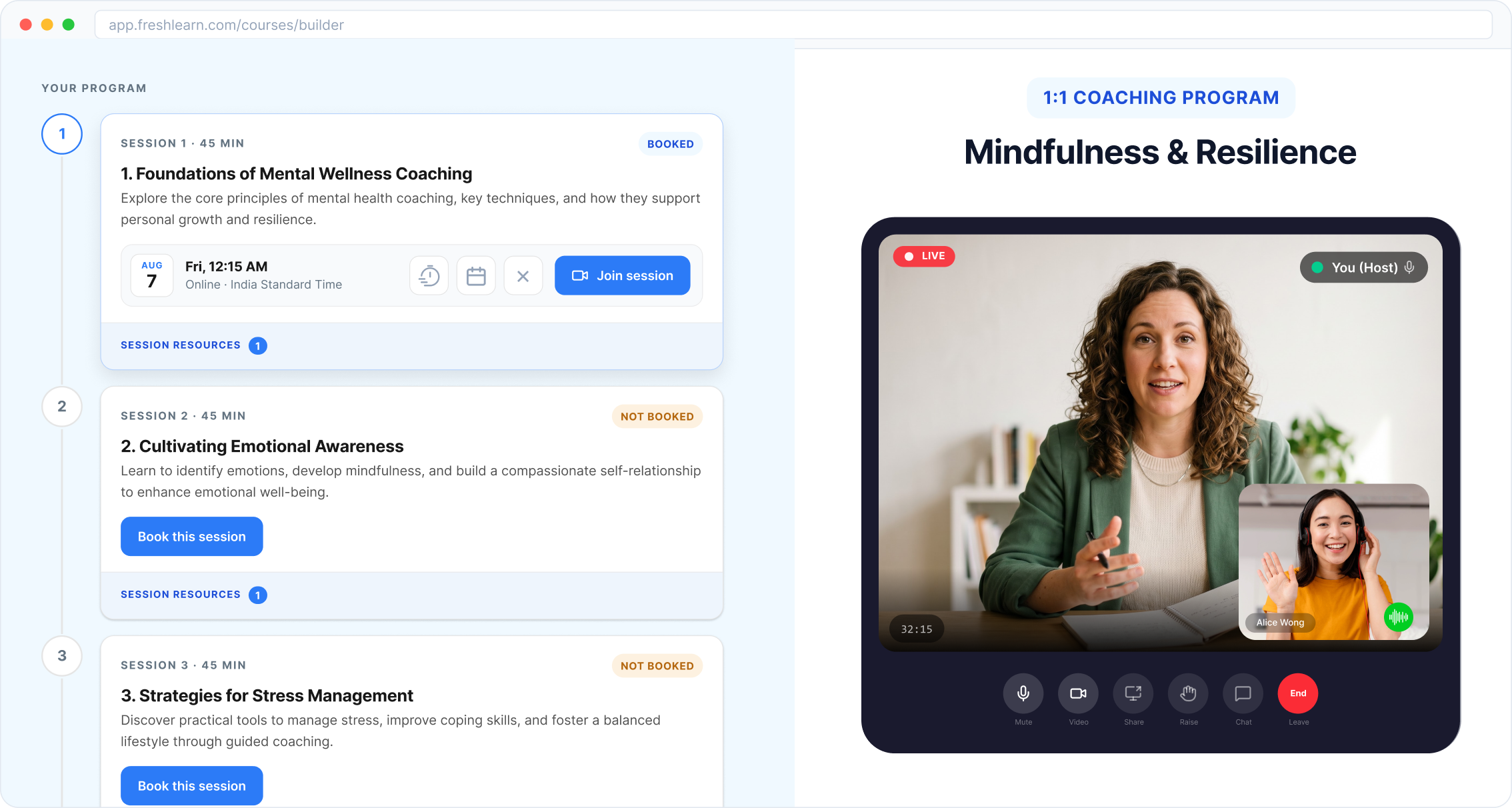
If you're a coach building your first structured program from scratch, it's worth looking at how a coaching program gets structured more generally before you add certification requirements on top.
Step 3: Set pass criteria that can't be faked
Let's get one thing out of the way: completing every lesson isn't proof of competence.
It's proof that someone clicked through every lesson.
For a certification, that's not enough.
A stronger program combines at least two of these:
- A scored exam with an actual passing threshold. Somewhere between 70 and 80 percent is typical, depending on the field. The learner needs to meet the threshold; merely attempting the quiz doesn't count.
- Verified attendance or seat-time. You need to know that someone actually attended and for how long, rather than simply knowing that they registered. This becomes especially important for live and CE-style programs.
- A practical assessment. This could be a submitted assignment, recorded demonstration, or graded case study. Something where the learner has to actually apply what they've learned.
The seat-time issue deserves particular attention for CE programs.
If someone can skip ahead through a video, or leave a session open in another tab while they're off doing something else, those hours aren't really contact hours. At least, they're not hours a board is likely to accept.
That's the sort of thing that can become a problem during an audit.
Assessment tools therefore matter more than they might seem when you're first planning the program. FreshLearn's assessments feature lets you set minimum passing scores and prevent a learner from progressing until they meet the requirement.
That's a very different setup from a quiz that simply gives someone a score at the end.
Step 4: Issue certificates that hold up under scrutiny
A certificate is making a claim about someone.
So ask yourself: can another person check that claim?
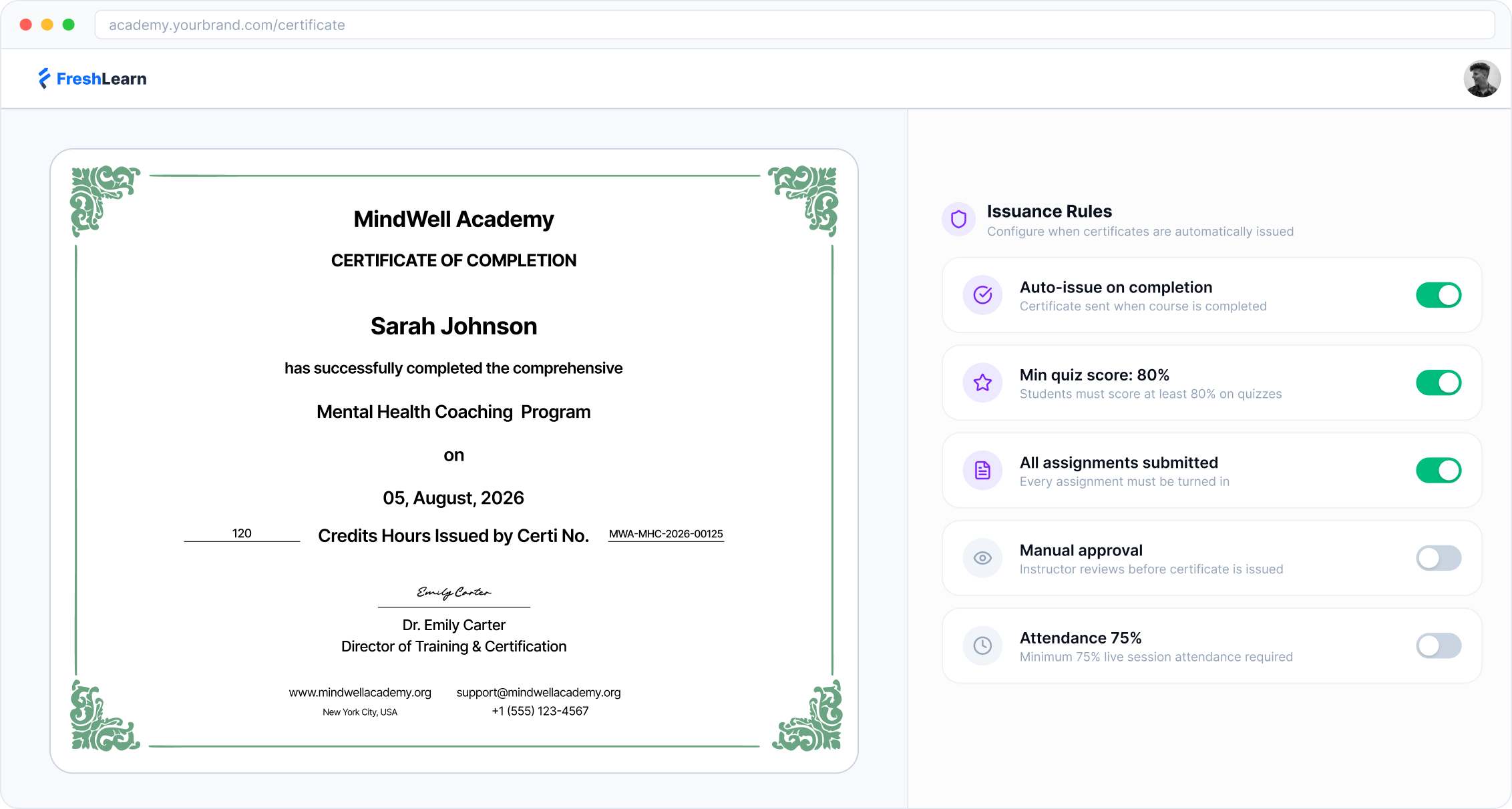
At the bare minimum, every certificate should have a unique serial number. That gives you a way to trace individual credentials instead of having a pile of identical-looking certificates that are difficult to distinguish.
There should also be a public verification page. An employer, client, board, or anyone else should be able to check the credential without having to email you and wait for a response.
The certificate should make the achievement clear, too. Depending on the program, that might include the exam score, credit hours, completion date, and provider details.
CE programs have more work to do.
You need attendance or seat-time records behind the credit hours. If an evaluation is required, it should happen before the certificate is issued. And you need an exportable history that you can produce quickly if a board or registry asks for it.
This is where the old-school approach starts to look shaky.
A binder full of sign-in sheets isn't exactly convenient when someone wants records for an audit. Neither is a spreadsheet that somebody was supposed to update three months ago and forgot about.
The platform underneath the program starts to matter quite a bit at this point.
FreshLearn's certificate infrastructure automatically puts a unique serial number on every certificate and connects it to a public verification page and QR code. Someone checking the credential can verify it without calling or emailing the provider first.
For CE providers, FreshLearn's mental health CE tools can make certificate issuance dependent on completion, a minimum exam score, and a completed evaluation. Live attendance and self-paced seat-time can also be tracked in the background.
In other words, when somebody eventually asks for the record, you don't have to reconstruct it from scratch. It already exists.
Step 5: Price it like a credential
Here's a common mistake: taking the price of a course and adding a certificate without really changing the pricing logic.
A certification isn't just a course with a nicer piece of paper.
The credential has value of its own. It might give someone another line on their résumé, help them meet a licensing requirement, or make a prospective client more comfortable hiring them.
There's also ongoing work behind the credential from your side. Verification, support, record-keeping, and maintaining the program all cost time and money after launch.
So don't price the program based purely on how many hours of video you've produced.
Look at what the certification actually enables.
If it helps someone qualify for paid work or satisfy a licensing requirement, there's a strong case for charging considerably more than you would for a course covering the same material without the credential.
There are a few other pricing options worth thinking through.
You could separate the exam fee from the content fee, particularly if learners commonly need to retake the exam. You could also build in recertification on a regular cycle. CE credits often need to be renewed anyway, so this can turn a one-time purchase into recurring revenue.
And be honest about what the certification does and doesn't guarantee.
Overpromising might help sell a few more programs in the short term, but it also weakens the credibility of the credential you're asking people to pay a premium for.
For the actual mechanics of pricing — psychology, tiers, anchoring, and so on — FreshLearn's guide to pricing an online course is a useful starting point before you add the certification premium.
Step 6: Pick a platform that was built for this
Most course platforms can generate a certificate.
That's a fairly low bar.
The harder question is whether the platform can support a credential that someone outside your organization would actually trust — and whether it can give you the records you need if a board ever comes knocking.
Start with the certificate itself.
Look for more than a downloadable image. You want unique serial numbers, verification links, and QR codes that let a third party check a credential without having to contact you first.
If your industry has compliance requirements, check the gating options, too. You should be able to decide exactly what has to happen before a certificate is issued. Maybe that's course completion and a passing exam. Maybe attendance and an evaluation matter as well.
The platform needs to support your actual rules rather than forcing you to work around them.
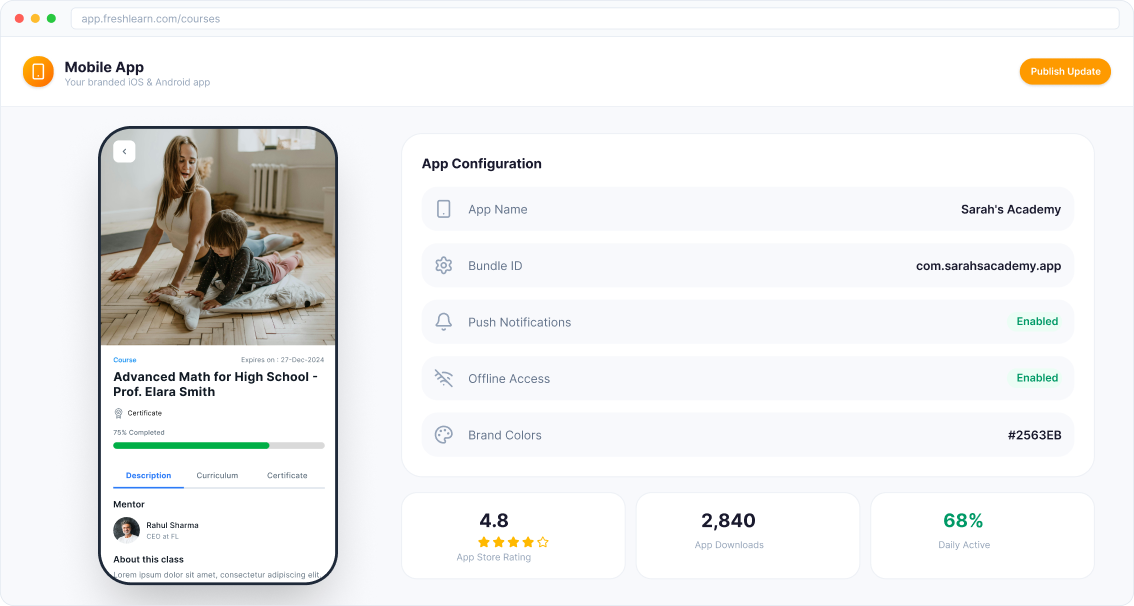
Branded mobile apps are another consideration, especially for live or cohort-based programs. There's a difference between giving learners an experience that feels like a real branded program and sending them back to a generic browser tab every time they need to check a session or access their course.
Then there are transaction fees.
This one is easy to ignore when you're getting started. It becomes much harder to ignore once you're selling a higher-priced certification at scale.
A percentage taken from every enrollment adds up quickly. And unlike a one-time software expense, it increases as your revenue increases.
FreshLearn brings these pieces together in one platform: zero transaction fees on every plan, white-label iOS and Android apps at no extra charge, and the certificate and compliance infrastructure covered above.
You don't have to bolt a certificate generator onto a course platform and then find another tool to handle compliance records.
Technical certification programs have many of the same structural requirements, even though the subject matter is different. This breakdown of how gated assessments hold up a rigorous certification track shows what that can look like outside a CE context.
For the full setup, see the certification programs use case page.
Build the credential, not just the course
A certification program takes more work than a normal course. That's not a flaw. It's the point. You're putting your name behind a standard and telling people that someone has met it.
So get the definition right first. Make the pass criteria meaningful. Then build the program on infrastructure that can issue certificates people can actually verify. Everything else gets easier once those pieces are sorted.
Want to see how FreshLearn handles certificate gating, seat-time tracking, and verification for a program like yours? Book a demo, and we'll walk through your specific setup.
FAQs
1. What's the actual difference between a course and a certification program?
A course teaches. A certification proves that a learner has met a particular standard and backs that claim with a credential someone else can check. If someone asks, "How do I verify this?" and your only answer is "You don't, really," then you probably have a course with a certificate attached rather than a true certification program.
2. How do I decide what my certification should actually certify?
Start with one sentence. What can someone with the certification do or prove that someone without it can't? If you're certifying a specific skill, that points toward a practical assessment. If you're certifying knowledge, an exam makes more sense. And if you're dealing with a compliance requirement such as CE hours, the program needs to follow whatever the relevant board actually requires. For CE programs, build attendance tracking into the system from day one. Trying to add it later is asking for trouble.
3. How many modules or hours should the program have?
There's no magic number. It depends on what you're certifying. A skill-based program needs enough material to cover every competency you're going to test, but there's no reason to add modules simply to make the program longer. CE programs are different. The board usually determines the requirement. If six hours are required, you need six real, trackable hours, not a rounded-up estimate.
4. What's a reasonable passing score for a certification exam?
Somewhere around 70 to 80 percent is common, although it varies depending on the field and how much is at stake. The exact number isn't really the point. What matters is that the threshold is enforced. If almost nobody can actually fail the exam, it isn't doing much as an assessment.
5. What makes a certificate defensible if someone questions it later?
Three things matter here. You need a unique serial number, a public verification page that a stranger can access without contacting you, and a record behind the certificate — such as the learner's score, attendance, or evaluation. Those records are what allow you to demonstrate that the credential wasn't simply generated and handed out.
6. Do I need formal accreditation to call something a certification?
It depends on the field. Mental health CE is a good example of why you need to check. Only board-recognized providers can issue credit that counts toward licensing renewal. Getting that wrong isn't a minor technicality; it can create real liability. In less regulated fields, "certification" can simply refer to a private standard you've established and are prepared to defend. An external accrediting body isn't necessarily required. If your program touches licensing or a regulated profession, check your approval status with the relevant board before you advertise a single hour of credit.
7. How much should I charge for a certification versus a regular course?
Usually more. Sometimes considerably more. The credential is doing something the course itself isn't. It might help someone qualify for paid work, satisfy a professional requirement, or give a potential client more confidence in their expertise. So price around what the certification enables, not simply around how much content you've created. If retakes are common in your field, charging separately for additional exam attempts is also worth considering.
8. Can I run CE credit hours through a certification program?
Yes, but you'll need more than a standard course setup. You need verified attendance or seat time behind each hour, a certificate that includes the credit hours and provider details, rules that prevent issuance until completion and usually an evaluation have been completed, and records you can export if a board requests them. FreshLearn's mental health CE tools are built around this workflow. They track attendance and seat time and let providers gate certificate issuance based on the rules they've established.
Written by