The NBCC-Compliant CE Course System: Certificates, Assessments, Evaluations, and Records

Quick Answer
An NBCC-compliant CE course requires an assessment that gates completion, a participant evaluation with five specific rating items collected before the certificate is issued, a certificate with six required fields including your ACEP number, and participant records retained for five years per program. For home study, credit is measured by word count or audio/visual runtime, not by time spent on the page; completion is verified by the assessment, not a timer. Certificates cannot be made available before the participant completes the program. NBCC audits every ACEP every three years from the approval anniversary; failure to submit complete materials by the deadline results in termination of ACEP status, not a warning.
Key Takeaways
- NBCC home-study completion is verified by assessment, not by time-on-page; there is no NBCC seat-time requirement for self-study programs, though individual state boards can impose stricter conditions.
- Text CE earns credit at 6,000 words per NBCC hour; audio/visual CE earns credit at 60 minutes per NBCC hour; both require a documented credit calculation submitted with the application.
- The assessment must be written by a professional with an advanced degree in a mental health field; every attempt must be retained, not just the passing score, and the author's credentials must be on file.
- The participant evaluation must include five NBCC-specified rating items; responses must be retained for five years and summarized in composite scores per program at audit.
- CE certificates require six specific fields and cannot be made available before course completion; a certificate accessible before completion is a policy violation regardless of whether anyone actually downloads it.
- Participant records must survive account deletion and course retirement for five full years; records purged on unenrollment create a compliance gap that only surfaces when it's too late to fix.
- NBCC audits every ACEP every three years from the approval anniversary date; missed deadlines result in termination of ACEP status and a ten-day window to stop issuing credit.
The paperwork side of becoming an NBCC ACEP looks straightforward until you read what you're actually attesting to. Among the statements in the application are: that you have "an accurate method to verify participant attendance," "a procedure for distributing certificates of completion within a timely manner," and "a secure recordkeeping process... for a period of 5 years following each program."
These aren't essay questions. They're descriptions of software that has to exist before you submit.
This article covers what that software needs to do: what NBCC requires inside the course, what gets captured at each step, and what your platform has to hand you when an audit arrives. If you're still deciding whether to become an ACEP, start with how to become an NBCC-approved CE provider and come back here when you're building.
If you haven't decided whether to become an approved provider yet, start with how to become an NBCC-approved CE provider and come back here when you're building.
What NBCC Actually Audits (and What It Doesn't)
Every ACEP gets an audit notification every three years from the anniversary date on the approval letter. You submit audit forms, supporting materials, and any outstanding fees by the stated deadline. NBCC also reserves the right to audit any ACEP activity or material at any time outside the regular cycle.
Missing the deadline isn't met with a warning. Failure to submit complete audit forms and materials results in termination of ACEP status. After the termination letter, you have ten days before you must stop offering NBCC credit and publish a notice on your site saying you're no longer approved.
What audits don't examine: your teaching. Nobody reviews your videos or evaluates whether you're good at this. NBCC audits your records. That single fact should shape how you build the whole system.
The Required Compliance Sequence for NBCC CE Courses
Every compliant home-study CE course follows the same chain: enrollment, content delivery, assessment, evaluation, certificate issuance, record retention. Each step has to happen in order, and breaking any link means the hours don't count.
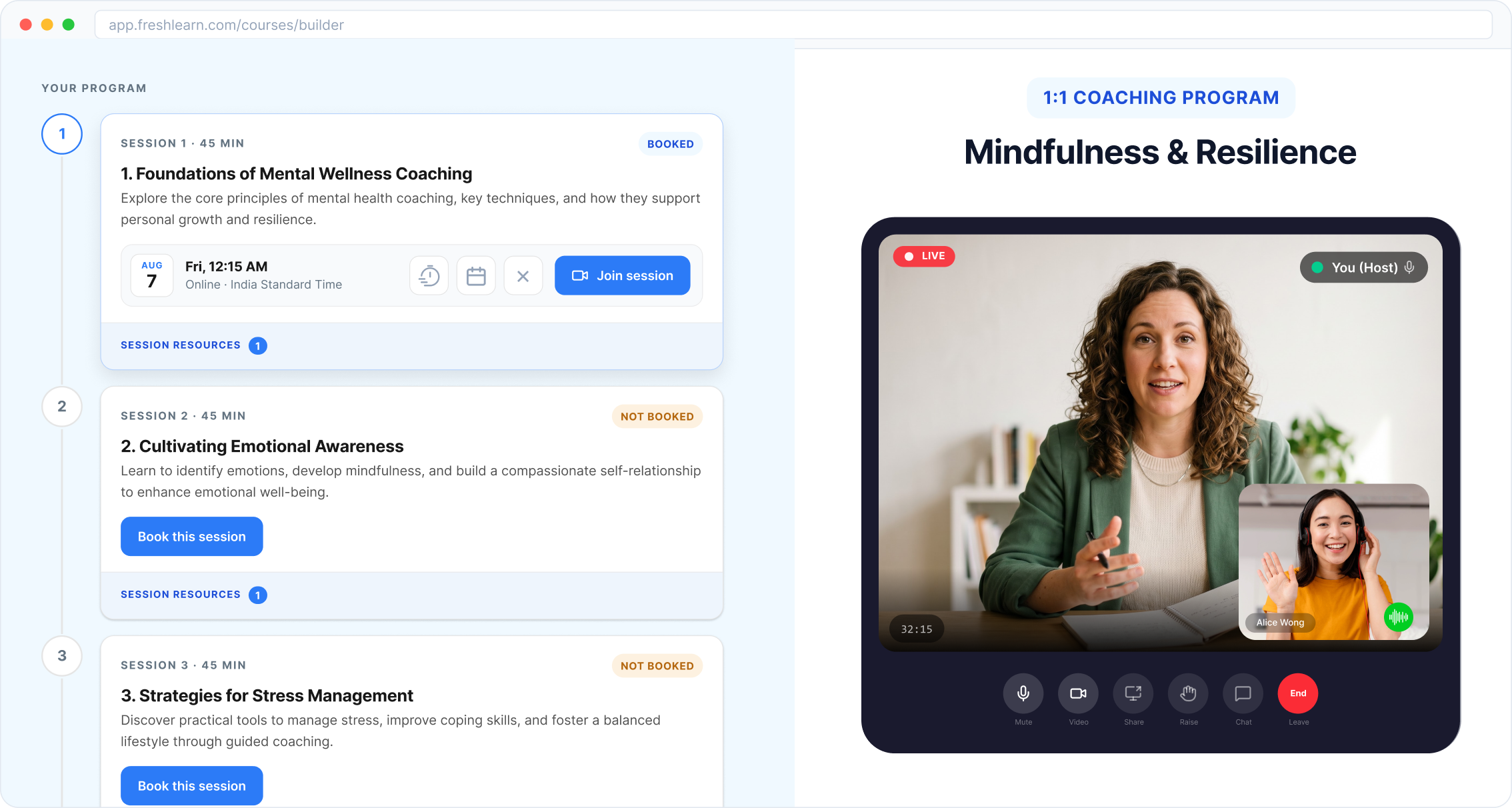
The last two steps are the ones most platforms create gaps in. The certificate has to be generated only after completion criteria are met. The evaluation has to be collected as part of that completion process, not sent by email afterward and never returned. And the records from all of it have to survive in a retrievable form for five years from the program date.
Live programs follow the same sequence with one substitution — verified attendance stands in for the assessment.
Seat-Time Tracking: What NBCC Actually Requires for Home-Study CE
There's a widespread assumption in the CE industry that compliant courses must track the minutes a learner spends on each page, with idle timers and activity checks. For NBCC home-study programs, that's not the requirement.
For on-demand courses, the gate is a passing assessment, not a timer. As long as the assessment exists and the participant completes it, completion is documented.
For video-based CE, you should still lock the player so participants can't skip ahead or jump to the next module before finishing the current one. The reason isn't that NBCC audits it. The reason is that you certified a specific number of hours of viewing time, and sequential unlock is how you know those hours were actually delivered. It also makes future applications to ASWB or state-level approval programs easier, since several of those do have stricter requirements on this point. The distinction matters: locking video progression is good practice and protects the credit you're issuing. It's not an NBCC audit requirement.
State boards are a separate consideration. Individual state boards can impose their own home-study conditions, and some do require seat-time verification. Check the requirements in the states where your buyers practice before building only to NBCC's minimum.
How NBCC CE Credit Hours Are Measured
A 3-hour text CE course is 18,000 words. Once written, updating it is a text edit: no studio, no reshoots when clinical guidance changes.
The application requires that you document the credit calculation in writing: the actual word count or recording length, converted to NBCC hours. NBCC doesn't accept your estimate. Submit the arithmetic.
One terminology note: "CEU" is prohibited under NBCC policy. Acceptable terms are NBCC hours, clock hours, credit hours, CE hours, or contact hours. The prohibited term appears on a large number of self-issued certificates and is worth avoiding.
NBCC CE Assessment Requirements for Home Study
For home study, the assessment is the completion mechanism, not a teaching tool. NBCC's policy states that home-study completion "must be verified by the completion of an assessment."
The policy is specific about who writes it: an assessment instrument prepared by a professional with an advanced degree in a mental health field, intended to evaluate the participant's knowledge of the program material. Question count, passing score, and retake policy are your decisions, but they're not unimportant decisions.
A few things worth building around:
Write questions that map directly to your stated learning objectives. That's the thread an auditor follows from the learning outcomes to the test content. If a question can't be traced to an objective, cut it or rewrite the objective.
Set a real passing threshold and publish it before participants enroll. They should know the standard upfront.
Retain every attempt, not just the passing score. If a participant passed on the fourth try, you need a complete record of all four. "She passed eventually" isn't an audit response; a full attempt history is.
Document the credentials of whoever wrote the assessment. The advanced mental health degree requirement is real, and the documentation proving the author held that degree has to be in your files alongside the course records.
The NBCC Participant Evaluation: Five Required Items
Every participant gets an evaluation document. NBCC specifies exactly what has to be in it: a rating scale, the program title and date, and rating items covering each of the following:
The form also needs space for written comments and a question about whether the program met the participant's expectations.
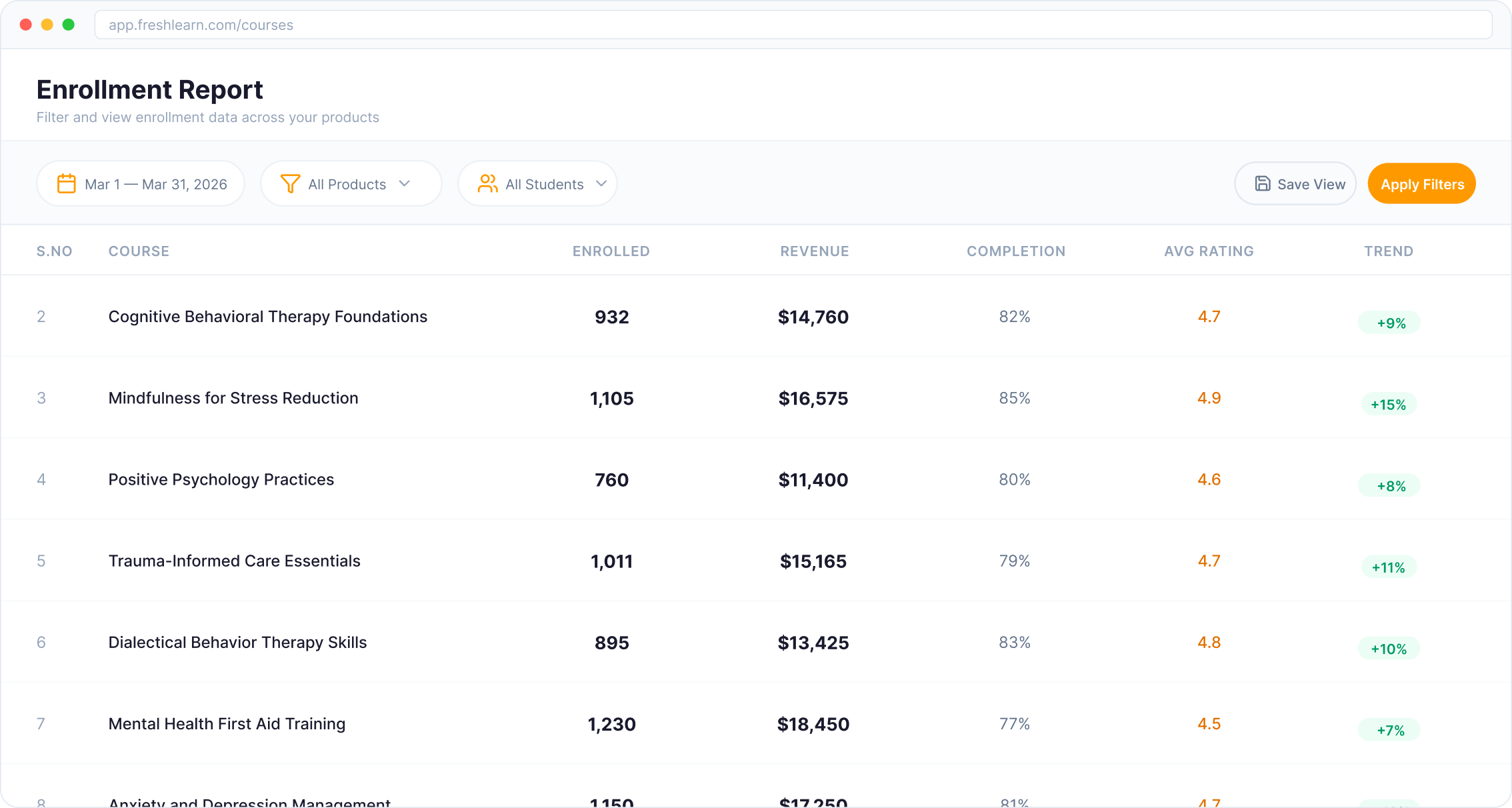
What happens with evaluations after collection is where the obligation gets real. You keep them for five years from the date of each program. At the third-year audit, you submit a summary per program: title and dates, participant count, all comments received, and composite rating scores for each of the five required items. NBCC also asks whether you modified programming based on the feedback.
That summary requirement has scale to it: composite scores per item, across every participant, for every program, going back years. If your evaluation responses live in a survey tool that isn't connected to your enrollment records, producing that summary is a manual reconciliation project. If the responses are tied to enrollment from the start, it's an export.
Build the evaluation into the course completion flow as a required step. An evaluation email that nobody opens is a five-year compliance gap.
NBCC CE Certificate Requirements: Six Fields and Two Timing Rules
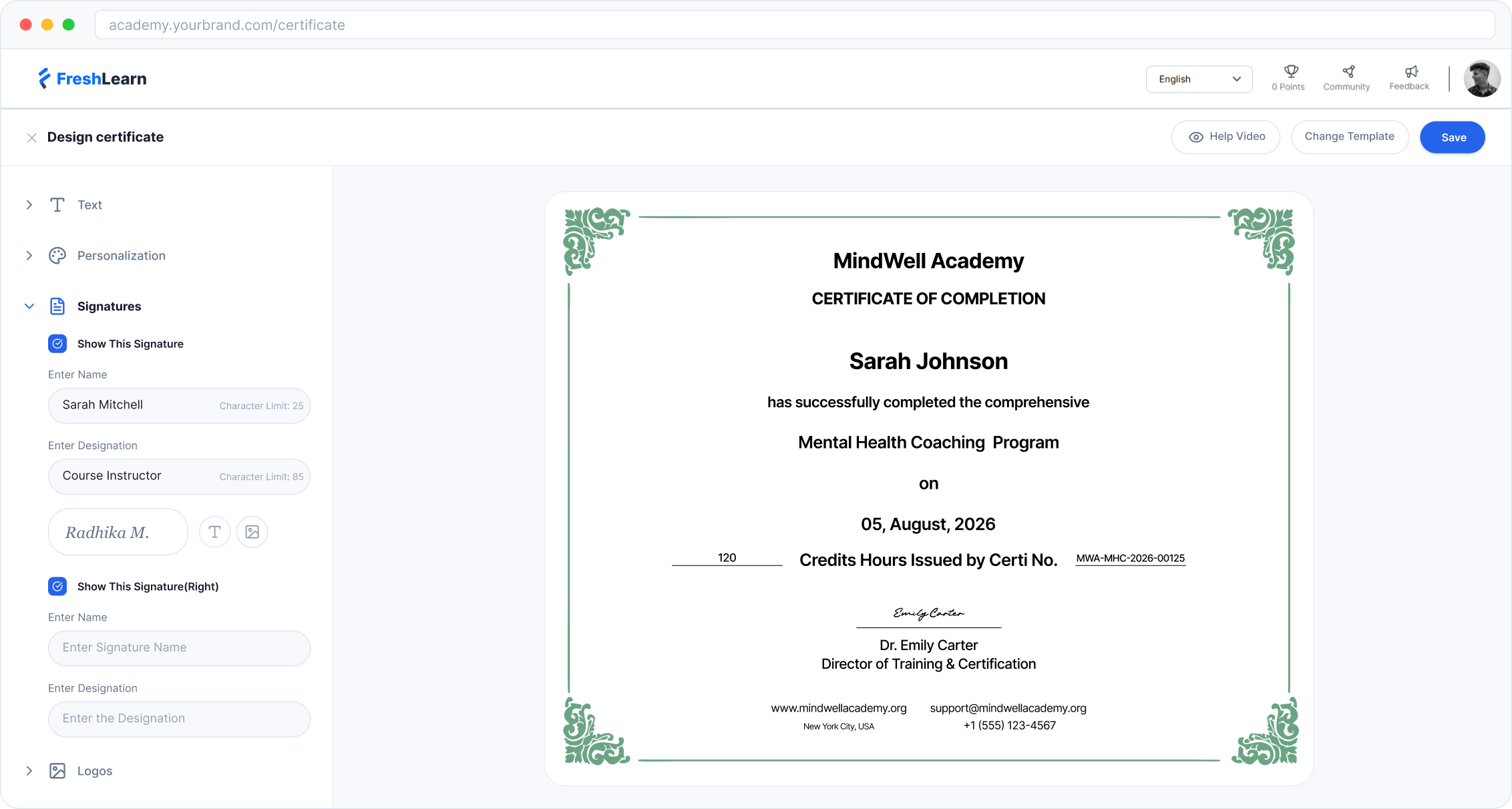
The certificate is what your participant carries to their licensing board. A missing field may mean the hours don't count, and you'll hear about it from them.
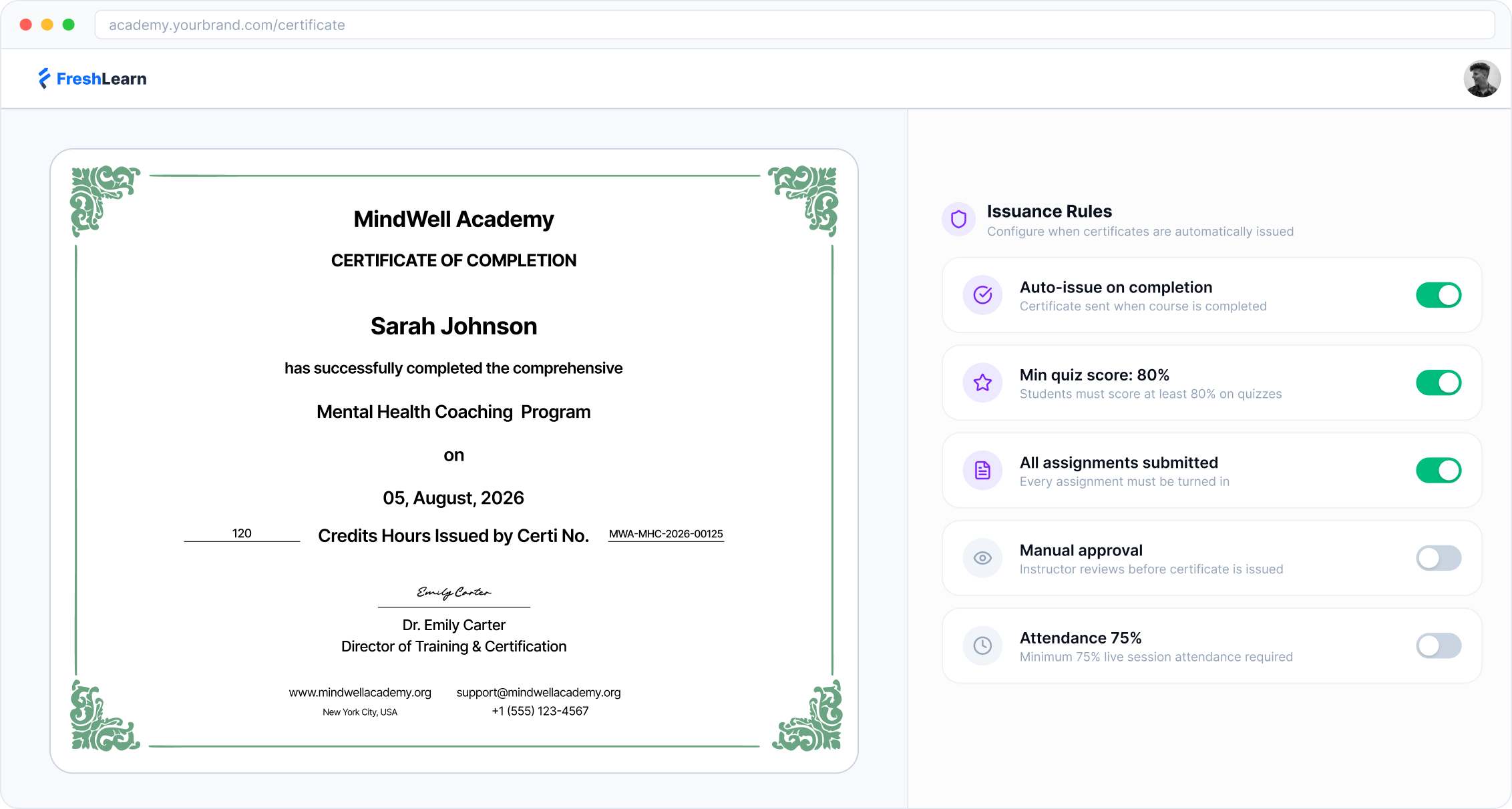
On timing: certificates have to be issued in a timely manner after completion, and they cannot be made available before the participant finishes. NBCC's language is unambiguous: certificates "must not be made available prior to the completion of the qualifying program." A participant who can download a certificate from the course dashboard on day one is a compliance violation regardless of whether they actually do it.
The approval statement on all program materials, including advertising and your website, has to use this exact wording:
[ACEP NAME] has been approved by NBCC as an Approved Continuing Education Provider, ACEP No. ____. Programs that do not qualify for NBCC credit are clearly identified. [ACEP NAME] is solely responsible for all aspects of the programs.
NBCC prohibits any other statement about NBCC approval or endorsement, including any implication that NBCC endorses your specific clinical theory or method.
A usable certificate template:
[YOUR ORGANIZATION NAME] [address | email | phone]
CERTIFICATE OF COMPLETION
This certifies that [PARTICIPANT FULL NAME] has completed
[PROGRAM TITLE]. Date of completion: [DATE] Credit awarded: [X.XX] NBCC hours
[NBCC approval statement, verbatim, with ACEP number]
[NAME], [TITLE], Authorized Representative
Certificate ID: [UNIQUE ID] | Issued: [TIMESTAMP]
The unique certificate ID and timestamp are not NBCC requirements. Add them anyway. When an auditor names a participant and a program date, a unique ID is how you find the record in seconds.
If You Run Live Programs, Three Things Change
Everything above describes home study. If you're approved for live events — in person or delivered in real time online — three requirements work differently.
Completion is proven by attendance, not an assessment. This is the one that matters most. NBCC requires that you ensure the participant “attended the live program, and was present for the number of NBCC hours indicated on the certificate,” verified by “an accurate, verifiable method.” There is no posttest requirement for live programs. The assessment instrument is part of the home study program materials list. If you run live events only, you don't need to build one.
The certificate has a different date field. A live document of completion carries the title and date of the live program rather than the date of completion, and may carry either your ACEP number or an NBCC Single Program Provider number. The other four fields are identical.
The evaluation adds a facilities item. NBCC's rating item (c) — the facility and accommodations — applies to live programs only. Home study courses skip it.
Your records also expand: for live programs you keep a list of every presenter, their qualifications, and an accurate description of the content each one delivered.
One note if you're not yet approved: NBCC's eligibility rule accepts two different live programs or one home study program. Live is often the faster route to qualifying, because most clinicians have already run workshops they can document.
Five Years of CE Records: What You Keep
For every program that offered NBCC credit, you keep all of the following for at least five years:
- Participant roster
- All live presenters, their qualifications, and what each covered
- All home-study authors and contributors, and what each contributed
- Program content description
- All participant evaluations
- Promotional and marketing materials
- Program agenda and all materials given to participants, including learning objectives
Secure backups are required. NBCC can request any of this at any time, not just at the three-year audit.
A question worth asking any CE platform before you commit to it: what happens to participant records when someone unenrolls, when their account is deleted, or when you retire the course? If the answer is "purged," you have a five-year compliance problem you won't discover until an auditor asks for a roster that no longer exists.
Written Policies You Need Before Applying for NBCC ACEP Status
The ACEP application asks you to attest to these. They need to be written before you submit.
- A policy on the confidentiality and security of participant information
- Program fee, refund, and cancellation policies
- A published policy for reviewing and resolving participant complaints and disputes
- ADA accommodations across all programs, plus non-discrimination
- Secure encryption for electronic payments on home-study programs
These aren't reviewed the way your course content is, but they're attested to in writing and subject to audit. Write them before you apply.
What Your CE Platform Needs to Be Able to Do
The application attestations about your systems describe software that has to exist. Here's how those requirements translate to platform capabilities:
Assembling this from separate tools (an LMS, a quiz plugin, a certificate plugin, a survey tool, and a payment processor) means five update cycles, five vendors, and five independent failure modes. The failure is rarely dramatic. It's a plugin update that quietly stops writing evaluation responses to the database for three months, discovered in year four of a five-year retention window.
FreshLearn handles the full workflow in one place with 0% transaction fees: assessments with pass thresholds and full attempt history, certificates that issue only on completion, evaluations tied to the course flow, and exportable per-participant records that survive unenrollment.
Building for ASWB and APA Approval
The course you build for NBCC qualifies the content for ASWB and APA approval as well, because the subject matter overlaps substantially. The approvals themselves don't overlap at all.
ASWB ACE approval covers LCSWs and LICSWs. ASWB has stricter standards than NBCC in several areas, including longer record retention requirements and prescribed posttest question counts. If you plan to pursue both approvals, it's worth building to ASWB's higher standard from the start rather than retrofitting a course designed only to NBCC's minimum.
APA CE Sponsor Approval covers psychologists. Applications go through APA's Continuing Education Committee, which meets twice a year.
The marginal cost of a second approval is much lower than the first, because the course, assessment, evaluation, and record-keeping infrastructure already exist. It's the same content reviewed by a different organization.
Pre-Launch NBCC Compliance Checklist
Run this before committing to a platform and before submitting your ACEP application.
Course access:
- Course content is gated to enrolled, authenticated users
- Credit calculation is documented: word count or recording length converted to NBCC hours
Assessment:
- Assessment exists, written by someone with an advanced mental health degree
- That credential is documented in your files
- Passing score and retake policy are set and published for participants
- Every assessment attempt is retained, not just the passing score
Evaluation:
- Evaluation form contains all five required rating items
- Form includes space for written comments and a met-expectations question
- Evaluation is collected as part of course completion, not emailed afterward
- Evaluation responses export in a form that produces composite scores per item
Certificate:
- Certificate contains all six required fields
- Approval statement appears verbatim with your ACEP number
- Certificate is not accessible before course completion
- Certificate issues automatically after completion criteria are met
- Certificate carries a unique ID and issue timestamp
Records:
- Participant records survive unenrollment, account deletion, and course retirement for five years
- Secure backups exist and are verifiable
Policies (written and on file):
- Participant information confidentiality
- Program fees, refunds, and cancellations
- Complaint and dispute resolution process
- ADA accommodations and non-discrimination
FAQs About NBCC CE Course Compliance
1. Does NBCC require seat-time tracking for home-study CE courses?
No. NBCC measures home-study credit by word count for text programs or runtime for audio/visual programs, and verifies completion through an assessment. There's no NBCC requirement for tracking minutes spent on a page. Live programs are different: attendance for those must be verified by an accurate, verifiable method for the hours awarded. Individual state boards can impose stricter conditions for home study, so check requirements in the states where your buyers hold their licenses.
2. What six fields must appear on an NBCC CE certificate of completion?
The ACEP name and contact information, the program title and date of completion, the participant's name, the number of NBCC hours awarded, an authorized representative's name and signature, and the NBCC ACEP number. All six are required; missing any one of them may void the hours for your participant.
3. Can a participant access their certificate before finishing the course?
No. NBCC's policy states that certificates "must not be made available prior to the completion of the qualifying program." A participant being able to reach the certificate before completing the course is a violation regardless of whether they actually download it.
4. How long do I have to keep CE records?
At least five years per program. That covers the participant roster, presenter and author qualifications tied to specific subject matter, program content description, all participant evaluations, marketing materials, and all materials given to participants, including learning objectives. Secure backups are required, and NBCC can request records at any time, not just at the three-year audit.
5. How many questions does the NBCC CE assessment need?
NBCC doesn't specify a count. It requires an assessment instrument prepared by a professional with an advanced degree in a mental health field, designed to evaluate the participant's knowledge of the program material. Passing score and retake policy are set by you, but both should be documented and published to participants before they enroll.
6. What does NBCC require in the participant evaluation summary at audit?
For each program, you submit the program title and dates, the number of participants, all participant comments verbatim, and composite rating scores for each of the five required evaluation items. You do not submit individual evaluations unless NBCC specifically requests them. That summary requirement covers every program going back years, which is why evaluation responses need to be stored alongside enrollment records from the start rather than in a separate tool.
7. What happens if I miss an NBCC audit deadline?
Failure to submit complete audit forms, supporting materials, and outstanding fees by the due date results in termination of ACEP status. From the termination letter, you have ten days before you must stop issuing NBCC credit and publish a notice on your website that you're no longer an approved provider.
8. Can I use a video-based course for NBCC CE?
Yes. NBCC explicitly allows audio/visual home-study programs and awards one NBCC hour per 60 minutes of listening or viewing time. You should still lock sequential progression so participants can't skip modules, not because NBCC audits it, but because you certified a specific number of hours of viewing time, and sequential unlock is how you know those hours were actually delivered.
9. Can I offer live CE classes as an NBCC ACEP?
Yes. NBCC approves two delivery formats — live event and home study — at $800 for the first and $400 to add the second. Live events can be in person or delivered in real time online.
10. Do live CE programs need a posttest?
No. NBCC verifies live program completion through attendance, using an accurate and verifiable method. The assessment requirement applies to home study programs.
Sources
- NBCC Continuing Education Provider Policy (PDF)
- NBCC ACEP Application (PDF, updated March 2024)
- NBCC — ACEP overview
- ASWB — ACE provider approval
- APA — Continuing Education Sponsor Approval
Last verified: August 2026. NBCC policies and fees change; confirm current requirements with NBCC before applying.
Written by