How to Become an NBCC-Approved CE Provider (ACEP) and Sell Continuing Education to Counselors

Quick Answer
Becoming an NBCC-Approved Continuing Education Provider (ACEP) means applying to NBCC with an $800 fee for your first delivery format, but the program has to already be built and running when you apply; you can't apply based on a plan. NBCC reviews the live course, your presenter credentials, your policies, and your credit calculation before issuing an ACEP number. That number is what makes CE hours valid for LPCs, LMHCs, and LMFTs renewing their licenses. Build first, then apply.
Key Takeaways
- The application fee is $800 for one delivery format; adding the second costs $400 more; both are nonrefundable and don't enter the review queue until payment clears.
- You can't apply based on a course outline; you need programs already running: at least two qualifying live programs or one home-study course, submitted live and functional with your application.
- Text-based CE earns credit at 6,000 words per NBCC hour; a 3-hour course is 18,000 words; anything under 1,500 words doesn't qualify for any credit.
- Six fields must appear on every certificate: ACEP name and contact, program title and completion date, participant name, hours awarded, authorized representative name and signature, and the ACEP number; missing any one of them voids the hours.
- NBCC cosponsorship applies to live events only, one program at a time, approved in advance; it doesn't extend to on-demand home-study programs under another provider's ACEP number.
- Evaluations aren't optional: collect them from every participant, keep them for five years, and summarize them for NBCC at the third-year audit.
- FreshLearn covers the full compliance workflow in one platform with 0% transaction fees: completion tracking, sequential progression, assessment gating, evaluation collection, certificate issuance, and exportable records.
A lot of practitioners who end up running CE programs didn't set out to build a CE business. They explained the same clinical approach enough times that someone eventually told them to write it down. Once you see how the market works, the incentive to formalize it makes sense.
Counselors have to complete continuing education to renew their licenses. Every LPC, LMHC, and LMFT, every renewal cycle, for as long as they're licensed. That's demand you don't have to manufacture; it's built into state licensing requirements. Most states use a two-year cycle with 20 to 40 hours required, including an ethics component. There's no opting out.
What you do have to create is the approval. CE hours only count if they come from an approved provider, and getting that approval is a compliance process that comes before the marketing. That's what this covers.
One clarification worth making upfront: CE requirements are set by each state board, not by NBCC. Hour counts, ethics minimums, and home-study caps all vary and can change. Check the requirements in the states where your buyers hold their licenses before you build a program around a specific credit count.
Who Controls NBCC Continuing Education Approval
Four organizations touch a counselor's career in some way, and it's common to mix them up.
NBCC is the relevant one for becoming a CE provider. It doesn't issue licenses (your state board does that), but it approves organizations to issue CE credit. Getting an NBCC ACEP number doesn't automatically satisfy every state board either. Some boards maintain their own approved-provider lists or cap the home-study hours they'll accept regardless of NBCC status. Verify what applies in the states where your buyers practice.
The Two Ways to Issue NBCC-Approved CE Credit
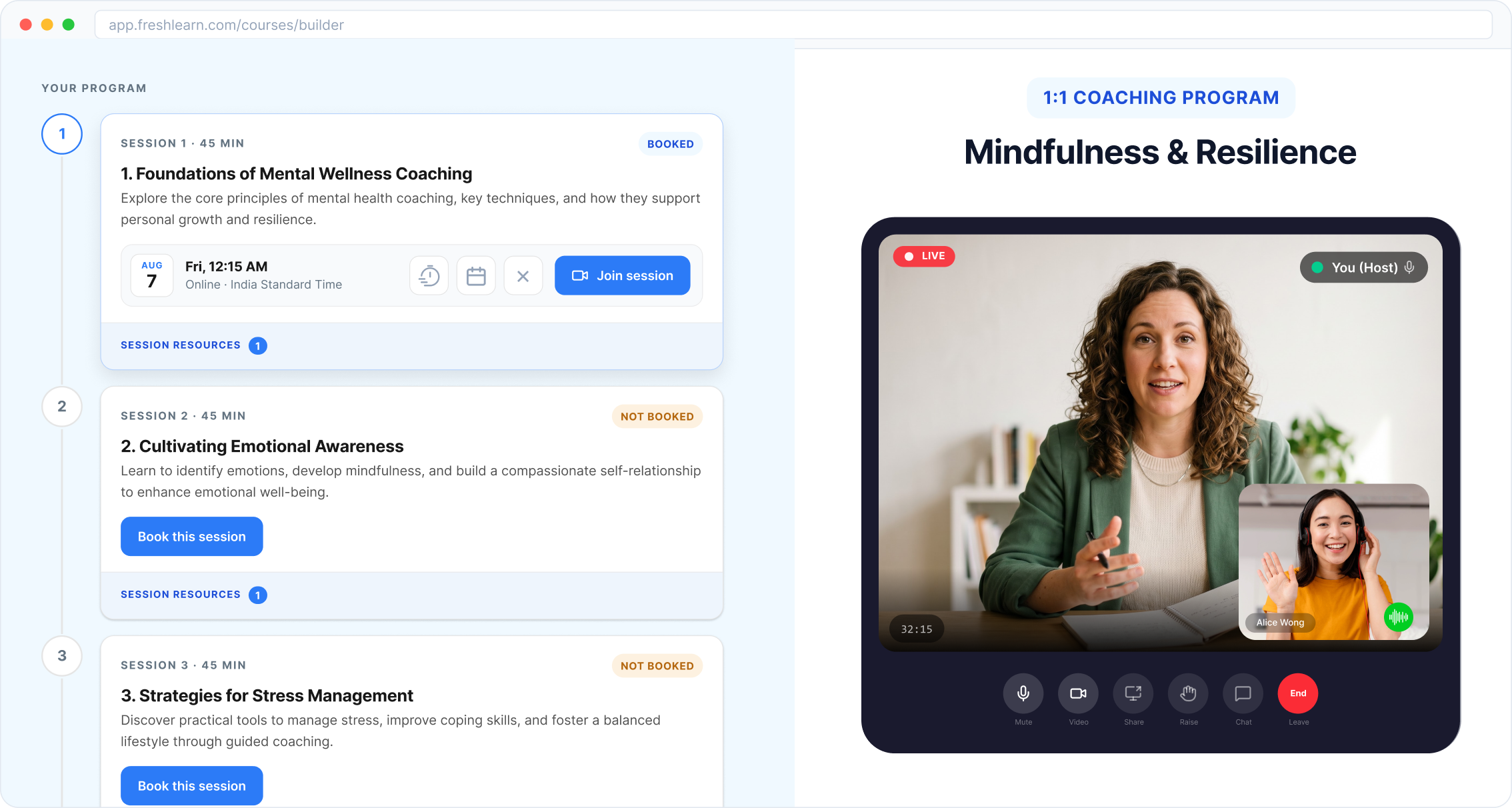
Become your own ACEP. You apply, get approved, receive an ACEP number, and can issue credit for any qualifying program you run. You own the brand, the margin, the customer relationship, and the compliance. If you're planning to build a real CE operation, this is the path.
Co-sponsorship. NBCC allows an approved ACEP to partner with another organization or individual on specific programs, but the policy is narrower than most people expect. Co-sponsorship is "permitted on a one-time, preapproved basis only with respect to a specific, live event delivery program." Live events only, one program at a time, approved in advance. It's a route for co-hosting a workshop with an established provider, not for building a library of on-demand home-study courses under someone else's ACEP number.
This is worth being clear about because the idea circulates that you can write self-study courses and sell them under an existing provider's approval. For home-study programs, you can't. An ACEP can use content it didn't author, provided it holds the rights and the author's credentials meet NBCC's presenter requirements; licensing content to deliver under your own number is legitimate. Using someone else's ACEP number as a workaround for applying isn't.
NBCC ACEP Eligibility Requirements
You can't apply until you've already built the program. That catches most first-time applicants off guard.
NBCC requires applicants to already be running qualifying programs before they submit: at least two different qualifying live programs or one qualifying home-study course, submitted live and accessible, including the login credentials NBCC's reviewers need to access it from the inside. No provisional applications for something still in development.
Beyond the program itself:
- An ACEP administrator: your point of contact with NBCC on anything approval-related.
- A program content administrator: must hold an advanced degree in a mental health field from an accredited institution; responsible for ensuring content and presenters meet policy. One person can hold both roles.
- Written policies on participant information confidentiality, program fees, refunds and cancellations, and complaint resolution. These are attested to in the application, so they have to exist before you submit.
- ADA compliance and non-discrimination across all programs.
One more rule with direct marketing consequences: don't advertise NBCC approval, pending approval, or provider status before receiving written notification from NBCC. Nothing on your site about approval until the letter arrives.
NBCC ACEP Application Fees and Required Documents
Start by choosing a delivery format.
Then, provide some details.
Fees are nonrefundable and nontransferable. The application doesn't enter the review queue until payment processes, and review happens in the order payment clears. Figures above are from the March 2024 ACEP Application; verify current amounts with NBCC before you budget.
For one complete home-study program, you submit ten things:
- Completed Attachment B for the program
- Advertising and registration materials
- A blank program evaluation form
- Presenter Qualification Forms for every author, credentials tied to what they specifically covered
- A sample certificate with no participant name filled in
- The full learning materials
- URLs, usernames, and passwords for NBCC's live review
- Your credit measurement calculation: exact word count or recording length, converted to NBCC hours
- An assessment instrument written by someone with an advanced mental health degree
- A reference list of every source used
Item 8 is the one that catches people. NBCC doesn't accept your estimate of how many hours the course is worth. You show the arithmetic.
How NBCC Calculates CE Credit Hours
The text-based math is worth sitting with before you scope the course. A 3-hour text-based CE course is 18,000 words, roughly the length of a short book. For a practitioner who already knows the material, that's achievable, and text-based CE tends to have better margins than video: no production costs, no reshoots when the clinical guidance gets updated.
Across all formats, live attendance has to be verifiable; you need to be able to show that a participant was present for the hours on their certificate. For home study, an assessment verifies completion. That's not optional; it's the mechanism NBCC uses to confirm someone actually finished.
On terminology: "CEU" is prohibited under NBCC policy. Acceptable terms are NBCC hours, clock hours, credit hours, CE hours, and contact hours. The prohibited term shows up on a lot of self-issued certificates and is worth avoiding.
Required Components of an NBCC CE Course
NBCC specifies what a qualifying home-study program has to contain. Building this in from the start is easier than retrofitting it.
Learning materials in text, audio, or web format, professional in both content and presentation.
Author and presenter information: names, credentials, and qualifications tied to the specific subject matter they covered.
An assessment instrument evaluating participant knowledge, written by someone with an advanced degree in a mental health field.
Instructions explaining how the participant obtains NBCC credit after completing the program.
A reference list of every source used in developing the program: journal articles, books, official documents.
A participant evaluation document. The requirements for this are specific enough to cover separately below.
Presenter Qualifications for NBCC CE Programs
Category 1 is required for any content related to counseling or treating clients: ethics, assessment, diagnosis, clinical practice. That's the rule that determines what most course catalogs can realistically include. Honorary degrees don't satisfy it.
The nine NBCC content areas
Your program has to sit primarily within one of these:
- Counseling Theory/Practice and the Counseling Relationship
- Human Growth and Development
- Social and Cultural Foundations
- Group Dynamics and Counseling
- Career Development and Counseling
- Assessment
- Research and Program Evaluation
- Counselor Professional Identity and Practice Issues
- Wellness and Prevention
Content area 8 is underutilized. It explicitly covers practice-building topics: starting a practice, fee-setting, billing, ethical marketing, clinical supervision models, and social media use. Less competitive than clinical content, and it qualifies for CE credit.
The Participant Evaluation: What NBCC Requires
Every participant gets an evaluation document. NBCC specifies what it has to contain: a rating scale, the program title and date, and rating items covering each of the following:
- The content of the program
- The knowledge and presentation skills of each presenter
- Facility and accommodations (live programs only)
- The content and quality of program materials
- The relevance of the program to professional counselors
Space for written comments is required, as is a question about whether the program met the participant's expectations.
The part that creates audit problems: you have to collect these evaluations from every participant and retain them for five years. At the third-year audit, you submit a summary per program covering title and dates, participant count, all comments verbatim, composite scores on each required item, and whether you've modified programming based on feedback. An evaluation link that nobody clicks is a compliance failure, not a formality. Build it into the course completion flow as a required step.
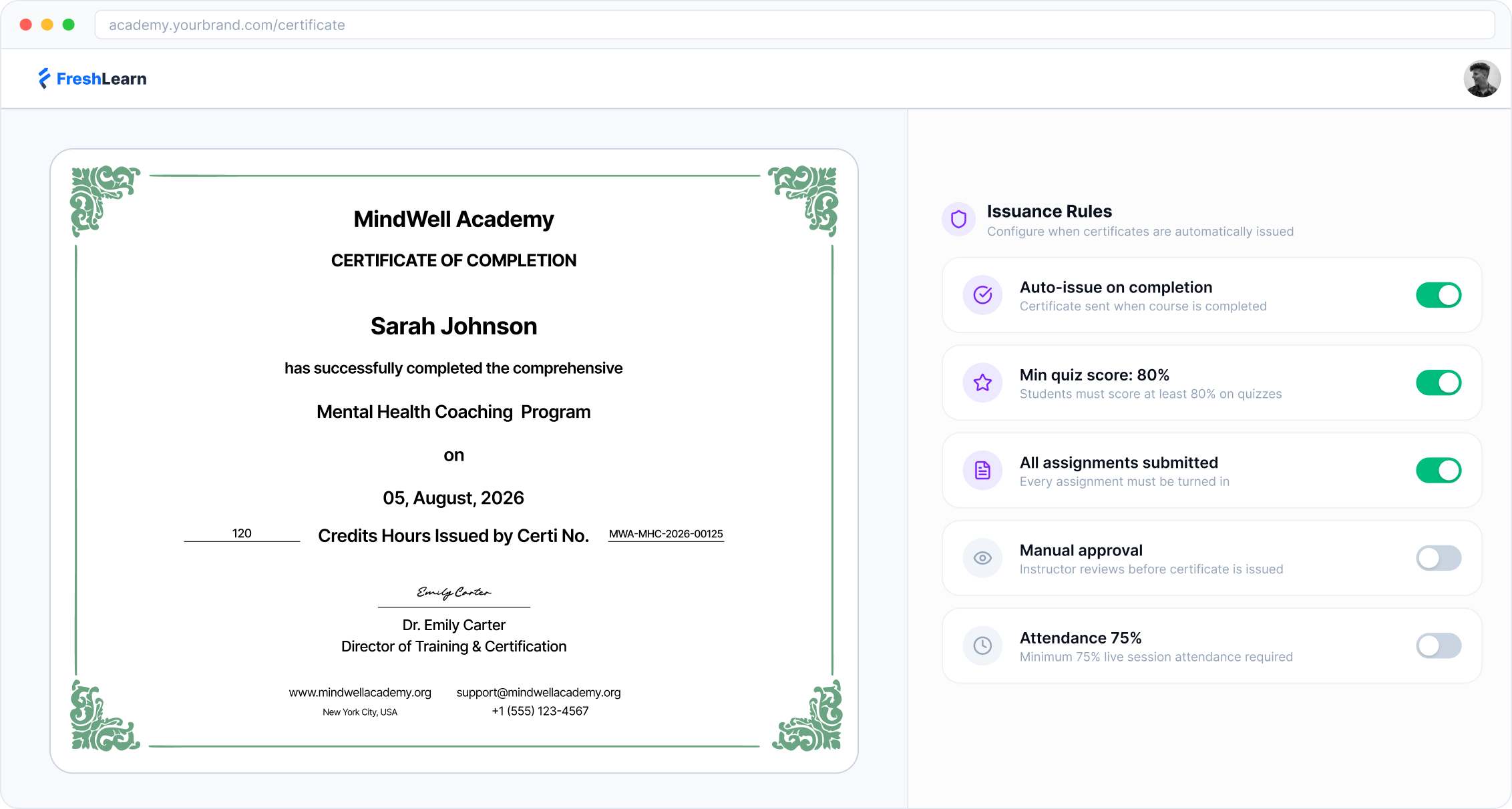
NBCC CE Certificates: Six Required Fields
Certificates go out after completion, not before. A certificate available to download before the participant finishes is a policy violation.
The approval statement has to appear on all program materials, including advertising and your website. Use this wording exactly:
[ACEP NAME] has been approved by NBCC as an Approved Continuing Education Provider, ACEP No. ____. Programs that do not qualify for NBCC credit are clearly identified. [ACEP NAME] is solely responsible for all aspects of the programs.
NBCC prohibits any statement implying they endorse your specific clinical theory or method.
CE Record-Keeping: What You Maintain for Five Years
For every program that offered NBCC credit:
- Participant roster
- All live presenters, qualifications, and what each covered
- All home-study authors and contributors, and what each contributed
- Program content description
- All participant evaluations
- Promotional and marketing materials
- Program agenda and all materials given to participants, including learning objectives
Secure backups are required. NBCC can request any of this at any time, not just at the third-year audit. Keep it organized well enough to produce on short notice.
Choosing a Platform That Can Support NBCC Compliance
Your application includes attestations about your operational systems. These describe software that has to exist before you apply, not things you plan to figure out later.
You can assemble this from separate tools: an LMS, a quiz plugin, a certificate plugin, a survey tool, a payment processor. Each has its own update cycle and its own ways of breaking the others. Or you can run it from one platform. FreshLearn handles the full workflow in one place with 0% transaction fees: completion tracking, sequential progression, assessments, evaluations, certificates, and record exports.
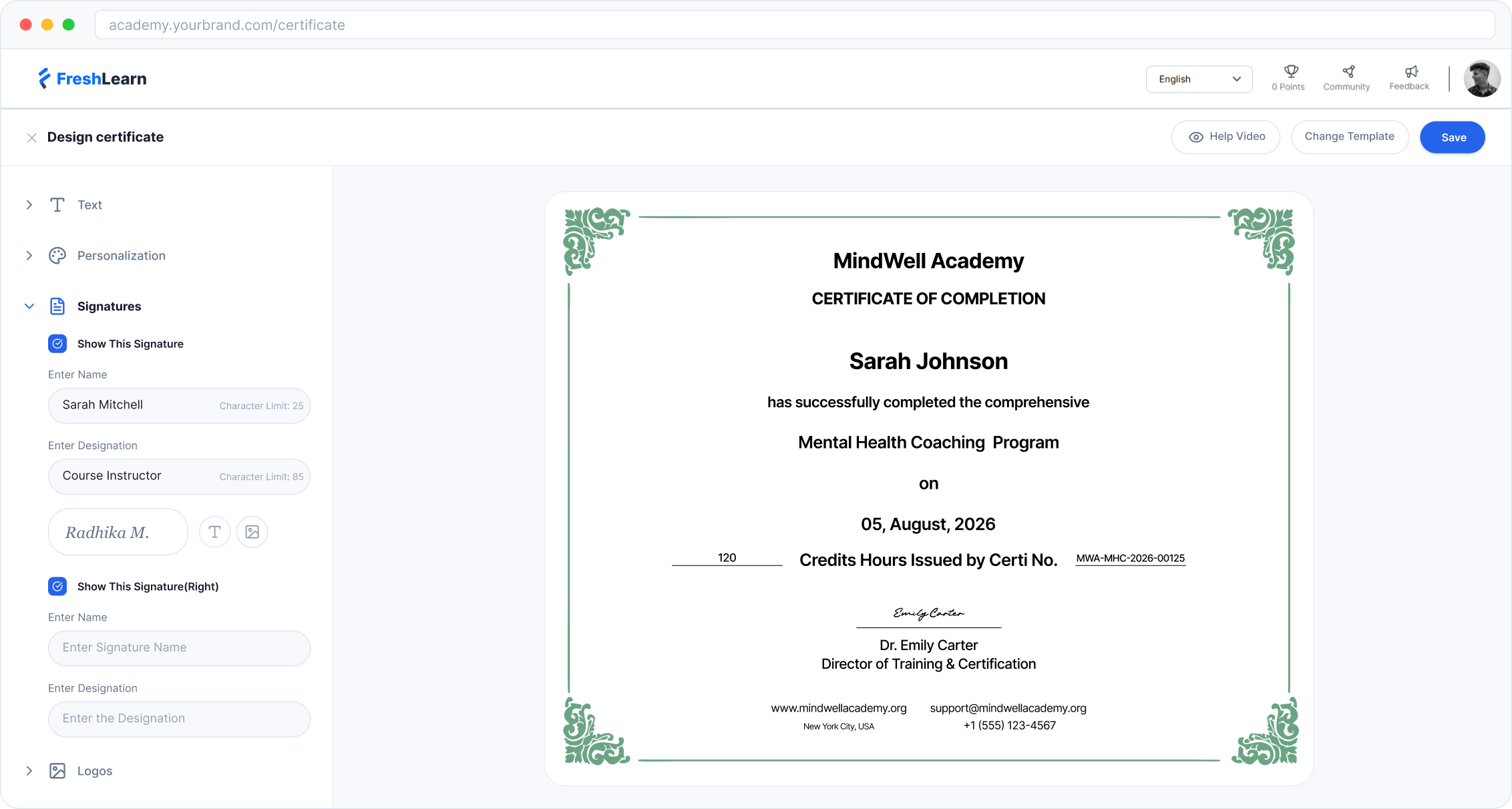
For the full specification — the six certificate fields, the assessment that verifies completion, the five required evaluation items, and what five years of records actually contains — see the NBCC-compliant CE course system.
Pricing and Packaging CE Programs
Clinicians think in hours because that's how their board counts. Price accordingly: publish a per-hour rate, then offer a bundle that covers the full renewal cycle at a discount. That's typically where the margin concentrates.
Ethics hours are mandatory in nearly every state, which makes them high-intent. A solid ethics course is your lowest-cost acquisition; specialty courses carry the revenue once you have the relationship.
Deep specialty content holds its price in a way that generic content doesn't. Volume providers can't credibly replicate twelve years in a specific clinical area. That's a real structural advantage for a practitioner building a CE catalog.
Group practices and agencies often buy CE for whole teams. A single conversation with a practice owner can outperform months of marketing to individual clinicians.
Stacking ASWB and APA Approvals
The course you built for counselors is largely the same one social workers and psychologists need. The content, assessment, evaluation, and record-keeping infrastructure transfer. Only the approval body changes, and the marginal cost of a second approval is much lower than the first.
ASWB ACE approval covers LCSWs and LICSWs. ASWB requires prequalification before application and involves a licensed social worker in program planning.
APA CE Sponsor Approval covers psychologists. Applications go through APA's Continuing Education Committee, which meets twice a year.
Providers who list NBCC, ASWB, and APA approvals side by side built the course once and ran it through the approval process for each profession separately. It's the most direct path to reaching the entire mental health field from a single program.
Five Mistakes That Create Audit Problems
Learning objectives that don't measure anything. These go in your five-year records. "Understand trauma" is not a learning objective. "Identify three behavioral indicators of complex trauma during an intake assessment" is.
Presenter documentation that doesn't match. Every author needs credentials on file tied specifically to the subject matter they covered, not just their general professional background.
Incomplete certificates. Six fields, no exceptions. A missing ACEP number or missing signature voids the hours for your participant.
Evaluations offered but not collected. The link existing isn't enough. You need the responses, five years of retention, and a composite summary ready for audit.
Marketing approval you don't have. Nothing about NBCC approval or pending approval goes on your materials until the written notification arrives.
Getting to NBCC ACEP Status: Your First 90 Days
Days 1 to 30: Build the program. Choose a content area and topic. Write learning objectives that are actually measurable. If you're going text-based, target the word count that matches your intended hours: 6,000 per hour. Draft your confidentiality, refund, and complaint policies.
Days 31 to 60: Make it a complete program. Load everything onto your platform. Write the assessment. Build the evaluation form with all five required rating items. Design the certificate with all six required fields. Put presenter documentation together. Write out the credit calculation.
Days 61 to 90: Apply and build the audience. Submit with your $800 fee and all required attachments. While it's in the review queue, build your email list, but put nothing on your site about NBCC approval. When the notification arrives, add the approval statement and ACEP number to all materials and open enrollment.
FAQs About the NBCC ACEP Program
1. Do I need to be a licensed counselor to become an NBCC ACEP?
Not personally, but someone on the team does. Your program content administrator needs an advanced degree in a mental health field, and any content related to counseling or treating clients requires a Category 1 presenter with a graduate degree in a mental health field. One person can fill both roles. The credential requirement is attached to the content and the responsible role, not necessarily to the business owner, but it doesn't go away.
2. How much does NBCC ACEP approval cost?
$800 for the first delivery format, plus $400 to add the second. Both are nonrefundable. After approval, NBCC invoices an annual maintenance fee and requires a formal third-year audit. These amounts are from the March 2024 ACEP Application; confirm current figures with NBCC before budgeting.
3. Can I apply before I've built a course?
No. You need programs already running: at least two qualifying live programs or one qualifying home-study course, submitted live and accessible, with login credentials for NBCC's reviewers. No provisional applications.
4. How long do I have to keep CE records?
Five years per program. That covers the participant roster, presenter and author qualifications tied to specific subject matter, program content description, all participant evaluations, marketing materials, and all participant materials including learning objectives. Secure backups are required, and NBCC can ask for any of it at any time.
5. How many words is a 3-hour text-based CE course?
18,000 words. One NBCC hour equals 6,000 words, awarded in quarter-hour increments. The minimum to qualify for any credit is 1,500 words. A 1-hour starter course is 6,000 words, roughly the length of a long journal article or a detailed clinical white paper.
6. Does NBCC approval work in all 50 states?
It's widely accepted, but not automatically everywhere. Some state boards have their own approved-provider requirements or cap the home-study hours that count toward renewal. Check the requirements in each state where your buyers hold their licenses.
7. Can one course count for both counselors and social workers?
The content usually can, but the approvals can't. NBCC ACEP covers licensed counselors; ASWB ACE covers licensed social workers. Separate applications, separate standards, separate fees. The course usually changes very little between them; the compliance process starts over.
8. What's the difference between NBCC hours and CEUs?
"CEU" is prohibited under NBCC policy. Acceptable terms are NBCC hours, clock hours, credit hours, CE hours, and contact hours. The prohibited term appears on a lot of circulating certificates from self-approved providers and is a straightforward compliance mistake to avoid.
Sources
- NBCC Continuing Education Provider Policy (PDF)
- NBCC ACEP Application (PDF, updated March 2024)
- NBCC ACEP Mark Use Policy (PDF)
- NBCC — ACEP overview
- NBCC — CE Provider Applicants
- NBCC — Directory of Approved CE Providers
- ASWB — ACE provider approval
- APA — Continuing Education Sponsor Approval
Last verified: August 2026. NBCC fees, policies, and state board requirements change — confirm current requirements with NBCC before applying.
Written by