
Top LearnUpon Alternatives for Finance Teams in 2026

When I started comparing LearnUpon against other LMS platforms used in financial services, a consistent set of issues surfaced across Reddit threads, user forums, and peer discussions.
L&D teams in banks and fintech organizations repeatedly highlight the same friction points: rigid role permissions, clunky admin workflows, and compliance features that feel half-built.
One user described it best: “LearnUpon does the job, but lacks the flexibility larger systems offer.”
In financial environments governed by ongoing AML, KYC, SOC 2, and GDPR obligations, “doing the job” is insufficient. These teams require audit-ready reporting, granular access controls, secure data handling, and automated workflows that reduce operational load.
To address this gap, I’ve compared the top LearnUpon alternatives through the lens of what actually matters to financial organizations.
Quick Comparison Table
Why are financial service companies looking for alternatives to LearnUpon?
Many teams choose LearnUpon because it’s a great platform, but then hit roadblocks because it doesn’t keep pace with every requirement. Here’s why financial companies need options.
The high stakes of compliance and audit readiness
In banks and credit unions, audits are constant. You need automated certification tracking, configurable renewal workflows, and audit-ready logs. LearnUpon offers reporting and audit logs.
But many users find its reporting tools limited and overly manual. When it comes to customizing reports or tracking multi-department compliance, users often need to export data into spreadsheets. (Source)
The pain of rapid content updates and version control
When regulations shift (AML, KYC, vendor rules), you must quickly update courses and show historical records. With LearnUpon, reviewers note you often must create entirely new course versions rather than edit existing ones, which complicates tracking when learners are mid-program.
Balancing cost-effectiveness with advanced training features
Even if a platform looks full-featured, the true value depends on how easily you deliver to multiple audiences (employees, partners, and customers) and control costs.
LearnUpon’s pricing isn’t transparent, and many advanced capabilities appear locked behind higher tiers, making budgeting harder for finance teams.
Some users report spending up to $20,000 a year. For many mid-sized or fast-growing firms, that’s a steep entry point, especially when additional features or integrations add to the total cost.
For a wider view of what’s shaping learning technology this year, don’t miss our detailed comparison of the 13 best LMS for corporate training.
Key criteria for evaluating an LMS for financial services
Before you shortlist your next LMS, check for these essentials:
- Compliance management and certification tracking: Look for automated compliance features, like SCORM support, renewals, recertifications, and AML/KYC tracking. The right system flags overdue learners, sends reminders, and logs completions for audit proof.
- Security and data protection: You’ll often come across data breaches in finance. To handle those, your LMS must meet SOC 2, ISO 27001, and GDPR standards. It’s also important to implement encryption and single sign-on (SSO) to control access and protect sensitive employee and customer data.
- Advanced reporting and audit trails: A finance-ready LMS should provide clear dashboards, downloadable audit logs, and customizable reports. These show completion rates, overdue courses, and certification history. Look for real-time analytics that link training progress to compliance KPIs and risk metrics.
- Integration capabilities: Your LMS should work within your existing ecosystem, and that covers HRIS, CRM, and communication tools. Integrations with systems like Workday, Salesforce, and Microsoft Teams ensure training data syncs automatically, so you’ll reduce duplication and reporting errors.
- Scalability and multi-branch support: Financial firms operate across branches and partner networks. A scalable LMS should handle multi-tenant setups, support localized content, and manage both internal and external learners in one view.
If you’re a smaller financial team or startup, you might also like our detailed guide on the best LMS platforms for small businesses.
The 7 best LearnUpon alternatives for financial services: A detailed comparison
After reviewing dozens of platforms across the above criteria, these seven stood out because they actually work for regulated industries. Here’s how each compares.
1. FreshLearn

FreshLearn helps financial teams get a full-fledged learning academy live in a month without an IT setup. It's built-in AI helps you map courses, draft lessons, and create quizzes. As part of its 2026 product roadmap, FreshLearn has also launched SCORM support, so enterprise-grade training can easily be run on the platform.
Everything, from content to integrations and domains, is in one place, so training actually scales instead of splintering across multiple apps. The platform’s automated reminders, email sequences, and certificates keep learners on track and cut follow-ups by hours each week.
Whether you’re running compliance programs, onboarding new hires, or training partners, FreshLearn delivers the same capabilities that big enterprise LMS platforms charge tens of thousands for, without last-minute charges.
Migration is free on yearly plans, and payments are processed directly through Stripe or PayPal with no hidden fees. Add 24/7 support, and you’re never stuck waiting for answers.
Pros to consider
- Better course completion: Teams see 2-3× higher course completion and save 10+ hours a week with FreshLearn’s automation and smart nudges.
- Personalized learning for every role: Self-paced video paths adapt to each role. Your finance trainees get the content they actually need on desktop or mobile.
- Faster onboarding: Built-in cohort scheduling, reminders, and one-click integrations with Zoom or Teams help new hires and sales teams ramp up 50% faster.
- Higher retention and trust: Branded certificates and LinkedIn badges motivate learners and build credibility. Certified users show three times higher adoption and two times lower churn.
- More engagement across teams: Discussion forums, expert Q&A, and gamified leaderboards reduce support tickets by up to 40%.
- Simple, transparent pricing: No transaction fees, surprise charges, or locked features. You get per-user pricing, allowing you to plan around it.
Cons to keep in mind
- It may not suit global enterprises with deeply layered talent systems.
- Some users say updates are now less frequent, as most key features are already built.
- A few find the settings interface dense. It may require support to locate specific options.
Best for
Financial firms that want a secure, intuitive LMS to manage compliance, onboarding, and partner training without inflated enterprise costs or hidden fees.
2. Absorb LMS
Absorb LMS is built for financial institutions that need serious compliance control and data-driven learning. It automates certification renewals, tracks policy acknowledgments, and produces audit-ready reports, ideal for banking, investment, or insurance teams.
The platform comes with built-in financial services content on topics like risk, data privacy, and governance. Its AI-driven engine personalizes learning paths, helping employees and partners get only the training they need. You can choose from ready-to-use courses on data privacy, risk management, cybersecurity, and governance, or upload your own custom content.
Your global teams will also benefit from multilingual support, mobile access, and enterprise-grade data security.
Pros to consider
- Wide integrations: Connects easily with tools like Workday, Salesforce, Zoom, Slack, and LinkedIn Learning. This helps teams keep training data, communication, and reporting in sync.
- Automated compliance tracking: Sends reminders, renews certifications, and reports learner progress automatically. You don’t need manual tracking for training completion or renewals.
- Built-in upskilling tool: The “Skills” feature helps employees learn new skills and helps managers see progress, making training more focused and useful.
- Strong data protection: Fully GDPR and SOC 2 Type 2 compliant, ensuring sensitive financial and learner data stays secure.
- Rich content library: Includes ready-to-use courses on cybersecurity, data privacy, and risk management. It’s ideal for financial teams that need trusted, current materials.
Cons to keep in mind
- Pricing isn’t listed publicly, so teams need to contact sales for quotes.
- The admin dashboard can feel overwhelming at first, with too many settings and options.
- Some features, like messaging and discussions, aren’t very interactive or flexible.
- Reports and course layouts have limited customization options. Users also report that large files or data-intensive pages can load slowly.
Best for
Enterprises that need a proven, AI-enabled LMS to manage compliance, track certifications, and train large, distributed teams.
3. Docebo
Docebo is for financial organizations that want data-backed learning programs, automated compliance, and scalable upskilling without running multiple tools. It focuses on compliance, skills growth, and measurable business impact.
Automated renewals and recertifications make it easy to stay compliant without manual follow-ups. The platform uses AI to personalize learning content for each user, so every learner gets training that fits their role and goals.
Beyond internal teams, companies can use Docebo to educate clients and partners to boost revenue and retention. Its advanced analytics track how training affects real outcomes like sales, time-to-productivity, and customer lifetime value. Docebo also connects with your existing systems, including older ones, to keep everything in sync.
Pros to consider
- Built-in version control: Quickly update or roll back content when regulations change, ensuring all training materials stay accurate and compliant.
- Extensive course library: Get access to 20,000+ ready-made courses on compliance, finance, leadership, and emerging tech like AI and blockchain.
- Enterprise-grade security: Docebo meets ISO 27001, 27017, 27018, and 27701 standards and maintains SOC 2 certification for strict data protection.
- Automated compliance tracking: The system handles renewals, recertifications, and reminders automatically, reducing manual work for admins.
- Seamless integrations: Connects easily with tools like Salesforce, ADP, Stripe, and Zoom through APIs, making it simple to fit into existing systems.
Cons to keep in mind
- The platform can be expensive and may feel too complex for mid-sized companies.
- Some users report slow load times and occasional glitches, like lost progress or confusing navigation.
- Instructor-led training tools lack flexibility, with limited automation and manual setup for sessions and calendars.
- Certain features, like analytics, notifications, and skill management, need improvement and can require extra workarounds or API use to function smoothly.
Best for
Large financial institutions are looking for a secure, AI-powered LMS with deep compliance tools, strong analytics, and version control.
4. TalentLMS
TalentLMS is a simple, reliable platform for financial services teams that want fast, compliant training without dealing with legacy systems.
When employees complete training, the platform automatically issues certificates to verify compliance with policies and regulations. You can update courses anytime as laws change, keeping training accurate and audit-ready.
Real-time reporting gives a clear view of who’s completed what, where knowledge gaps exist, and which teams need extra support.
TalentLMS also includes AI-powered assessments that create quick knowledge checks to confirm understanding of topics like security and data protection.
Getting started is easy. You just upload your content or drag and drop existing materials to go live within minutes. It’s a ready-to-use, reliable LMS that makes compliance training simple, measurable, and easy to manage.
Pros to consider
- AI course creation: Quickly turn ideas into full courses with quizzes and assessments, cutting course-building time from months to minutes.
- Career-focused learning paths: Create step-by-step training journeys that help employees build skills and grow within their roles.
- Custom reporting: Generate detailed reports to track completions, pass rates, and team progress with metrics that matter to your organization.
- Seamless integrations: Connect TalentLMS with your HR, communication, and other tools to keep data synced across platforms.
- Strong security: Protect sensitive financial data with advanced encryption, ISO certification, GDPR compliance, and single sign-on (SSO) support.
Cons to keep in mind
- Reporting tools are basic and don’t support advanced grouping or curriculum-level reports.
- Some users report weak customer support and slow issue resolution after account changes or technical problems.
- The AI features need improvement, especially for translations and industry-specific content accuracy.
- Limited branding and customization options make the learner portal look more like a generic platform than a company-branded experience.
Best for
Small and mid-sized financial teams that want an easy, ready-to-use LMS for compliance and skill development. If you value quick setup, simple reporting, and strong data security, it’s for you.
5. WorkRamp
WorkRamp is an AI-driven LMS built to help financial institutions combine compliance management, skill development, and customer education in a single system that’s easy to manage and use.
Admins can quickly create and assign courses, while employees access all training on demand, whether it’s for anti-money laundering, product knowledge, or onboarding. Automated alerts and reminders ensure no one misses key deadlines or certifications.
The platform supports multiple learning portals under one account, so you can manage internal, partner, and customer training separately but with one login.
You can use your own materials or pull from WorkRamp’s financial content library to get programs running fast. Their dashboards give real-time visibility into progress and audit readiness, and everything can be customized to match your brand.
Pros to consider
- AI-powered learning: Creates personalized training experiences based on each employee’s role, skills, and performance.
- Large content library: Access over 75,000 ready-to-use courses to help teams build critical financial and compliance skills.
- Built-in course authoring: Create and edit content directly in the platform with text, video, quizzes, and SCORM files without external tools.
- Strong integrations: Connect WorkRamp with tools like Workday, BambooHR, ADP, and Salesforce to sync data and automate enrollments.
- Enterprise-grade security: SOC 2 Type II certified with AES 256-bit encryption, SSO, and role-based access controls. You’ll also get detailed audit logs to protect sensitive data.
Cons to keep in mind
- Reporting tools are limited and lack deep customization for tracking detailed learner data or visualizing engagement trends.
- The platform isn’t ideal for strict compliance training since it lacks version control, branching, and detailed edit logs.
- The employee and customer portals look and work differently, which can confuse users switching between them.
- Automation options are basic, and the pricing model is based on total users rather than active users, making it less flexible for growing teams.
Best for
Financial businesses that are looking for an AI-powered LMS for internal and external training with strong integration options.
6. D2L Brightspace
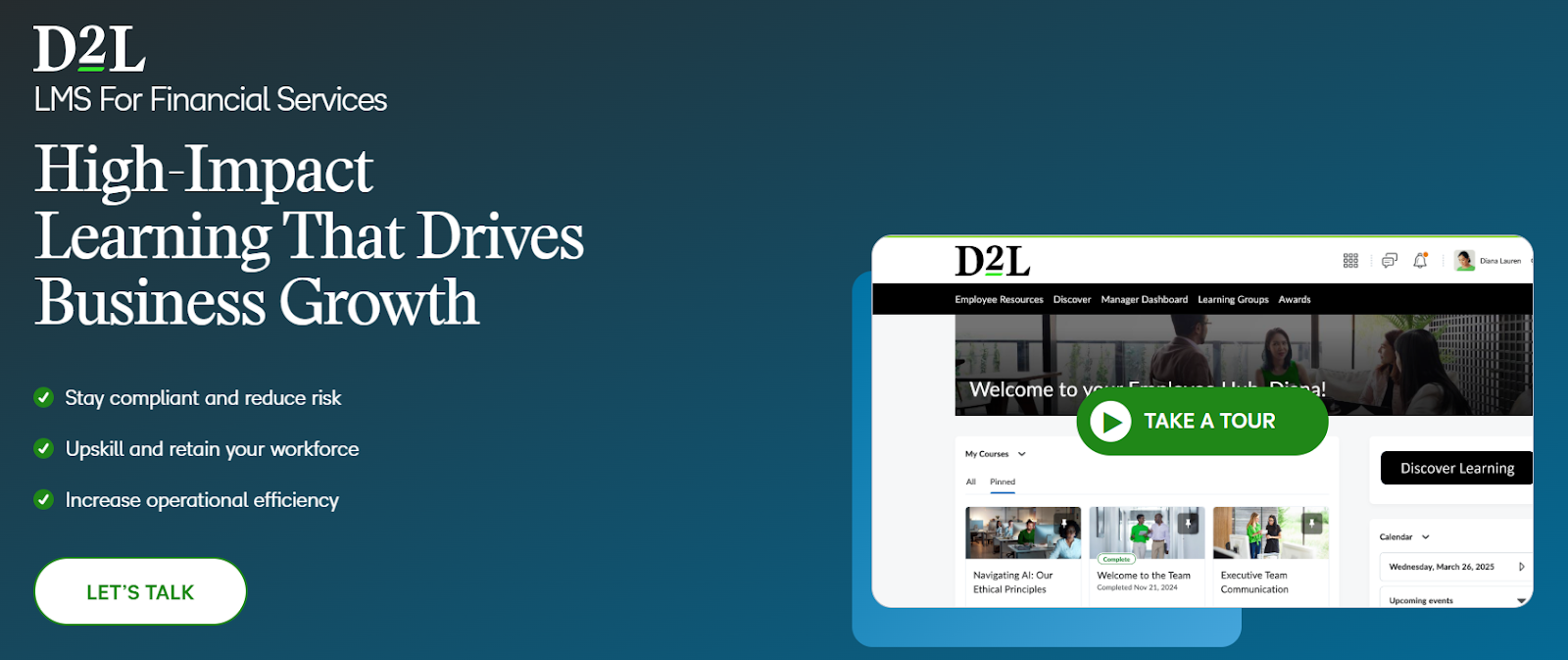
D2L Brightspace is a modern LMS designed to make learning more engaging and adaptable for financial institutions. It uses AI and learning science to personalize each learner’s path, offering options for live, blended, or self-paced training.
Administrators can automate repetitive tasks like course setup, notifications, and reporting, saving hours of manual work. The platform has built-in tools for content creation, integrations with existing systems, and advanced reporting to track progress and performance.
D2L also supports e-commerce, making it easy to offer paid learning programs to clients or partners. With more than 25 years of expertise, D2L provides both technology and ongoing support, helping organizations build training programs that stay relevant, accessible, and scalable.
Pros to consider
- Easy course migration: Move hundreds or even thousands of courses at once using bulk migration tools, with support from D2L experts to make the process smooth.
- Prebuilt professional content: Access over 7,000 ready-to-use BizLibrary courses that save time on content creation and support staff development.
- High compliance standards: Meets SCORM, WCAG 2.0, HTML5, and PCI standards with full audit trails for compliance and risk management.
- Extensive integrations: Works seamlessly with over 1,800 tools, including Salesforce and other CRMs, for a plug-and-play experience.
- Mobile learning app: The Brightspace Pulse app keeps learners on track with easy access to course calendars, assignments, grades, and notifications.
Cons to keep in mind
- The admin interface isn’t easy to use and requires jumping between settings and permissions. And that can slow down setup and configuration.
- Some users face integration issues with third-party tools and find the learning curve steep.
- Collaboration features like forums and peer activities feel outdated, leading to a more passive learning experience.
- Many advanced features are locked behind additional fees, and the pricing model can be expensive for smaller organizations.
Best for
Large financial organizations that want secure, scalable training and CPD tracking all in one platform.
7. Cornerstone OnDemand
Cornerstone OnDemand is built for large, highly regulated organizations that treat learning as part of business infrastructure, not just HR. It centralizes compliance, training, and professional development on a single enterprise platform, giving banks and financial institutions a complete view of their workforce’s readiness.
The system automates training assignments, version control, and certification renewals so global teams always stay audit-ready. It also supports complex user hierarchies, ideal for large networks of branches, partners, and third-party vendors. The Galaxy mobile app lets field employees complete training and record attendance even without an internet connection.
For leadership, Cornerstone’s analytics takes training data and converts it to insights that help track progress and manage risk. It also integrates well with Salesforce, Workday, Microsoft Teams, and Slack to keep learning aligned with everyday workflows.
Pros to consider
- Flexible learning formats: Supports microlearning, instructor-led sessions, virtual reality, and hands-on labs for different training needs.
- Comprehensive reporting: Includes over 100 pre-built reports that can be accessed anytime or automatically shared with stakeholders.
- Enterprise-grade security: Meets ISO 27001 standards with regular internal and third-party audits to ensure data protection.
- User-friendly experience: Simple for learners to navigate and easy for admins to manage content, reports, and curricula.
- Strong implementation and support: Guided setup with dedicated specialists and responsive customer support throughout deployment.
Cons to keep in mind
- The platform can be rigid, with workflows that are difficult to modify once they are configured.
- Reversioning courses in multiple curricula is slow and requires manual updates and workarounds.
- Some admin tools and reports feel outdated or inconsistent compared to newer parts of the interface.
- Reporting is powerful but not very intuitive, with limited real-time customization and filters that take time to refresh.
Best for
Global banks, insurers, and large financial enterprises that run complex compliance programs are looking for a unified system for workforce learning and risk management.
Let’s wrap up
By now, you’ve seen that not all LMS platforms handle the demands of financial training equally. Each offers something, be it automation, analytics, or flexibility. But the right choice depends on how well it supports your compliance goals, internal processes, and growth plans.
When evaluating, keep a simple framework in mind:
- Can it automate certification tracking and audit reporting?
- Does it integrate with your existing HR or CRM systems?
- Will it scale easily as new regulations or regions come into play?
FreshLearn checks all three boxes. It’s built for regulated teams that can’t afford missed deadlines, scattered data, or opaque pricing. You get AI-powered course creation, automated certifications, and full audit visibility, all in one secure system.
If your current LMS feels like more work than support, this is your chance to reset. Start your free FreshLearn account today and launch your online academy.
FAQs
1. What’s the difference between a regular LMS and a banking LMS?
A regular LMS sticks to general employee training, like onboarding or skill-building. A banking LMS, on the other hand, is purpose-built for regulated industries. It supports compliance with laws like AML, KYC, and GDPR. These systems include stronger data protection (SOC 2, ISO 27001), automated certification renewals, and audit-ready reporting. The goal is risk management and regulatory proof, apart from learning.
2. How does an LMS help banks stay compliant?
An LMS automates the entire compliance process. It assigns mandatory courses, tracks completions, sends reminders, and automatically generates audit logs. For banks, this looks like fewer missed deadlines and faster proof of compliance during internal or external audits. It also helps track certifications for roles that require regular renewal, like financial advisors or compliance officers.
3. What features matter most in an LMS for financial services?
It’s right to look for convenience, but prioritize automation. Look for compliance management, certification tracking, audit reporting, SOC 2 and ISO 27001 compliance, role-based learning paths, and integrations with HR and CRM tools for smoother oversight.
You might also like
Hosted by
