Certificate vs Certification: What's the Real Difference?

Quick Answer
A certificate is proof that someone completed something: a course, a workshop, a webinar. It doesn't require an assessment, doesn't imply an ongoing standard, and nobody outside your program governs it.
A certification is different. It's a credential that says someone met a defined standard, usually verified through an exam or practical assessment, sometimes tied to a recognized body like NBCC, ASWB, NBHWC, or ICF in the mental health and coaching space, and often requiring renewal through continuing education.
Mixing the two up isn't just a semantics problem. It affects what you can legally claim, what you need to build to back that claim up, and whether a licensing board takes your program seriously.
Key Takeaways
- A certificate proves completion. A certification proves a standard was met, usually through assessment.
- Certificates don't expire and don't require a governing body. Certifications often do both.
- In mental health and coaching specifically, bodies like NBCC (National Board for Certified Counselors), ASWB (Association of Social Work Boards), NBHWC (National Board for Health & Wellness Coaching), and ICF (International Coaching Federation) set recognized standards; calling something a "certification" without meeting one of these (or a comparable internal standard) is a real legal and ethical risk, not just marketing sloppiness.
- Certification, accreditation, and license are three different things that get used interchangeably. A certification credentials a person; an accreditation credentials a training program; a license is a legal permission to practice, usually issued by a government body.
- Certificates are cheap and fast to build: a completion trigger and a template. Certifications require an assessment engine, pass thresholds, and often a verification system.
- CE-style certification adds another layer: seat-time or attendance tracking, evaluation gating, and audit-ready records a board can request.
- The infrastructure difference matters as much as the definitional one. A platform that can issue a PDF isn't the same as one that can gate, track, and verify a real credential.
Certificate: proof you showed up and finished
A certificate says one thing: this person completed this thing. That's it. No exam required, no external body checking your work, no standard beyond "they got to the end."
Think diploma-adjacent, not license-adjacent.
This covers a lot of ground. Course completions. Workshop attendance. A webinar series someone sat through. None of that implies the person can do anything with what they learned, and a certificate doesn't claim otherwise. It's a nice touch, a shareable LinkedIn post, a small trust signal. Nothing more.
Here's what a certificate doesn't imply, and this list matters more than it looks:
- No governing body vouching for the content or the assessment (because there usually isn't one).
- No renewal requirement. It doesn't expire because nothing about it was ever time-bound.
- No guarantee of competence. Someone can watch every video and still not be able to apply a single thing.
None of that makes certificates useless. A course completion certificate is exactly the right tool for, well, a course. Problems start when someone dresses one up to look like more than it is.
Certification: proof of a standard, verified
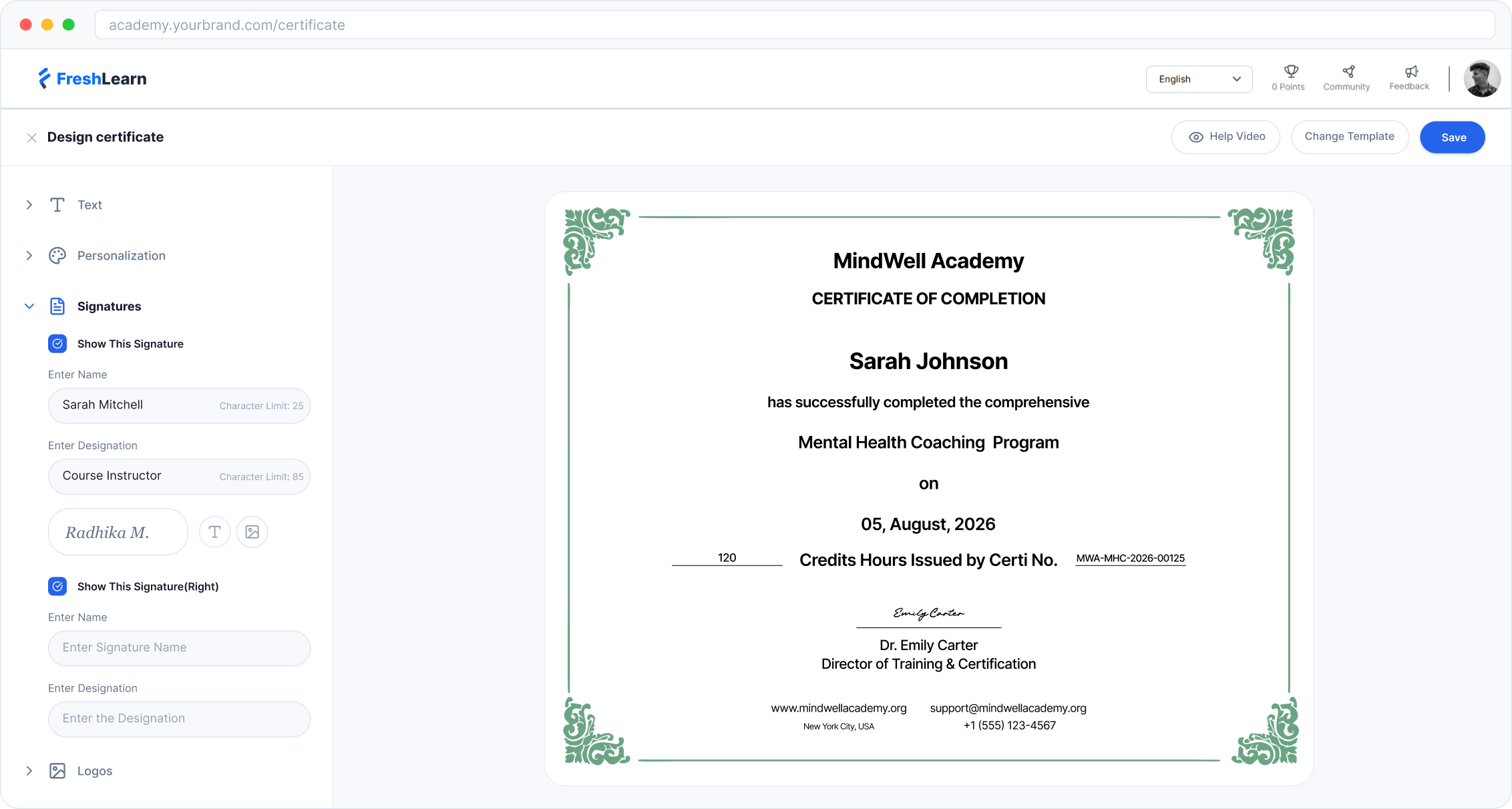
A certification claims something bigger: this person meets a defined standard, and that claim has been checked.
Usually that check comes through an exam, a practical assessment, or both. Sometimes it's tied to a recognized third-party body. In mental health coaching specifically, that's names like NBCC, ASWB, NBHWC, and ICF, organizations that set their own standards, run their own exams, and maintain their own registries of who's actually credentialed.
Seeing what these bodies actually require makes the standard less abstract. ICF's entry-level Associate Certified Coach (ACC) credential requires at least 60 hours of coach-specific training plus 100 hours of logged coaching experience, on top of passing a credentialing exam; the Professional Certified Coach (PCC) level raises that to 125+ training hours and 500 coaching hours. NBHWC's health and wellness coach credential requires completing an NBHWC-approved training program, documenting 50 coaching sessions of at least 20 minutes each, and passing the Health & Wellness Coach Certifying Examination, developed in partnership with the National Board of Medical Examiners. Neither of those is a pass/fail quiz at the end of a video course. That's the gap between a certificate and a real certification, made concrete.
You don't have to be affiliated with one of those bodies to run a legitimate certification. Plenty of respected certifications are privately defined, no external board involved. But if you're not affiliated with a recognized body, the burden shifts entirely onto you: your standard has to be real, your assessment has to actually test it, and you have to be able to defend both if someone asks.
That's the part a lot of course creators skip. A certification without a genuine standard behind it isn't a certification. It's a certificate with a more impressive font.
Renewal is the other piece that separates the two. Real certifications often expire, on purpose. Skills atrophy, standards evolve, regulations get updated. ICF credentials, for example, run on a three-year renewal cycle requiring 40 hours of continuing coach education. Continuing education requirements exist precisely because a credential earned five years ago doesn't automatically mean current competence. A certificate never needs this, because it was never claiming ongoing competence to begin with.
The difference between certification, accreditation, and license
Since these three get blurred together constantly, it's worth being precise. A certification is awarded to a person, confirming they met a standard. An accreditation is awarded to a training program or provider, confirming the program itself meets a standard set by an external reviewer; think of ICF accrediting a coach training school, or NBCC and ASWB approving a continuing education provider. A license is a legal permission to practice a profession, issued by a government body (a state licensing board for counselors or social workers, for instance), and is the only one of the three that's typically mandatory by law.
Practically, this means a CE provider can be "NBCC-approved" (an accreditation-style status for the provider) while the individual courses they sell issue "certificates of completion," not certifications, unless there's a real assessment behind each one. And a coach can hold an ICF certification without ever needing a government license, because coaching itself isn't a licensed profession in most places, while a therapist or counselor absolutely needs a license to practice, certification or not. Keeping these three straight protects you from claims you can't actually back up.
Certificate vs certification, side by side
That last row is where a lot of creators underestimate what they're signing up for. Building a certificate takes an afternoon. Building a defensible certification is a real project, and it should be treated like one.
What this actually means for your business
This isn't just semantics. It changes three concrete things about how you run your program.
What you can legally call your offer. In most places, calling something a "certification" carries real weight, and if there's no genuine standard or assessment behind it, that claim can get you into trouble: with a licensing board if you're in a regulated space, or with a consumer protection complaint if a customer feels misled. This isn't a hypothetical. It's the exact thing regulators look for.
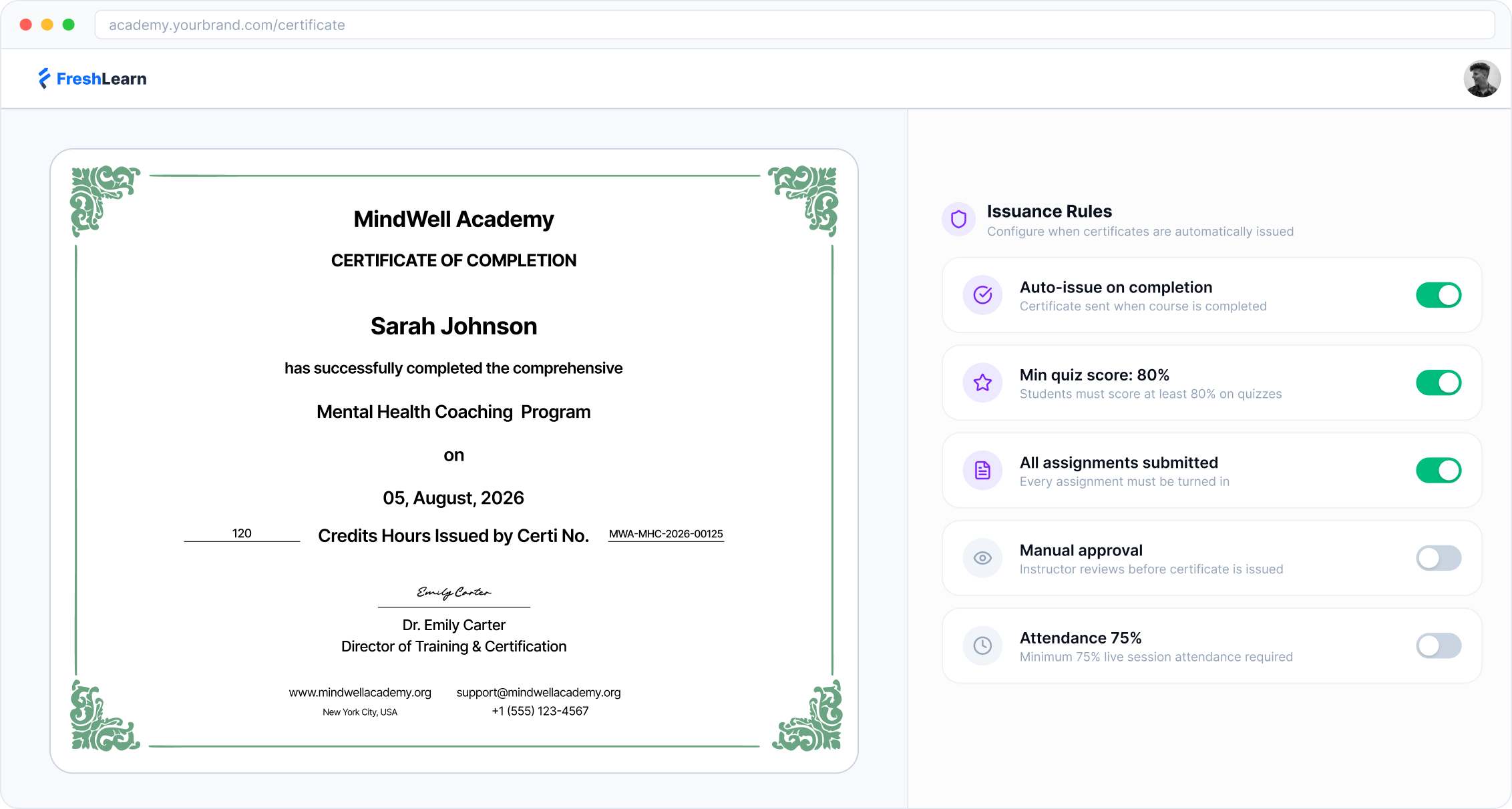
What infrastructure you need to build. A certificate needs a completion trigger and a design. A certification needs an assessment with a real pass threshold, a way to verify the credential later, and, if you're issuing CE credit, attendance or seat-time tracking that can survive an audit. Underbuilding this is how "certifications" end up being certificates in disguise.
What ethical exposure you're taking on. If a client trusts your certification enough to make a career decision, or a hiring decision, based on it, and it turns out there's no real standard behind the credential, that's not just a bad look. It's a trust violation with consequences that can follow you.
A handful of warning signs tend to show up together when a "certification" is really just a certificate wearing a costume:
- Learners pass automatically on completion, with no scored exam or practical check anywhere in the process.
- The credential never expires and has no renewal or continuing education requirement, in a field where competence genuinely changes over time.
- There's no way for a third party to verify the credential later; it's just a PDF with a name on it.
- Marketing implies affiliation with a recognized body (NBCC, ASWB, NBHWC, ICF) without actual approval from that body.
- "Certification guaranteed" language appears anywhere before a learner has done anything to earn it.
If your program has more than one of these, it's worth treating that as a signal to either build the missing infrastructure or rename the offer honestly, before a regulator or a disappointed customer does it for you.
None of this means you need NBCC or ASWB approval to run a legitimate certification. Most course creators don't have that, and don't need it. It means being honest, publicly, about what your standard is and how it's verified, whether or not a national body is involved.
Deciding which one to build
Ask yourself a few blunt questions before you commit to either path.
Does completing your program mean the learner can actually do something new, something someone else would care about verifying? If not, a certificate is the honest answer, and there's nothing wrong with that.
Is there a real standard you can define, test, and defend if challenged? If yes, and you're willing to build the assessment infrastructure that goes with it, a certification is worth the extra effort.
Are you in a regulated space, like mental health CE, where a licensing board might eventually check your claims? If so, don't guess. Confirm your approval status and requirements with the specific board involved before you market a single certification.
Do you have (or can you build) the pass/fail thresholds, verification system, and, if relevant, seat-time tracking a certification requires? If the honest answer is "not yet," that's fine. Build the certificate version first, then upgrade once the infrastructure exists.
There's no shame in the certificate. It's the wrong choice only when it's dressed up as something it isn't.
What your platform needs to support either one
Certificates have modest requirements: a completion trigger, a clean design, maybe a shareable link. Most course platforms handle this fine.
Certifications need more, and this is where a lot of platforms quietly fall short. At minimum: a real assessment engine with configurable pass/fail thresholds, not just a quiz that tallies a score for show. A verification system, ideally a unique serial number per credential plus a public page where anyone can confirm it's genuine. And if you're running CE credit specifically, attendance or seat-time tracking behind every hour, plus records you can export if a board comes asking.
FreshLearn's certificate infrastructure covers both ends of this: simple completion certificates for course-style offers, and, for programs that need it, unique serial numbers with public verification pages built in.
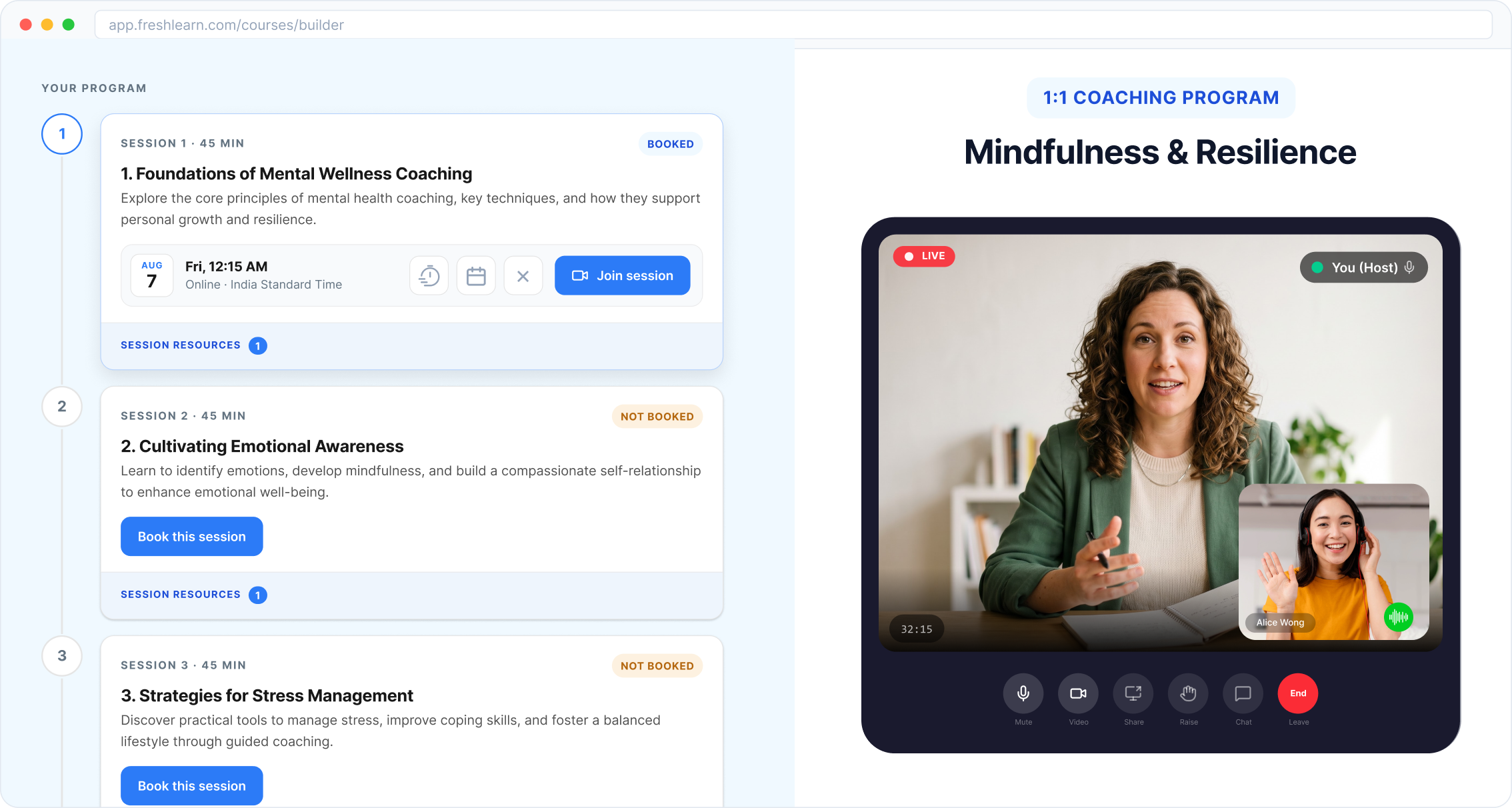
For CE providers specifically, FreshLearn's mental health CE tools add exam gating, seat-time tracking, and audit-ready records on top, so the certification claim actually has something behind it. It also comes with zero transaction fees and white-label branded apps included at no extra cost, which matters more once you're charging certification-level prices instead of course-level ones.
If you've already decided a certification is the right build, the step-by-step guide to creating a certification program walks through curriculum design, pass criteria, and certificate infrastructure in more depth than fits here.
Ready to build the right one?
Getting this distinction right protects you and your customers. It also determines what you actually need to build.
If you're deciding between a certificate and a full certification program, or you already know which one you need and want to see how the infrastructure works, book a demo and we'll walk through what fits your program.
FAQs
1. Can I call my course a "certification" if there's no exam?
Not honestly, no. A certification implies a standard was verified, and without an exam or comparable assessment, there's nothing to verify. This isn't just a branding nitpick; in regulated spaces, it can be a real legal issue. If there's no assessment, "certificate of completion" is the accurate term.
2. Do I need approval from a body like NBCC or ASWB to run a certification?
No, not for every certification. Plenty of legitimate certifications are privately defined, with no national board involved. You only need approval from a specific body like NBCC or ASWB if you're issuing continuing education credit that needs to count toward licensure renewal for counselors or social workers; that requires their formal approval process, not just using their name.
3. What's the difference between a certificate and a diploma?
Functionally, not much; both typically prove completion without implying an external standard was verified. "Diploma" tends to get used for longer, more academic programs, while "certificate" covers shorter courses and workshops, but neither carries the assessment and governance implications a certification does.
4. What's the difference between a certification and an accreditation?
A certification credentials an individual person. An accreditation credentials a training program or organization, confirming an external reviewer checked its curriculum, faculty, and outcomes against a published standard. ICF accrediting a coach training school is an accreditation; the ACC credential that school's graduates go on to earn from ICF is a certification. Completing an accredited program doesn't automatically hand you the certification; you usually still have to meet separate requirements, like an exam or logged experience hours, to earn the credential itself.
5. Is a certification the same as a professional license?
No, and this distinction matters most in regulated fields. A certification is typically voluntary and issued by a private organization or training provider; a license is a legal requirement to practice, issued by a government body, and usually mandatory before someone can call themselves a counselor, social worker, or therapist. You can hold a coaching certification without any license, since coaching itself isn't a licensed profession in most jurisdictions, but a licensed counselor or social worker needs their license regardless of how many certifications they've also earned.
6. Which credentialing bodies matter most in mental health coaching?
NBCC (National Board for Certified Counselors) and ASWB (Association of Social Work Boards) govern continuing education for counselors and social workers respectively. NBHWC (National Board for Health & Wellness Coaching) sets the standard for health and wellness coaching, administered in partnership with the National Board of Medical Examiners. ICF (International Coaching Federation) is the broader standard for professional coaching generally. Which one applies depends entirely on your audience's license type.
7. Does a certification always have to expire?
No, but many do, especially in fields where competence needs ongoing verification: continuing education credits for licensed professionals are the clearest example. A certification without an expiration date isn't automatically illegitimate; it just needs a real standard behind it either way. Expiration is common, not mandatory.
8. What happens if someone challenges my "certification" and there's nothing behind it?
Best case, you lose credibility with that one person. Worse case, in a regulated field, a licensing board investigates, or a customer files a consumer protection complaint over a misleading claim. The exposure scales with how much your customers relied on the claim to make real decisions, so the stakes are highest exactly where mental health CE providers operate.
Hosted by